
Google's $17 billion Wyoming data center announcement puts a less familiar technology at the center of the AI infrastructure race: a proposed 702-megawatt fuel-cell project paired with carbon capture and storage. The investment is substantial, but the announcement does not establish that the fuel-cell plant is operating, that its carbon capture performance has been demonstrated at that scale, or that nearby residents will face no additional electricity costs.
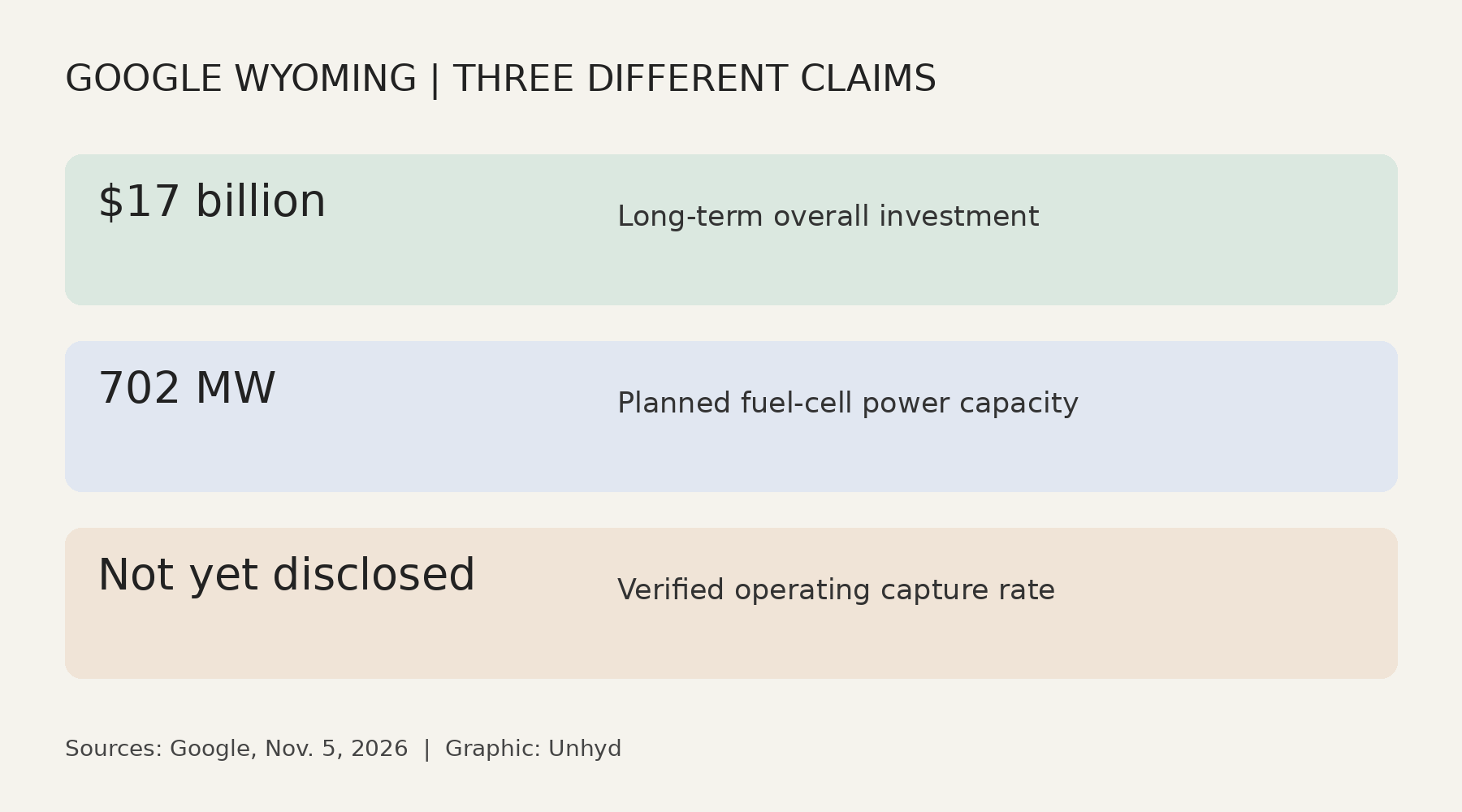
On November 5, Google announced its first data center in Wyoming, working with Tallgrass Energy, Black Hills Energy, American Electric Power (AEP) and Related Digital. The company describes a long-term $17 billion investment in Laramie County and says it intends to pay for all the electricity it uses and infrastructure directly driven by its growth.
What Google actually announced in Wyoming
The energy centerpiece is a contracted project with AEP involving a planned 702MW fuel-cell development with carbon capture and storage. Google calls it the largest planned commercial-scale project of its kind. That description is a company characterization of a proposed project, not evidence of an operating record. The announcement also names Bloom Energy among partners working on community issues, but it does not provide a detailed public construction schedule or independently verified capture rate for the planned installation.
Google says the investment will support its first Wyoming data center. It does not say that all $17 billion will be spent on the fuel-cell plant. The overall investment, the planned power project and the data center itself are distinct commitments with different execution risks.
Independent Reuters reporting placed the announcement against growing political resistance to data-center development. The story is therefore not just about a new computing campus: it is about whether a company can demonstrate that its power arrangements protect local electricity users while meeting rapidly growing AI demand.
Why 702 megawatts is not an emissions result
Megawatts measure power capacity, not annual electricity consumption or greenhouse-gas emissions. A 702MW nameplate figure does not tell readers how many megawatt-hours a facility will actually generate over a year. That depends on operating hours, availability and the capacity factor. Nor does the phrase “carbon capture and storage” reveal what percentage of emissions will be captured, how much energy the capture process consumes, or how stored carbon will be monitored.
The project's proposed technology and its eventual performance should therefore be reported separately. Key unanswered questions include the fuel source, expected operating profile, capture boundary, independently measured capture rate and storage arrangements. Without those figures, it would be premature to describe the data center as carbon-neutral or the power system as zero-emissions.
That distinction echoes Unhyd's existing coverage of data-center energy and water, which examines why broad sustainability totals can obscure local impacts. A new power source may reduce pressure on one part of a grid while introducing other costs, fuel dependencies or environmental questions.
Who pays for the new electricity infrastructure?
Google's pledge to pay for 100% of its power and the infrastructure needs directly caused by its expansion is unusually relevant because electricity bills have become a central issue in debates over data-center construction. But the pledge is not itself a published rate agreement or an independent accounting of costs allocated among the utility, the developer and existing customers.
For residents, the most useful evidence would be utility filings identifying the new load, the dedicated facilities it requires, the rate structure and any protections against stranded costs if the data center's demand changes. Such documents would allow a clearer assessment than the announcement alone.
Google also says it and its partners will form a Community Council to address the effects of growth around Cheyenne. The announcement does not establish the council's membership, decision-making powers or whether its recommendations will be binding. Those are meaningful questions for local reporting rather than reasons to assume either success or failure.
Why this matters beyond Wyoming
Data centers have traditionally depended heavily on grid connections and utility expansion. A proposed fuel-cell project at this scale signals interest in additional ways to secure dependable power for computing facilities. But dependable power is not automatically low-carbon power, and onsite or dedicated generation does not eliminate the need to examine transmission, fuel supply and public costs.
Google's announcement also arrives amid a wider reassessment of the economics of AI infrastructure. In Unhyd's comparison of Microsoft and Alphabet, the key distinction was between growing AI-related business and the cash needed to build capacity. Wyoming adds another layer: the physical and regulatory work required before that capacity can operate.
Four milestones that would turn the proposal into evidence
First, Google and its partners can publish a construction timetable and define which parts of the $17 billion investment are committed to which facilities. Second, utilities and regulators can document how costs and electricity demand will be allocated. Third, the fuel-cell developers can disclose performance assumptions and a credible plan for measuring carbon capture and storage. Fourth, the company can report actual operating results after commissioning, including electricity consumption and emissions.
None of those steps should be presumed completed merely because the announcement is ambitious. The November 5 news is a consequential investment commitment and a potentially important test of an alternative power architecture for AI infrastructure. Whether it becomes a replicable model will depend on independently checkable operating performance and the terms under which surrounding communities share its costs and benefits.