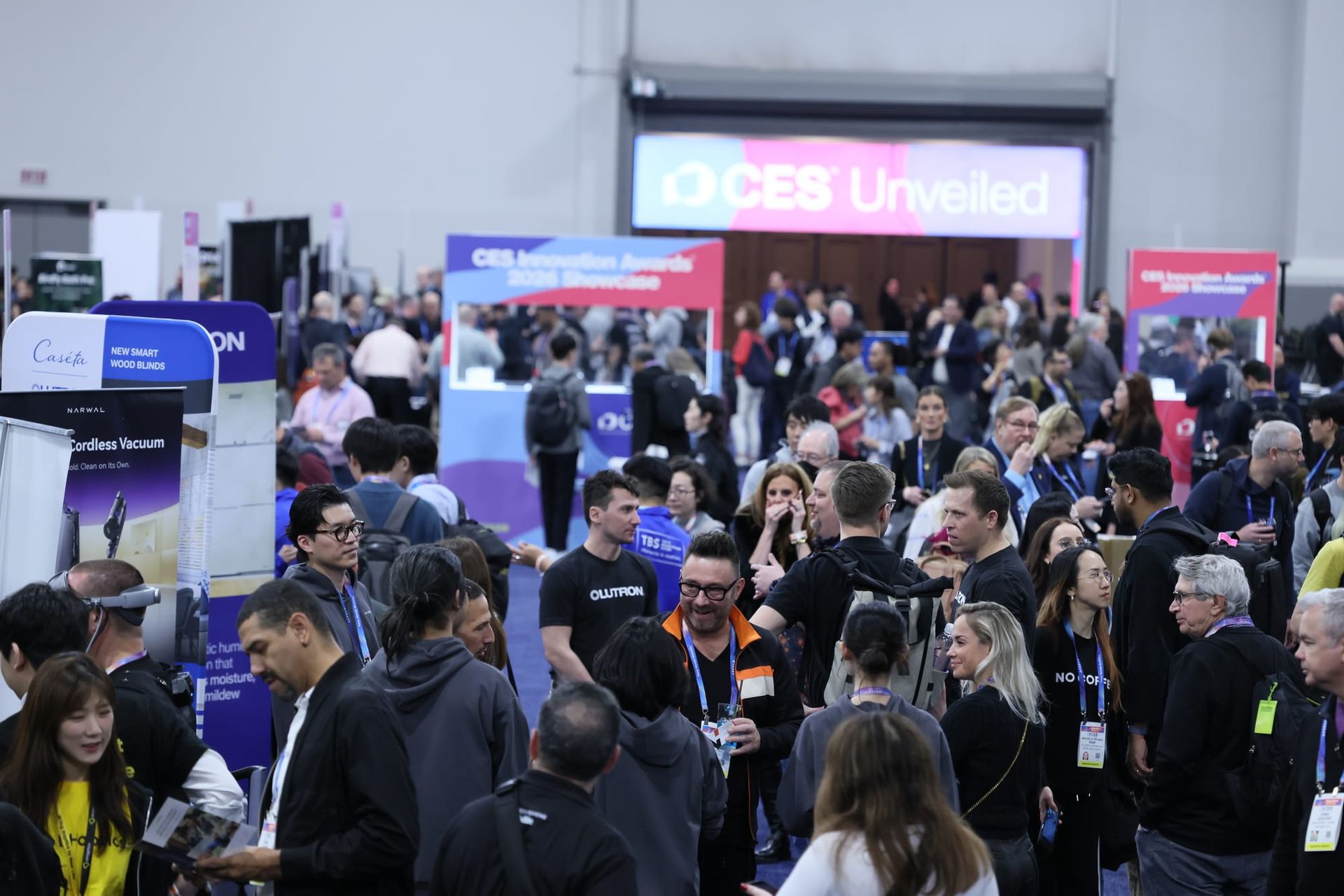
The CES 2027 Innovation Awards have named products that promise to guide people out of emergencies, detect road hazards and monitor health through everyday footwear. Announced by the Consumer Technology Association (CTA) on November 9, the winners offer a more concrete preview of technology heading toward CES in January. But an award for innovation is not proof that a life-safety or medical claim works under real conditions.
That distinction comes from the organizer itself. CTA says its judges evaluate engineering and functionality, design and originality, while its published rules state that the association does not test or endorse award-winning products. Three Best of Innovation listings demonstrate why the difference matters: the claims are specific enough to investigate, yet the public entries alone do not provide complete independent validation.
What the CES 2027 Innovation Awards actually recognize
CTA's November 9 announcement describes nearly 4,000 submissions across 37 product categories, approximately 10% more submissions than the previous year. It reports that submissions in robotics and enterprise technology each grew 74%, while AI entries grew 15%. AI, digital health and robotics together accounted for a quarter of entries.
These are figures about award applications and category participation, not measures of sales, deployment, customer satisfaction or technical reliability. Nor are submissions necessarily distinct products across the entire competition: the program rules allow a product to enter as many as four categories, each with a separate application fee.
The program uses outside expert judges who score submitted materials. A Best of Innovation designation goes to the highest-scoring honoree or honorees in a category. CTA says it does not disclose judges' specific scores and does not independently test or endorse the products. An award can therefore recognize a promising design while leaving performance, regulatory status and real-world availability open to further reporting.
LEADWAY: Can flying evacuation guides perform during a real fire?
LEADWAY, developed by LEADWAY and Hanseo University, won Best of Innovation in Smart Communities. Its CES description proposes drones that lead building occupants toward safe exits, using lights, onboard guidance, sensors and a communications network to respond when normal routes become dangerous.
The award entry says the approach extends visible guidance from 1 meter to 8 meters and raises route recognition from 46% to 91%. It also describes a goal of reducing evacuation time from 12 minutes to 7 minutes. Those percentages and distances are figures published in the product's award description, not measurements independently replicated by Unhyd. The evacuation-time figure is expressed as a target, not a verified deployment outcome.
The practical questions are substantial. What building layouts, smoke densities, participant groups and power-failure conditions produced the recognition figures? How do drones behave when their batteries fail, visibility deteriorates or emergency responders must control the scene? Can the system coexist with applicable evacuation procedures and building requirements? The public listing does not supply the study protocol or a named independent test report that resolves those questions.
Teradar: What is the benchmark behind a 20-times resolution claim?
Vehicle-sensing company Teradar received Best of Innovation in Vehicle Tech & Advanced Mobility for its THZ Summit system. The listing describes terahertz imaging technology and claims 20 times greater resolution at distances beyond 300 meters, alongside reliable performance in rain, fog and snow.
Those statements are potentially consequential for vehicle perception, but a headline comparison cannot establish its meaning without the reference system, measurement method and test conditions. Twenty times greater resolution compared with what sensor, at which range and under which lighting or weather conditions? The award entry does not provide the full supporting test dataset.
For vehicle deployment, the difference between detecting an object and using the signal safely in a driving system is also important. The National Highway Traffic Safety Administration's automated-driving guidance describes operational boundaries, object-and-event detection and fallback behavior as relevant safety considerations. That guidance does not evaluate or certify THZ Summit. Independent comparison testing and named vehicle integrations would be stronger evidence of the product's practical impact.
SHOEALLS: A medical-device claim needs a defined scope
The SHOEALLS LifeGuard won Best of Innovation in Accessibility & Longevity. Its CES listing describes footwear integrating energy harvesting, gait analysis, location tracking and alerts for potential falls or inactivity. It also states that a battery-free vibration chip is certified as a medical device and describes intended support for balance and motor function.
Those are several different kinds of claims. A component's asserted certification does not automatically demonstrate that the complete shoe has clinical validation for every health outcome mentioned. The listing does not identify the certifying jurisdiction, authorization number, intended medical indication or prospective study results for the complete product.
In the United States, the Food and Drug Administration distinguishes registration from clearance or approval and cautions against interpreting vague 'FDA certified' descriptions as regulatory authorization. The CES entry does not specifically claim FDA certification; the FDA guidance helps explain why any certification should be verified by jurisdiction, device and intended use rather than inferred from an award.
For consumers and caregivers, relevant evidence would include accuracy for detecting falls, rates of missed events and false alerts, data privacy safeguards and published clinical evaluation, if the product is making medical claims. These questions are reporting priorities, not findings that the shoe has failed them.
The gap between recognition and proof
The three winning entries concern different problems, so there is no single test that can establish all their claims. An evacuation system needs credible emergency scenarios and repeatable outcomes. A vehicle sensor needs comparisons under specified operating conditions. A health-monitoring product needs evidence appropriate to its intended medical and consumer uses.
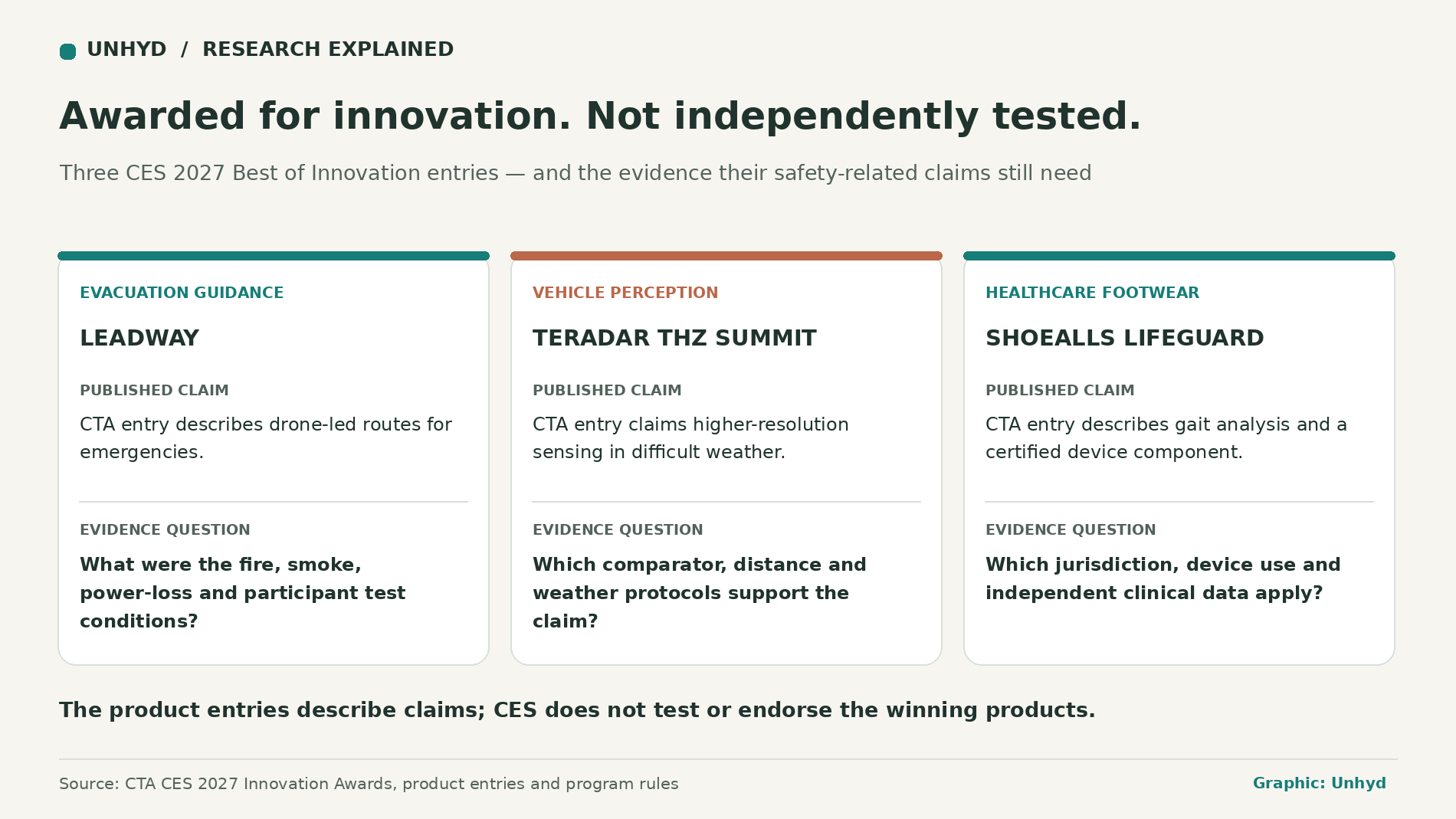
CTA's November announcement also highlights the expansion of the awards into art technology, in partnership with Christie's. That illustrates the breadth of the competition, not an equivalent scientific standard across categories. The standards of evidence necessary for a creative display and a safety-related device are inherently different.
Unhyd's earlier CES 2027 technology preview outlined how to distinguish announcements, demonstrations, validation and availability. The newly published winner descriptions now provide specific claims to test against that approach, instead of anticipating products that had yet to be named.
What could change the story by CES in January?
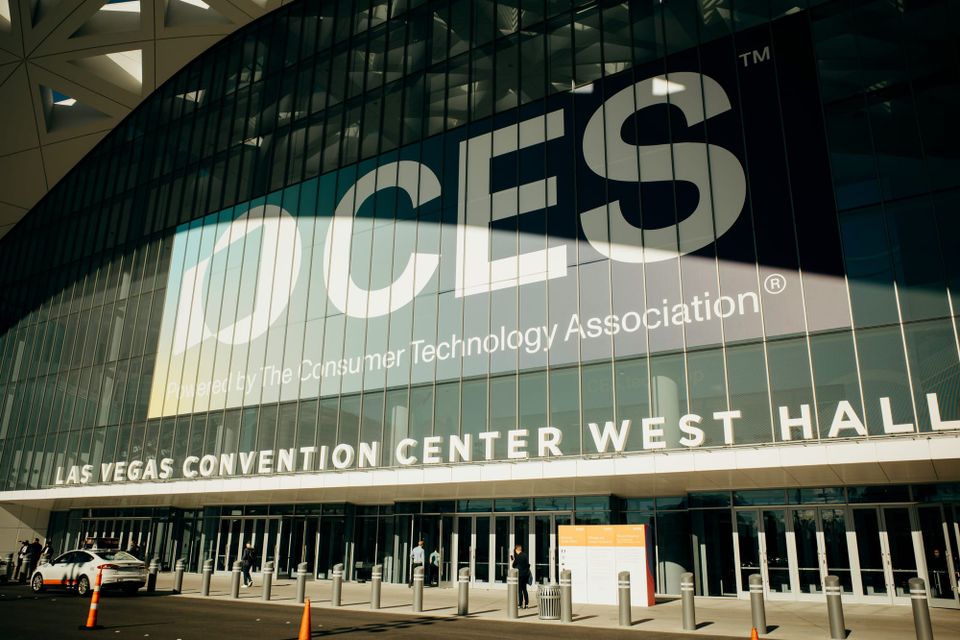
CES 2027 takes place January 6–9 in Las Vegas, and CTA says additional award honorees will be revealed January 4. Select products are expected at the CES Innovation Awards Showcase. A live demonstration could help assess usability, but it would not necessarily reproduce the emergency conditions, vehicle environments or clinical settings behind a product's strongest claims.
For these three companies, the next meaningful evidence would include original test methods, identified measurement baselines, third-party evaluations, product availability and verifiable regulatory documentation where relevant. Unhyd has not interviewed the manufacturers or conducted independent tests, and the publicly listed award descriptions should be read as attributed product claims.
An innovation award can be valuable recognition for inventive engineering. Its significance becomes clearer when the underlying evidence is open to scrutiny. The winners to watch are not simply those with the most ambitious claims, but those willing and able to explain how the claims were measured.