
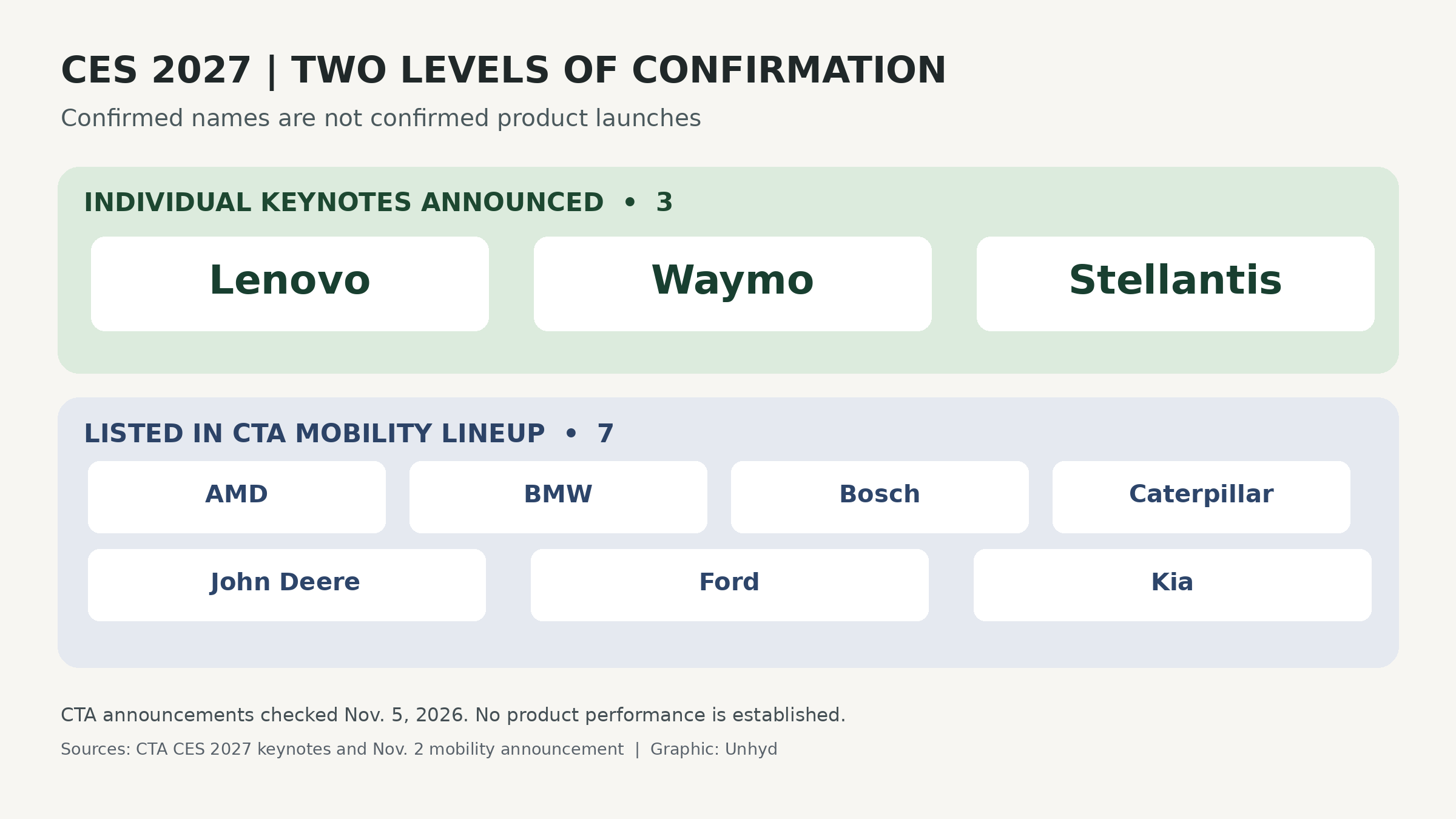
The CES 2027 brands to watch are not necessarily the companies promising the flashiest new products. A more useful watchlist begins with what the event organizer has actually confirmed. Three companies—Lenovo, Waymo and Stellantis—have announced keynote appearances, while seven others on this list were named in a major mobility announcement on November 2. Those levels of confirmation are different, and neither proves that an unreleased product will ship.
CES takes place January 6–9, 2027, in Las Vegas. In its November 2 announcement, the Consumer Technology Association (CTA) said vehicle-technology exhibits would occupy more than 350,000 square feet, the largest mobility footprint in the event's history. That is the organizer's announced figure; it is not an independently audited measurement of the final show floor.
CES 2027 brands to watch: three confirmed keynotes
1. Lenovo: can hybrid AI become a coherent experience?
Lenovo has confirmed that Chairman and CEO Yuanqing Yang will hold Tech World at Sphere in Las Vegas at 5 p.m. Pacific on January 6. The company's October 7 statement identifies hybrid AI spanning personal devices, enterprise systems and public models as the theme. That is more specific than a generic promise of AI features, but it does not establish the performance of any yet-to-be-announced device.
What to examine: Which capabilities actually run on a user's device, which require cloud services, what information is shared between them and what happens when connectivity is lost? A cross-device demonstration should be tested for continuity, privacy controls and availability—not only how smoothly it runs onstage.
2. Waymo: how does driverless mobility scale responsibly?
Waymo co-CEO Tekedra Mawakana is scheduled to speak on January 5, ahead of the show floor opening. CTA's September 21 announcement says the keynote will address safety, international expansion and fleet evolution. Waymo is also listed for the West Hall exhibition. These are confirmed subjects and appearances, not proof of a new city launch at CES.
What to examine: Ask for dated operational safety data, the geographic limits of service, how remote support works and what accessibility means in actual rider experience. The central challenge is not whether a car can complete a staged route; it is whether performance holds across varied, documented real-world conditions.
3. Stellantis: what changes for the driver after the keynote?
Stellantis CEO Antonio Filosa is scheduled for a January 6 keynote. CTA says the company plans to discuss connected vehicles and introduce new vehicles and software platforms, without providing the complete model list in the September 8 release. Unlike a purely speculative prediction, the company has signaled categories of announcements; the details still await disclosure.
What to examine: Determine which features are available at purchase, which arrive through updates, how long updates will be supported and whether subscriptions change the ownership experience. Software-defined mobility should be assessed in years of reliability, not minutes of presentation.
Seven additional names in the confirmed mobility lineup
CTA's November 2 release names the following companies among mobility participants. It does not give each one a 2027 keynote or identify a specific product launch. Treat their inclusion as evidence of planned participation, not a statement that they will unveil a particular vehicle, chip, robot or service.
4. AMD: the computing behind vehicle intelligence
AMD is named in the mobility lineup. The relevant reporting question is how on-board computing could support perception, driver assistance, infotainment or other vehicle workloads under real power and thermal limits. Any chip specifications or deployment claims should come from a named product and verified customer program rather than being inferred from AMD's presence at CES.
5. BMW: the interface between software and driver
BMW is listed among the companies participating in CES mobility programming. Watch for demonstrated changes in in-car controls, driver information and connected services. The test is whether features reduce distraction and preserve understandable controls, especially when network service or software components fail. No particular 2027 BMW model is confirmed by the CTA announcement.
6. Bosch: sensors and the infrastructure of trust
Bosch is both on CTA's roster and presenter of the event's Mobility Stage. That makes the company a useful source for discussing the components and integration work behind intelligent vehicles. Distinguish a component demonstration from an automotive system validated for production; a sensor's laboratory capability is not a full vehicle safety claim.
7. Caterpillar: autonomy outside passenger cars
Caterpillar's inclusion broadens the watchlist beyond consumer transportation. Heavy machinery operates amid different hazards, duty cycles and labor requirements than an urban robotaxi. The useful questions concern operator intervention, site conditions, maintenance, deployment status and measurable productivity. A CES demonstration would not by itself establish performance across every construction or mining environment.
8. John Deere: what works in the field?
John Deere gives CES a connection to agriculture and outdoor machine operation. Watch for evidence about where autonomy is available, the crops or tasks supported, weather and terrain constraints, and the role of human supervision. Commercial deployment conditions should be distinguished from prototypes or carefully managed showcase environments.
9. Ford: what does connected mobility cost to maintain?
Ford's appearance on the mobility roster creates an opportunity to examine practical issues behind connected vehicles: repairability, software support, cybersecurity updates and customer control over collected data. The announced lineup alone does not establish that Ford will unveil a new model or charging technology at the show.
10. Kia: are vehicle features usable beyond a concept car?
Kia is also named in CTA's lineup. Rather than anticipate an unnamed product, watch for evidence of availability dates, regional rollouts, software maintenance and accessible pricing if new features are presented. A prototype interface can be compelling; real customer utility depends on implementation, reliability and support.
How to read a CES preview without confusing plans with products
These ten names represent two evidence levels: three individually announced keynotes and seven companies listed in a broader event program. They are not ranked by expected product quality, investment potential or likelihood of announcing a breakthrough. The distinction is more informative than a countdown built around rumors.
Unhyd previously examined broad CES 2027 trends, including robotics and connected living. This narrower watchlist reflects later confirmed CTA announcements and asks what each company would need to demonstrate. For readers interested in the software side of the story, Unhyd's explanation of autonomous AI agents supplies useful context for claims about systems taking action on behalf of users.
As of November 5, the show remains two months away. Schedules, exhibitors and product details can change. The questions worth taking to Las Vegas are consistent across brands: What has been announced? What was demonstrated? Under which conditions was it tested? Can customers obtain it, and what remains undisclosed? The brands that answer those questions with evidence will be more consequential than those with the largest screens.