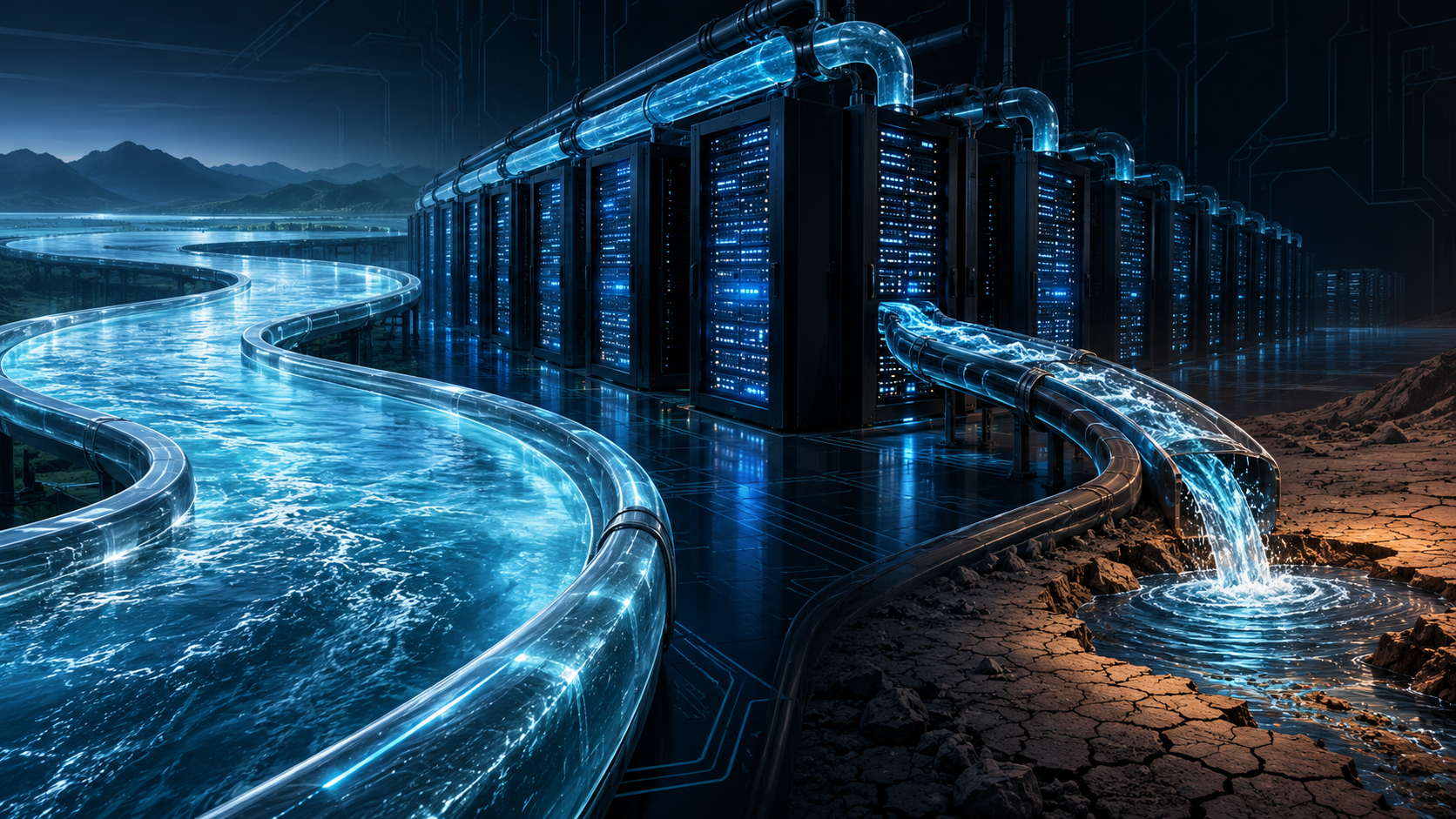
Data center water use is often presented as a single dramatic number. Yet the most important question for a community considering a new facility may not be how many gallons the industry consumes in a year. It may be whether a local utility can deliver enough water on the hottest day. Federal research and a 2026 academic preprint measure these different problems, and treating them as interchangeable can lead to poor decisions.
Lawrence Berkeley National Laboratory estimated that U.S. data centers consumed 66 billion liters of water directly in 2023 and had an indirect water footprint of nearly 800 billion liters through electricity generation. A separate March 2026 research preprint modeled a need for 697–1,451 million gallons per day of additional peak water capacity through 2030 under its baseline assumptions. These are not three versions of the same measurement: they differ in geography of impact, units, accounting boundary and time period.
What data center water use actually measures
Start with three terms. A withdrawal is water taken from a source or utility system, whether or not it is later returned. Consumption is the portion not returned to that source, commonly because it evaporates. Capacity is the rate at which infrastructure must be able to supply water when demand peaks. A system can have adequate annual supply and still lack the pipes, pumps, treatment capacity or available source water to meet an unusually high daily requirement.
The distinction matters because cooling equipment does not operate identically every hour. Evaporative cooling can save electricity but uses water to reject heat. A facility that relies more heavily on that method during hot weather may create a sharp seasonal demand. Dry cooling can reduce on-site consumption, but its electricity requirements and performance vary with climate and design. Neither approach can be declared universally better without considering both water and power conditions.
Two 2023 estimates: 66 billion liters and nearly 800 billion liters
Berkeley Lab's 2024 United States Data Center Energy Usage Report estimates 66 billion liters of direct consumption in 2023, up from 21.2 billion liters in 2014. Hyperscale and colocation facilities accounted for 84% of the later total. The direct figure describes consumption at data-center sites, including cooling, not all water passing through a utility connection.
The same report attributes nearly 800 billion liters of indirect consumption to electricity generation supplying those U.S. facilities in 2023. This water is consumed at power plants and other electricity-generating infrastructure, potentially far from the data centers themselves. The laboratory calculated the indirect footprint using regional grid mixes and estimated electricity use of about 176 terawatt-hours.
A transparent comparison illustrates the scale: dividing approximately 800 by 66 gives about 12.1. On the report's assumptions, the modeled upstream electricity-related footprint was roughly twelve times the direct on-site estimate. That arithmetic does not mean every facility has the same ratio, that both figures describe withdrawals, or that a particular community bears twelve times the water burden of its nearby campus.
There is an important methodological caveat. Berkeley Lab says its indirect calculation does not account for individual power-purchase agreements or on-site generation, and it assumes data centers in a balancing authority use the same regional grid mix. That makes the result a useful national model, not a verified water bill for an individual company. Different electricity sources can have markedly different water-consumption intensities.
Why peak water capacity changes the question
The 2026 preprint Small Bottle, Big Pipe, by researchers affiliated with UC Riverside, Rochester Institute of Technology and Caltech, asks a different question: how much additional peak withdrawal capacity might public water systems need to accommodate data-center growth? Under a baseline in which 2024 water-use intensity persists, its scenarios estimate 697–1,451 million gallons per day of new capacity through 2030. With an optimistic 10% compound annual reduction in industry water-use intensity, the modeled range falls to 227–604 million gallons per day.
Those figures are modeled additional capacity needs, not water already consumed, not a prediction that every planned facility will open, and not a nationwide daily average. The study is available as a preprint; its findings should not be treated as an independently established operating requirement for any named water system. Its assumptions about data-center expansion, cooling methods and peak-use patterns are consequential.
Why can capacity requirements look large when annual totals appear manageable? A utility has to serve customers during peak conditions, not only on an average day. A plant sized to deliver water on the hottest afternoon may have substantial unused capacity at other times. The researchers emphasize that data-center demand can be concentrated both geographically and seasonally. A nationwide total cannot tell a local utility whether its intake, treatment plant or distribution pipes can meet that demand.
Three figures that should not be put on one chart axis
Consider the three measurements side by side. The 66-billion-liter figure is estimated annual on-site consumption across U.S. data centers in 2023. The nearly 800-billion-liter figure is estimated annual indirect consumption associated with the electricity used by those facilities in that same year. The 697–1,451-million-gallon-per-day range is a future scenario for additional peak withdrawal capacity. Converting liters to gallons does not make these measurements comparable, because their boundaries and purposes still differ.
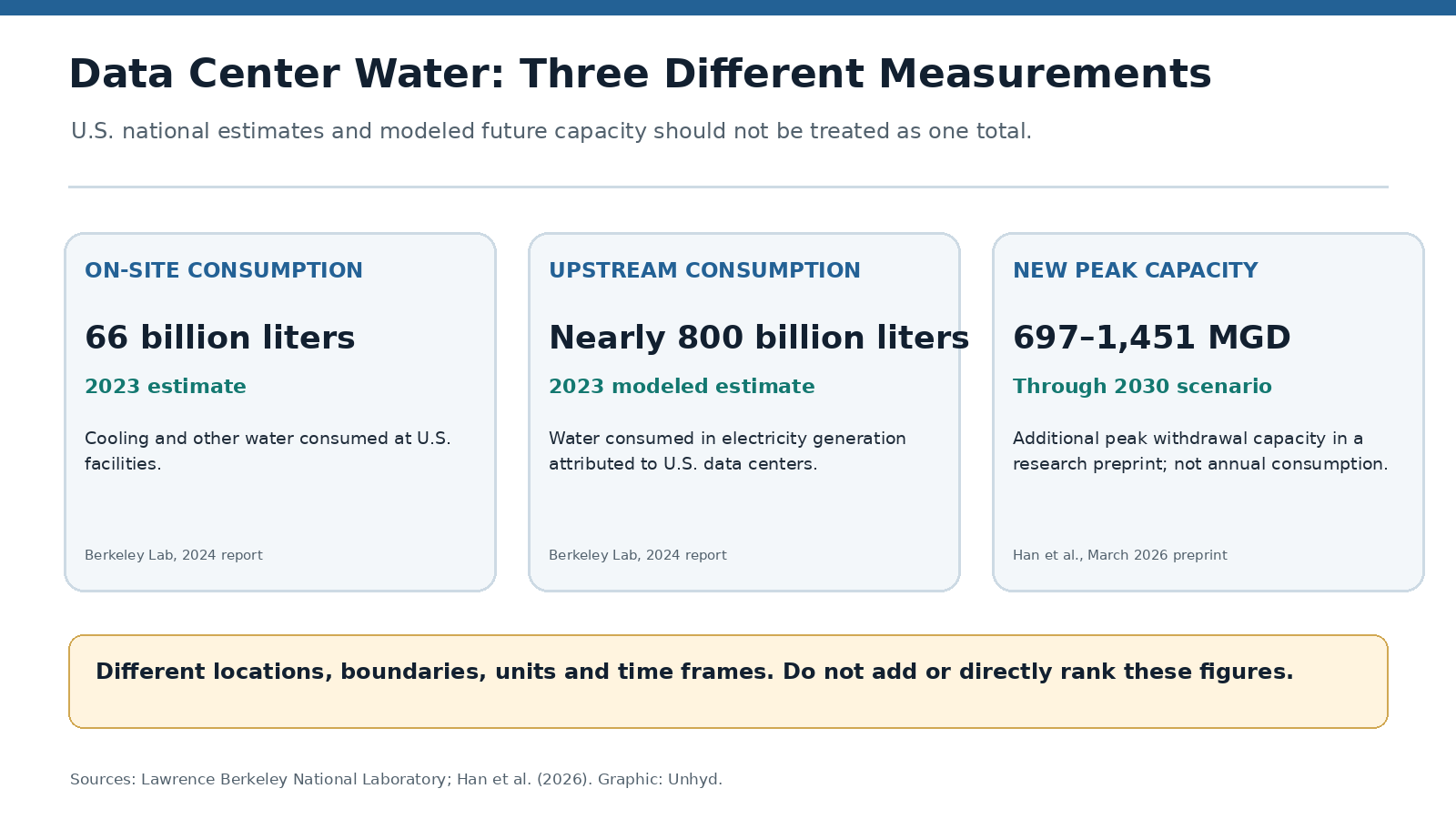
Even adding direct and indirect annual consumption requires a clear accounting boundary and assumptions about potential overlaps or exclusions. Such a sum would not identify where water is scarce. Adding a future peak-capacity estimate to either annual total would be meaningless. For a visual explanation, use the accompanying three-panel Unhyd graphic here, which deliberately avoids a shared scale.
What the latest energy forecast adds—and what it cannot
Berkeley Lab's June 2026 electricity update estimates a 649-TWh U.S. data-center reference case in 2030, with wider scenarios of 521–843 TWh. Those electricity projections are relevant to future cooling and upstream water requirements, but they do not supply a verified 2030 water total. Applying a single historical liters-per-kilowatt-hour ratio mechanically to every 2030 scenario would ignore changes in cooling systems, electricity mixes and facility locations.
Unhyd previously examined the uncertainty in the 2030 data-center electricity forecast. Water adds a second infrastructure constraint: a site can have enough electrical capacity but inadequate summer water capacity, or enough water but insufficient grid service. Decisions should examine the two together rather than treating either as an isolated environmental score.
The local test: what should a proposed facility disclose?
A community reviewing a data-center proposal should ask for the expected average and maximum daily withdrawals, not just an annual total. The application should identify the water source, whether it is potable or reclaimed, the cooling technology, the expected consumptive fraction, and what happens during drought or a prolonged heatwave. If the developer proposes to switch cooling methods during shortages, the corresponding electricity demand and grid implications deserve scrutiny.
Water infrastructure financing matters too. A proposed facility may pay for a new pipe or treatment upgrade, but the relevant question is whether that upgrade is adequate for existing residents and other customers during peak conditions, and who pays for operation, maintenance and future expansion. Public documents should distinguish capacity reserved for a new customer from capacity available to the broader community.
Finally, a responsible analysis should identify the basin or utility service territory. National totals cannot establish whether a particular aquifer is stressed. The International Energy Agency's October 2026 analysis reports that nearly 40% of identified AI-dedicated data-center capacity is in areas of high or extremely high baseline water stress. That is a geographic exposure measure for identified AI-dedicated capacity, not the share of all U.S. water consumed by AI.
A more useful way to report data-center water
The most revealing data-center water story is rarely a single national gallon figure. It separates on-site consumption from electricity-related consumption, annual volume from peak withdrawal capacity, and modeled scenarios from observed operations. It then connects those measures to a named water system, its spare capacity and the costs of serving new demand.
That framework neither minimizes water use nor assumes every proposed data center threatens its neighbors. It makes the real trade-offs measurable. A reader should leave knowing not merely that data centers need water, but which water, where, when, under what assumptions—and who is responsible for making enough of it available.