The CES 2027 technologies to watch are not simply the most futuristic gadgets that might appear in Las Vegas. The Consumer Technology Association (CTA) has already identified AI, robotics, health, energy, wearables and mobility as major program areas for the January 6–9 show. What remains uncertain is which products will be demonstrated, how they will perform outside controlled settings and when buyers will actually be able to use them.
That uncertainty is a reason to prepare sharper questions, not to forecast unnamed launches. CES's 2027 conference program confirms the broad technology areas, while a November 2 announcement details more than 350,000 square feet of mobility exhibits. Neither source independently validates future device capabilities.
Seven CES 2027 technologies to watch—and how to test the claims
1. Autonomous vehicles: measure actual operating boundaries
Driverless transportation is an established CES topic, and Waymo's January 5 keynote gives it particular visibility. A live ride can demonstrate user experience but not independently prove broad safety. Ask for the service's operational design domain: the roads, weather, speeds and situations in which the vehicle is authorized to drive. Request comparable safety data, the role of remote assistance and clear explanations of incidents and exclusions.
A vehicle that succeeds in a small, mapped area has met a different test from one deployed across many cities. CES may illustrate progress, but performance should be assessed against the conditions customers will encounter.
2. Robots in workplaces and homes: count tasks completed, not gestures
CTA's robotics program ranges from homes to work sites. The important measures are successful task completion, number of interventions, duration of reliable operation and safeguards around people. A humanoid robot walking onstage is not proof it can manage a full shift, clean an unfamiliar home or operate safely without supervision.
Ask developers to repeat the same task under varied conditions and disclose how many tries were required. For industrial deployments, request a named customer, scope of deployment and maintenance requirements before describing a prototype as commercially proven.
3. AI that acts on your behalf: verify authority and reversibility
An assistant that summarizes information is different from one authorized to purchase products, send messages or control equipment. CES's Foundry program highlights AI applications, but the editorial question is how systems behave when they have permission to act.
Ask what actions require confirmation, whether a user can cancel or reverse changes, how personal data is retained and what the agent does when its information is wrong. Unhyd's earlier explainer on AI agents describes the underlying move from answers toward multi-step software actions. The 2027 test is whether vendors can show practical controls for that shift rather than polished scripted demos.
4. Wearable and connected health technology: check the claim against evidence
CES is introducing a dedicated Health Hub at The Venetian, covering monitoring, digital therapeutics, remote care and wellness. That does not mean every health product shown is a regulated medical device or has demonstrated clinical benefit.
The U.S. Food and Drug Administration's January 2026 general-wellness guidance distinguishes certain low-risk lifestyle uses from disease-related medical claims. Before treating a wearable reading as medically actionable, ask what the manufacturer claims the device is for, what reference standard was used, what validation population was studied and what regulatory status applies to that specific function.
For consumer context, Unhyd's guide to wearable health data explains why a useful trend is not necessarily a diagnosis.
5. Smarter homes: ask about interoperability and product life
Connected devices frequently promise automation that works seamlessly across rooms or brands. A credible demonstration should identify which protocols and versions are supported, whether features operate without the internet and how long security updates will be provided. Ask whether a malfunctioning cloud service disables basic functions such as a lock, alarm or thermostat.
Interoperability is a claim about the ecosystem, not just the individual product. Show-floor testing should include mixed-brand setups and failure recovery, rather than only equipment supplied by the vendor.
6. Energy storage and grid-connected devices: define the conditions
CTA's energy program includes storage, distributed power, smart grids and efficiency technology. Treat battery capacity, output power and usable backup time as different measures. The stated runtime of a backup system depends on the actual load; an efficiency claim depends on test boundaries and operating conditions.
Useful questions include certification, cycle life, maintenance, replacement costs, interoperability with local utilities and whether a claimed backup duration was measured or modeled. Unhyd's analysis of AI energy measurements offers a related lesson: numerical comparisons become misleading when their test boundaries are hidden.
7. AI built into personal devices: test offline capability and privacy
Lenovo's already-announced CES keynote will discuss hybrid AI across personal and enterprise environments. More generally, AI laptops, phones and household devices should be evaluated on latency, battery use, reliability and the amount of sensitive data that leaves the device. A device may advertise 'on-device AI' while relying on remote models for some tasks; the distinction should be explicit.
Ask to disconnect the internet, repeat the core demonstration and compare battery consumption with an equivalent non-AI task. Those tests do not establish every aspect of product quality, but they reveal more than vague claims about personal intelligence.
A better CES scorecard: announced, demonstrated, validated, available
Across all seven technologies, four stages deserve separate labels. Announced means the company has described a capability or plan. Demonstrated means it has shown an example under specified conditions. Validated requires testing methods and evidence suited to the claim, ideally with independent scrutiny. Available means customers can obtain the product in a named market under stated terms. Products need not pass those stages in a rigid sequence, but the terms should not be used interchangeably.
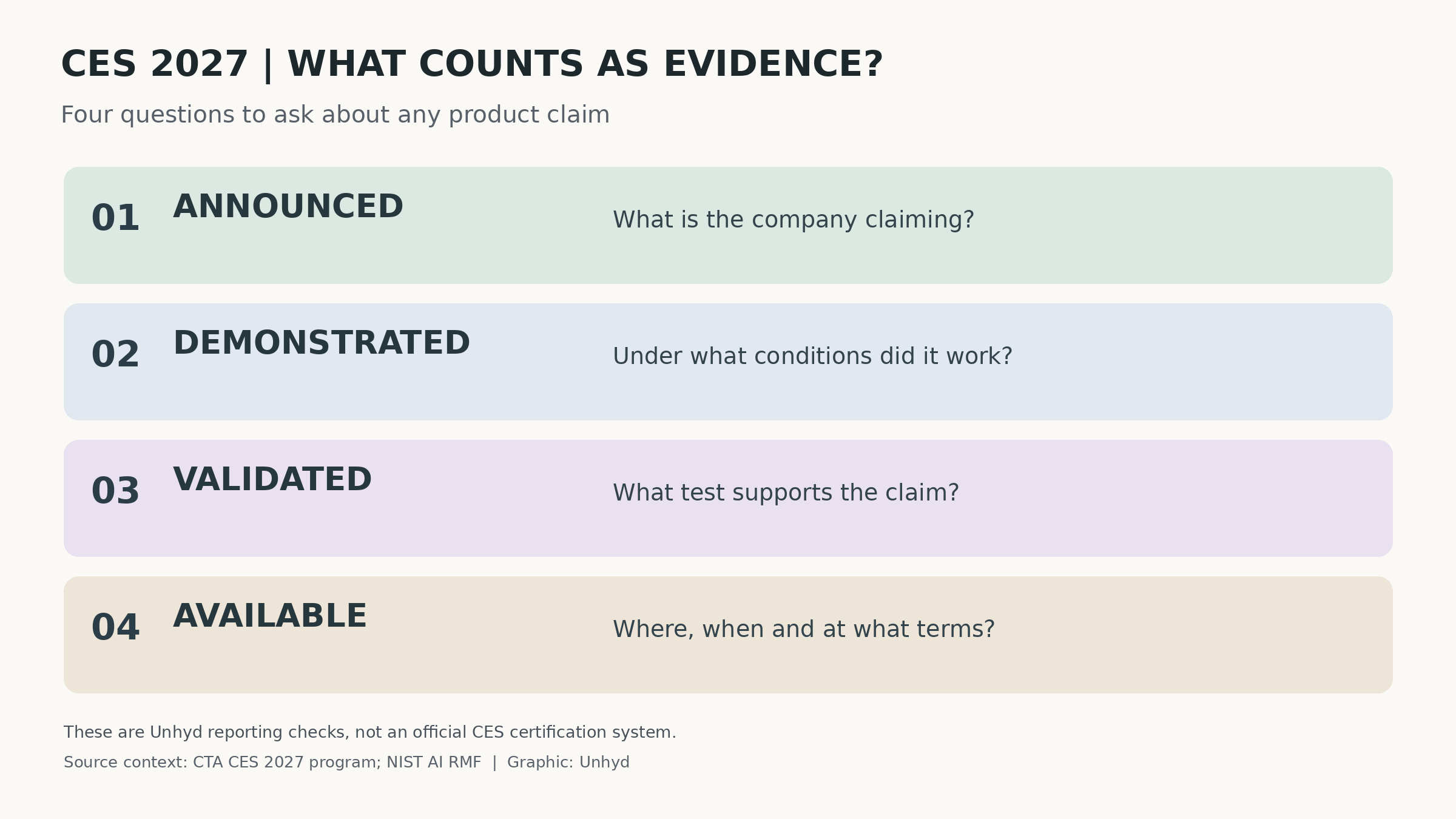
The National Institute of Standards and Technology's AI risk-management measurement guidance underscores the importance of documented evaluations, testing conditions, failure modes and human oversight for AI systems. Its framework is useful context, not a certification of CES exhibitors.
Unhyd's earlier CES 2027 predictions article covered possible directions for consumer technology. This more practical guide focuses on how to distinguish a credible development from a sales presentation when specific 2027 products are announced. After CES, the strongest follow-up stories will revisit these tests using named demonstrations, published specifications and real-world evidence rather than treating attendance or an award as proof.