
The American Heart Association is establishing a national Center for the Brain, extending its longstanding stroke work into a broader effort to connect brain health, cardiovascular prevention, research and healthcare. Announced on November 8, 2026, the initiative comes with a substantial institutional track record—but limited public detail on the new center’s dedicated budget or delivery schedule.
The most revealing account of the AHA Center for the Brain may be an executive recruitment notice published before the announcement. It describes an effort to unify existing programs, develop new partnerships and funding models, and bring brain-health evidence into clinical practice. That offers a clearer test of the initiative than its ambitions alone: what will change for patients and healthcare systems?
What is actually new about the AHA Center for the Brain?
In its November 8 announcement, the association said the center would connect researchers, healthcare professionals, policymakers and communities to promote brain health throughout life. It builds on work the American Stroke Association has undertaken for decades, rather than creating a stroke research program from scratch.
The center’s official website identifies five areas: science, healthcare, communities, advocacy and innovation. Those encompass funding research, developing guidance, improving care, communicating health information, supporting policy and backing promising solutions.
The important shift is organizational. The center is intended to bring work on stroke, cognition, prevention and healthy aging into a more coordinated strategy. A public announcement establishes that direction; it does not, by itself, demonstrate that a new service, clinical protocol or treatment has reached patients.
An executive job posting reveals the operating strategy
An American Heart Association recruitment posting dated October 22 describes a National Senior Vice President role responsible for the Center for the Brain. Its duties include coordinating an organization-wide brain-health and stroke portfolio, developing business models, securing partnerships and funding, and translating research into healthcare quality programs.
It also identifies what the organization wants to measure: growth in programs and partnerships, integration of brain health into existing initiatives, broader engagement and progress toward population-level outcomes. These are stated success categories, not published numerical targets.
The listing is evidence of a defined leadership mandate. It does not establish who holds the position as of November 9, whether recruitment is still underway or when particular initiatives will begin. The association has separately identified Mitch Elkind as its chief science officer for brain health and stroke.
Nearly $800 million in research funding is not the center's new budget
The center’s website highlights nearly $800 million awarded by the association toward brain- and stroke-related research, more than 11.5 million patient records collected through its Get With The Guidelines–Stroke program, and over $32 million in brain-health-related grants and investments through American Heart Association Ventures.
Those figures describe existing institutional activity and capacity. They are not presented as a fresh appropriation for the center. The patient-record figure is a count of records, not a verified count of unique patients, and it should not be treated as a measure of improved outcomes.
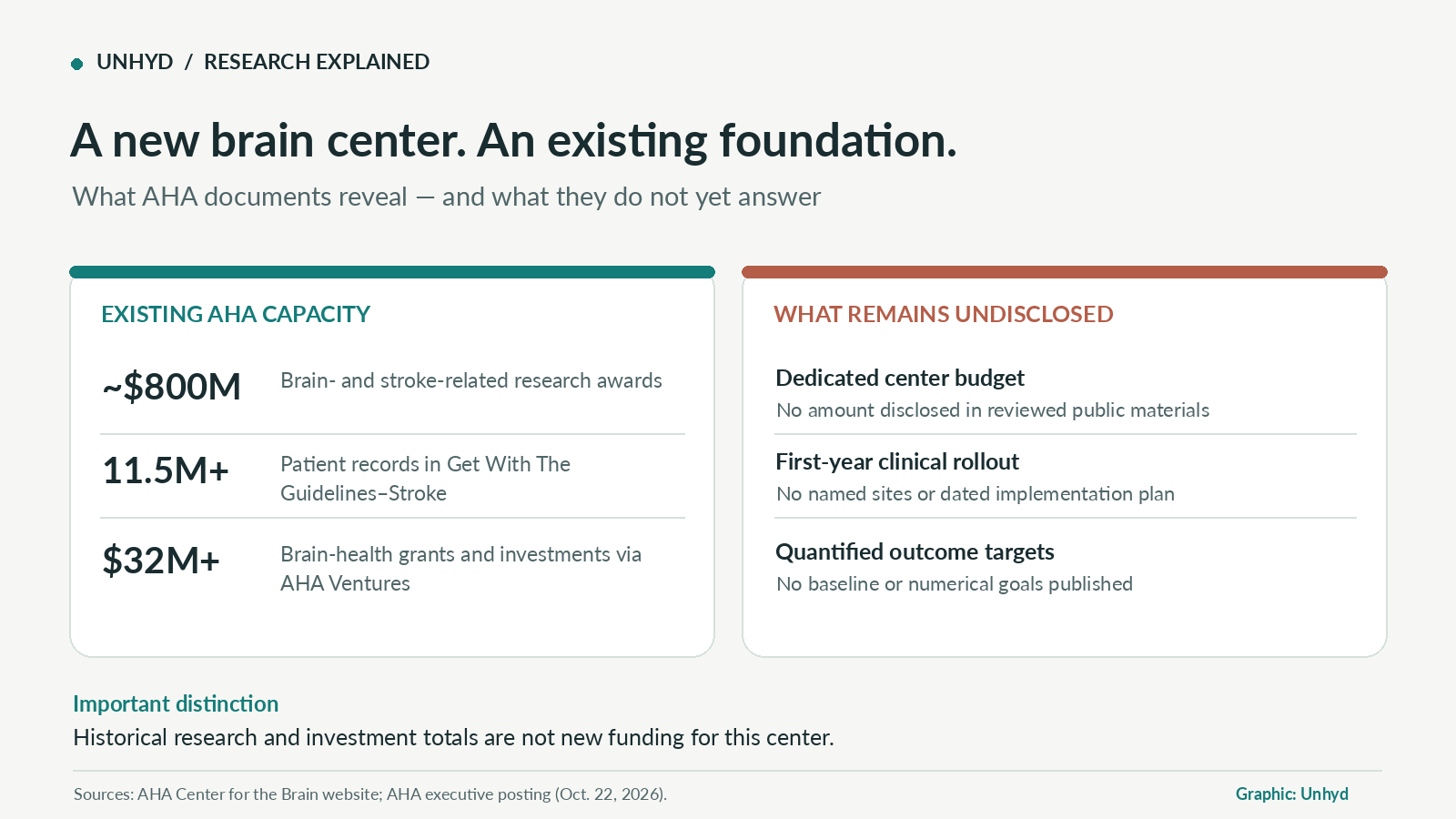
A separate center-specific operating budget, newly committed research funding and first-year spending plan were not identified in the public materials reviewed for this article. Without those distinctions, it would be misleading to characterize the historical totals as new money or add them into a single launch investment.
The clinical opportunity is real—but so is the implementation gap
The scientific rationale for connecting cardiovascular and brain health has support beyond the center’s announcement. The National Institute on Aging notes that blood-pressure control can benefit cardiovascular health and may support brain health. Evidence from the NIH-funded SPRINT MIND research found a reduction in mild cognitive impairment under intensive blood-pressure treatment in the studied population.
But reducing one risk factor does not guarantee the prevention of every form of dementia. Brain health also involves neurological, psychological, environmental and social influences. The center’s practical challenge is to translate a complex evidence base into appropriately tested guidance and clinical routines.
The executive posting specifically points to opportunities to integrate brain health into cardiovascular care, quality-improvement programs, registries and professional education. It does not confirm that doctors are already being asked to adopt a particular new assessment tool or that participating hospitals have implemented a new center-designed standard.
As Unhyd has examined in its coverage of wearable health monitoring, technologies promising earlier health alerts raise a separate question about clinical usefulness. The new center’s impact will likewise depend on whether potential tools and interventions become appropriately validated, accessible care rather than remaining promising ideas.
A brain-health guideline has a target date—but not a confirmed center role
The association’s guideline publication schedule lists Prevention and Optimization of Brain Health Across the Life Course for the first quarter of 2028. That is a planned publication window, not a promise that the recommendation will be issued on a specific day.
It is a useful milestone for tracking the broader AHA and American Stroke Association brain-health agenda. But the schedule does not say that the newly announced center will independently write the guideline or control its publication. Conflating the two would give the center credit for work whose governance has not been publicly established.
The center’s website also lists upcoming November and December 2026 discussions on the heart-brain connection, including blood pressure and vascular biomarkers. These offer near-term public-facing activity, but an event schedule is not a substitute for clinical implementation or independently measured results.
What should the public watch for next?
Three questions will help distinguish the center’s stated ambition from demonstrable progress.
- Resources: What dedicated budget, new research awards and external partnerships are committed specifically to the center, rather than inherited from existing programs?
- Delivery: Which hospitals, clinical networks or communities will adopt a defined intervention, and on what timetable?
- Results: What baselines and independently assessable measures will show whether the effort improved access, preventive care or health outcomes?
Those questions are not allegations of failure. They are the normal accountability questions for an initiative seeking to turn a large research and advocacy portfolio into practical benefits. The association’s published materials describe its intended structure and priorities but do not yet answer them fully.
The center may eventually demonstrate value through stronger evidence, better-connected care and more effective prevention. For now, the verified development is the creation of a coordinating initiative with a defined executive mandate and considerable existing assets. The more consequential story will be what those assets deliver—and how the public can tell.