

The FTC personalized pricing inquiry announced on October 28, 2026, asks a consequential question: can a company use information about an individual customer to decide what that person pays—and use information about an individual worker to decide which jobs or pay offers that person receives? The Federal Trade Commission has ordered nine companies to provide information. It has not announced that any of them violated the law or that a particular customer was overcharged.
The distinction becomes clearer when the FTC announcement is read alongside the 15-page public special-order template. The agency is not simply asking whether prices change. It wants to know whether personal information enters the decision, which tools use that information, how offers are allocated and what happens to the money between a customer and a worker.
What the FTC personalized pricing inquiry actually covers
The nine named recipients are Delta, United, JetBlue, Lyft, Uber, DoorDash, Instacart, Target and Walmart. Grouping those names by the principal businesses mentioned in the announcement produces three airlines, two ride-hailing platforms, two delivery or shopping platforms and two major retailers. This is a classification of the announced recipients, not a finding that every company uses personalized pricing. Some firms operate across more than one category.
The FTC issued the requests under Section 6(b) of the FTC Act, which permits broad studies without a specific law-enforcement purpose. The agency says companies have 45 days from receipt of their orders to respond. Because service dates are not provided in the announcement, October 28 plus 45 calendar days should not be reported as one confirmed deadline for all nine companies.
The publicly linked PDF is a template, with placeholders for a company name and contacts. It reveals the agency's intended lines of questioning, but it is not evidence that nine completed responses exist or that every served order has precisely the same wording. The announced Commission vote to issue the orders was 2–0.
Three different decisions are under examination
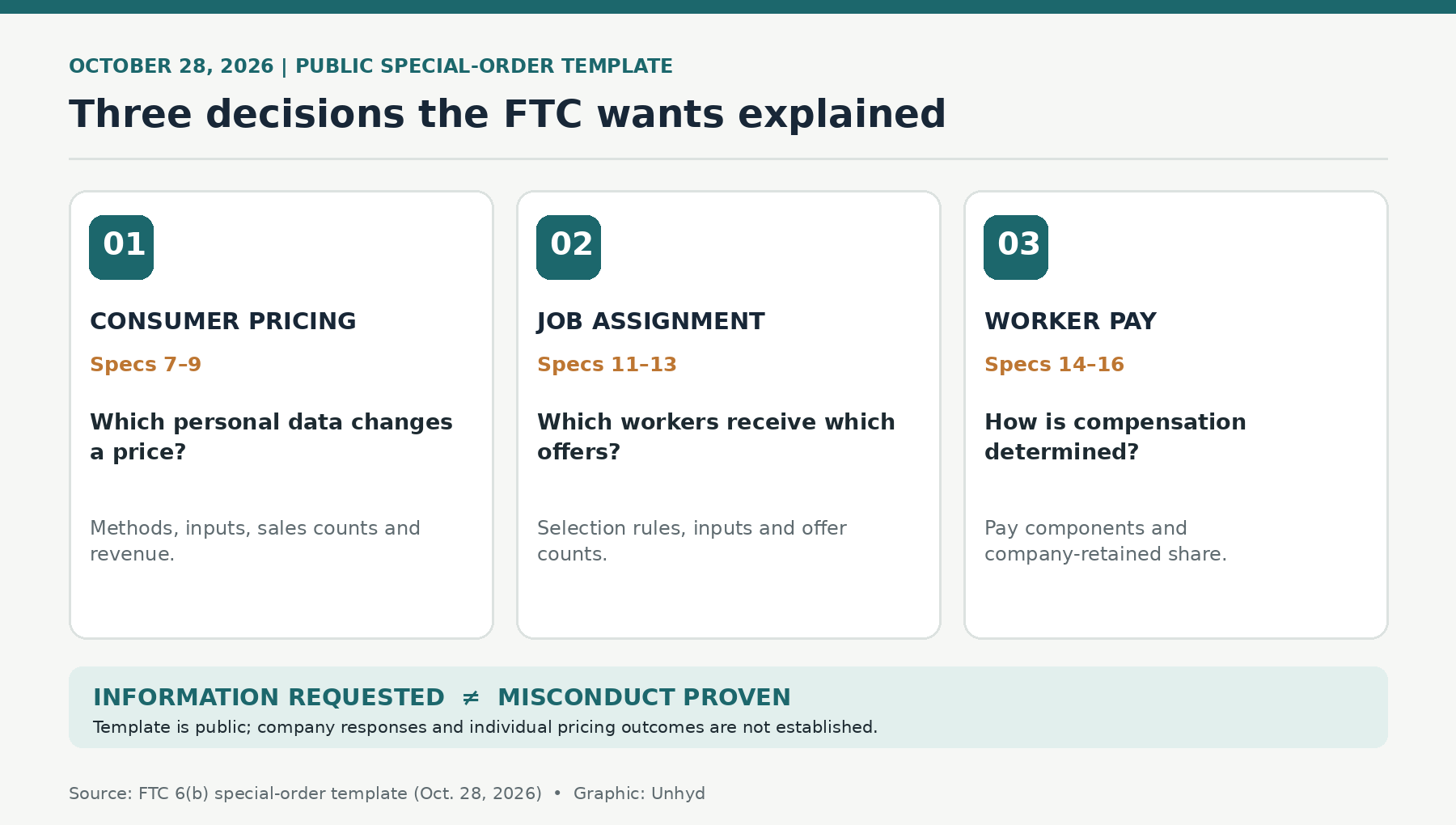
First, consumer pricing. Specification 7 of the public template asks companies to describe methods that use personal information to set or adjust prices, including the tools, inputs, affected price components, treatment of missing information and circumstances in which a calculated price is overridden. Specification 9 asks for sales counts and revenue associated with those methods. The request is designed to distinguish a practice's existence from its scale.
Second, assignment of work. Specification 11 separately asks whether personal information affects which jobs are offered to which workers. That matters because two drivers could be shown different opportunities even before the price or compensation for an individual trip is considered. Specification 13 asks how many offers were made and how many used the relevant assignment method.
Third, worker compensation. Specification 14 asks how personal information enters the calculation of pay. It also asks how the customer price is divided between worker compensation and company revenue. Specification 16 seeks counts and dollar totals for jobs compensated using such methods. A company could vary consumer prices without varying worker pay, or vary assignment and pay without changing the price seen by the customer. The public evidence does not establish which combinations any recipient actually uses.
These are three distinct mechanisms. Treating them all as “AI raises prices” would obscure the most important questions and presume the conclusion of an inquiry that has only just begun.
Why a price change is not proof of personal targeting
A ride can cost more during a busy period because demand, travel time, route or available drivers changed. An airline seat can have a different fare because the booking class or inventory changed. A loyalty discount may depend on an openly disclosed program. Those observations alone do not show that a business estimated an individual shopper's willingness to pay from browsing history, device data or other personal information.
Conversely, two people seeing the same price does not prove that personal data never influenced it. A pricing system could segment customers into groups, apply a rule only in some situations or override an algorithm's output. The template explicitly asks about segmentation, inputs and overrides, which are details a screenshot comparison cannot reliably reveal.
The FTC's August 2026 proposed enforcement policy statement makes a narrower legal point: undisclosed use of personal data to set an individual price could be deceptive or unfair in some circumstances. The agency also acknowledges it lacks authority to ban personalized pricing in every circumstance. The statement was proposed for comment; it should not be described as a final blanket prohibition.
What the order could reveal that a consumer screenshot cannot
One of the most revealing questions in the template concerns inputs: which personal information is used, whether values differ by individual and how the system treats missing information. Another concerns internal tests: specification 20 asks for studies, experiments and A/B tests, including performance measures and results. Specification 22 asks for the exact language, location and dates of disclosures made to customers or workers.
Those requests could help investigators distinguish a disclosed loyalty benefit from an undisclosed personalized surcharge, and a route-based driver offer from one influenced by a driver's individual acceptance history. They could also reveal whether companies tested methods but did not deploy them. A proposed experiment is not the same as an operating system.
There are two important time windows. The template's general applicable period begins January 1, 2023, and continues through compliance, while its request for certain research projects reaches back to January 1, 2021. These are document-request windows, not evidence that a practice occurred throughout either period.
What nine orders do—and do not—tell us
The count of nine identifies recipients, not confirmed users of personalized algorithms. A sample of nine prominent companies cannot establish an industry-wide prevalence rate. Nor can the public announcement support a numerical estimate of how much consumers might have paid extra or how much gig workers might have lost. The information needed for such calculations is precisely what the FTC is seeking.
Suppose, purely hypothetically, that a platform charged one customer $24 and another $27 for what appeared to be the same service. The difference would be $3, or 12.5% of the lower quote: ($27 − $24) ÷ $24 × 100. But the arithmetic alone would not identify the cause. Timing, location, available capacity, taxes, promotions and service terms would need to be held constant before concluding that personal profiling caused the gap. This example is illustrative, not an observed transaction at any of the nine companies.
Even a matched comparison by two shoppers would be suggestive rather than definitive without knowing how a system selected the offer. The FTC's requests for underlying methods, counts, records and disclosures are more capable of answering that question than isolated consumer screenshots.
Why the worker side deserves equal attention
The inquiry's most distinctive feature is that it examines both ends of some transactions. The customer sees a charge. The driver or courier sees an offer, a route, possible incentives and compensation. The template defines compensation broadly enough to include base pay, mileage, wait time, bonuses, reimbursements, deductions and other adjustments. It asks companies to explain the share retained by the platform.
That makes it possible, at least in principle, to examine whether a personal-data-driven change affects the customer's payment, the worker's share, the chance of receiving a job—or several of those at once. The FTC has not released company-level answers, so the article cannot say that any named platform does this in a particular way.
For consumers, the question differs from the shelf-versus-register issue in Unhyd's Dollar General pricing analysis. That lawsuit concerns alleged discrepancies between displayed and charged prices; today's inquiry asks how a price or worker offer may have been determined in the first place. The two stories belong in a consumer-pricing cluster, but they should not be conflated.
What readers can reasonably do now
If comparing a flight, ride or delivery purchase, save the date, time, route or product, service tier, discounts and full fee breakdown. Compare identical terms where practical and avoid assuming that a price difference proves discrimination. A private-browsing window or a different account can be one observation, not a reliable test of whether profiling occurs; changing sessions can also change promotions or other variables.
Review loyalty-program disclosures and privacy controls when available, and distinguish optional discounts from unavoidable charges. Unhyd's internet-plan comparison guide offers a related method for recording advertised terms and final costs, although broadband pricing has its own rules.
Workers should preserve the offered job terms, timestamps, applicable incentive conditions and final pay statements if they want to compare what was offered with what was paid. Do not share other workers' personal information or infer the cause of a difference from one shift. The immediate benefit is a more reliable record, not a guaranteed legal claim.
What happens next—and what remains unknown
The meaningful next developments are company responses, any FTC staff report, an enforcement policy decision and possible future cases supported by evidence. The template states that certain confidential commercial material may be reported in aggregate or anonymized form, so a public company-by-company dataset is not guaranteed.
For now, the strongest finding is about the questions the government is asking. The FTC is looking beyond a final price to the personal data, allocation rules, worker compensation and disclosures that may have produced it. That is a substantive shift in investigative scope, but it is not yet proof of misconduct by any of the nine recipients.