The Dollar General pricing lawsuit filed October 26, 2026, is not simply a dispute about an occasional wrong shelf tag. The Federal Trade Commission and 20 states accuse the discount chain of repeatedly charging more at checkout than shoppers were shown on shelves or in advertisements, despite years of complaints, inspections and previous state enforcement actions. Those are allegations in a pending case, not findings of liability.
The most useful way to understand the evidence is to separate three measurements: customer complaints, failed store inspections and individual incorrectly priced items. The numbers sound interchangeable when summarized in a headline. They are not. A close reading of the 95-page federal-state complaint reveals both the strength of the regulators' case and the limits of what the public figures establish.
What the Dollar General pricing lawsuit alleges
The FTC's October 26 announcement says regulators are seeking relief over alleged price discrepancies across a retailer operating more than 21,000 stores. The complaint was filed in the U.S. District Court for the Middle District of Tennessee. The case remains pending, according to the agency's case docket.
Regulators say the company received at least 29,265 complaints classified as “Did Not Honor Marked Price” between January 1, 2023, and March 31, 2026. The complaint says these were recorded in all 48 states where the chain operates. It also alleges more than $6 million in payments under seven earlier state settlements concerning pricing accuracy between 2019 and 2025. The company has not been found liable in this new lawsuit merely because a complaint was filed.
The plaintiffs argue that the issue is systemic rather than a collection of unrelated cashier mistakes. They cite internal pricing processes, government inspections, consumer complaints and earlier enforcement. Some information in the publicly released complaint is redacted, so the public record does not provide a complete company-wide audit dataset.
Three numbers that should not become one national overcharge rate
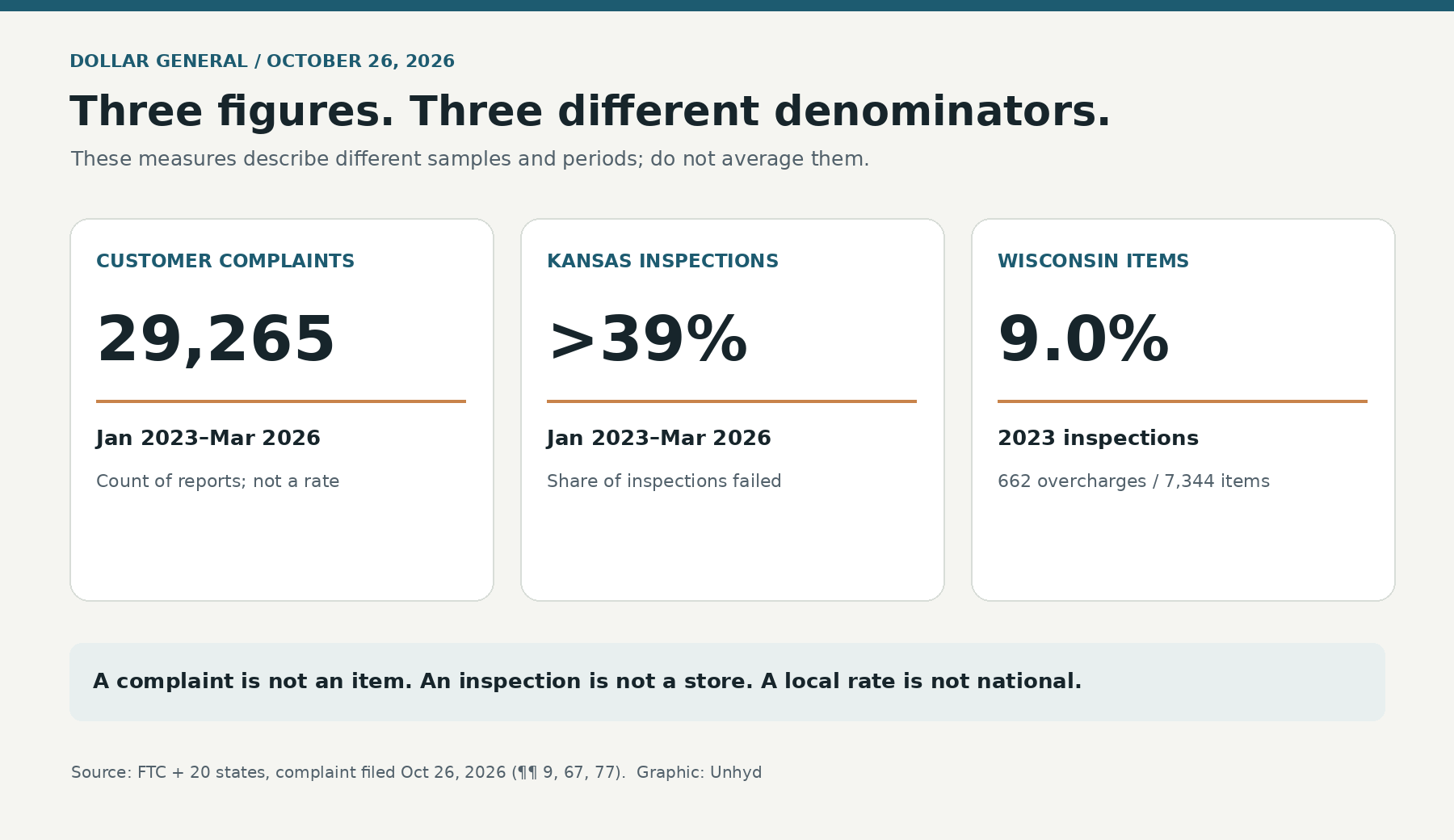
29,265 is a count of complaints, not transactions. It covers a defined complaint category over more than three years. It does not tell us how many purchases occurred during that period, how many unique shoppers complained, or how many discrepancies were ultimately confirmed. Dividing it by store count would produce complaints per store, not the percentage of transactions overcharged.
More than 39% is an inspection-failure share in Kansas, not an item-error share nationwide. The complaint says Dollar General failed over 39% of Kansas pricing inspections from January 1, 2023, to March 2, 2026. Inspections test selected items against a standard, and a failed inspection can contain more than one incorrect item. Repeated inspections of the same store may also be represented. The Kansas percentage is not a percentage of customers, stores or purchases across the United States.
662 of 7,344 is a product-level count in Wisconsin. For 2023, the complaint says 662 of 7,344 products scanned by Wisconsin price-verification inspectors resulted in overcharges. Dividing 662 by 7,344 yields approximately 0.09014, or 9.0% of the items in that inspection sample. It is a useful, reproducible measure within that reported sample. It is not the national error rate and does not say nine percent of every Wisconsin shopper's purchases were overcharged.
These are different periods, geographies and units of observation. They cannot be averaged together to create a national statistic, and the complaint does not publish the full nationwide denominator that such an estimate would require.
What individual undercover purchases actually found
The complaint also describes undercover shopping checks in 2026. At a Sharpsburg, Pennsylvania, store on March 11, six of 60 items reportedly rang up at prices different from the displayed prices: two undercharges and four overcharges, producing a net overcharge of $2.60. At a Baltimore, Maryland, store on April 1, five of 59 items reportedly differed, all five as overcharges, producing a net overcharge of $3.65.
The simple arithmetic is revealing. Six divided by 60 equals 10% of items with any price error in the Pennsylvania check. Five divided by 59 equals approximately 8.47%, rounded to the complaint's 8.5% for the Maryland check. Yet neither figure means that every error was an overcharge: Pennsylvania included two undercharges. Nor do the net dollar amounts represent an average loss per customer across a store or chain.
The difference between any price error, an overcharge and net overcharge after offsetting undercharges matters. A report that collapses all three into one figure can misstate the evidence even while citing a genuine official document.
Why a failed inspection is not the same as a failed store
According to the complaint, many jurisdictions use or adapt a price-verification method associated with the National Institute of Standards and Technology. In the cited procedure, an inspection fails when more than 2% of tested items have inaccurate prices. An inspection is a sample taken at a particular time, not a census of every item in the location.
That distinction cuts both ways. A store that passes an inspection can still have an incorrect price on an untested product. A store that fails twice has generated two inspection failures, but it is still one location. Some enforcement programs conduct re-inspections after a failure, which can affect the mix of inspections being counted.
The complaint reports that Kansas, Utah and other states saw substantial failure shares during their respective windows. Those figures support regulators' allegation of repeated problems, but they are not statistically interchangeable because sampling rules, enforcement priorities, time periods and follow-up visits differ.
Why the dollar amount at checkout matters beyond the percentage
Consider a purely hypothetical basket containing three products marked $3.00, $4.50 and $2.50. The expected subtotal before tax is $10.00. If those same products scan at $3.30, $4.80 and $2.90, the subtotal becomes $11.00—an extra dollar, or 10% of the expected pre-tax subtotal. This is illustrative arithmetic, not a Dollar General transaction.
For a household with a tightly controlled grocery or household-goods budget, an extra dollar is still an error worth correcting. But one hypothetical basket cannot establish how often it occurs, and multiplying it by all shoppers would be an invented loss estimate. The regulators' allegation of millions in consumer harm is their claim, not an amount independently derived from the publicly disclosed sample figures.
Previous settlements add context, but do not decide the new case
The complaint lists seven prior state pricing-related settlements, including actions involving Wisconsin, Vermont, New Jersey, Ohio, Colorado and Pennsylvania. These are relevant because they establish that pricing accuracy had drawn official scrutiny before October 2026. They do not automatically prove every allegation in the new multistate federal action.
The Ohio attorney general's October 26 statement confirms that Ohio previously sued Dollar General in 2022 and reached a $1 million settlement in 2023. It says the state joined the new lawsuit after continued concerns. A settlement and a newly filed complaint have different legal statuses; neither should be described as a verdict in the pending case.
What shoppers can document if a price rings up higher
Before leaving the store, compare the receipt's item-level prices with the posted shelf or advertised prices. If there is a discrepancy, ask the cashier or manager to check it. Keep the receipt and, when practical and permitted, take a photograph of the shelf label showing the product, price and any promotion dates or conditions. Avoid photographing other customers or staff unnecessarily.
Check whether the displayed offer required a coupon, membership, quantity threshold or specific product size. Those details can explain a legitimate difference, but they should be clear in the offer. If the retailer will not resolve a documented mismatch, a consumer can contact the relevant state or local consumer-protection or weights-and-measures agency. State-specific remedies vary; this article does not assume that every jurisdiction requires the same refund.
For broader consumer decisions, Unhyd's guide to comparing internet plans applies a similar discipline: compare the advertised number with the amount actually due. The underlying principle is the same, although retail shelf prices and broadband service contracts are governed by different rules. The same total-cost approach appears in our cell phone plan comparison, where the advertised monthly rate may omit device payments and activation fees.
What to watch next in the Dollar General case
The next meaningful evidence would include the defendant's response, court rulings, any additional public exhibits and a remedy specifying how stores must keep prices aligned. A reliable national error estimate would require representative transaction or item-level data with consistent sampling and clear treatment of repeat inspections—not merely the largest complaint count available.
The defensible conclusion on October 26 is narrower and more important than a sensational percentage: regulators have presented multiple categories of evidence alleging persistent price discrepancies, including consumer reports, local inspections and specific undercover purchases. Whether those allegations support the requested legal relief remains for the court to determine.