
The ADT acquisition agreed with Thrive Holdings on October 29, 2026, would take one of America's best-known home-security companies private in a transaction valued at approximately $15.3 billion including debt and other enterprise-value adjustments. ADT shareholders would receive $10 a share in cash, but the deal has not closed. The central question for customers is not just who will own their alarm provider: it is how a technology-focused buyer might change services built around access to homes, sensors and sensitive information.
ADT and Thrive say their agreement is designed to combine ADT's nationwide monitoring and service network with longer-term investment and engineering resources. They also say ADT's existing data and privacy policies will remain unchanged, with no new data sharing without customer permission. That is a stated commitment in the transaction announcement, not evidence that every future product or data practice has already been defined.
What the ADT acquisition price means
The companies' joint announcement values ADT's equity at about $7.6 billion and the enterprise at approximately $15.3 billion. Those are not competing prices. Equity value represents the value attributable to shareholders; enterprise value is a broader transaction measure that reflects the capital structure and relevant adjustments. The approximately $7.7 billion difference should not be described as a precise debt balance without reconciling the underlying transaction definitions.
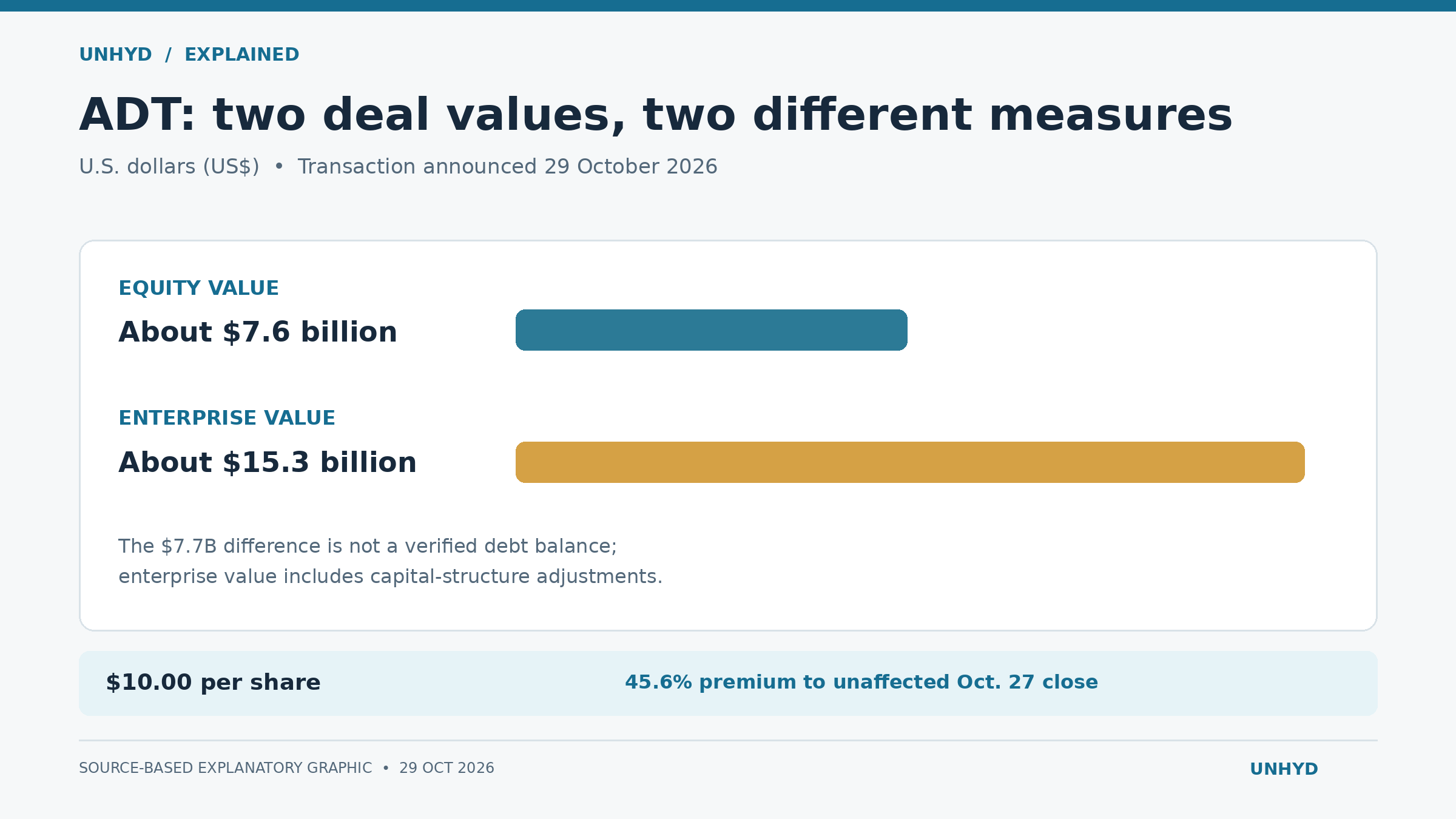
Shareholders would receive $10 per share if the deal closes. ADT says that is 45.6% above its unaffected October 27 closing price of $6.87 and 52.1% above its 30-day volume-weighted average price through October 27. Reuters reported a smaller premium of roughly 35% compared with the stock's last closing price immediately before the announcement. Both comparisons can be correct because they use different baselines; the company's 45.6% figure is explicitly tied to the earlier unaffected price.
The buyer is Thrive Holdings, a permanent-capital company affiliated with the Thrive investment ecosystem, not an announcement that ADT is merging into a consumer-security app. Thrive says it owns more than 75 businesses across accounting, IT services and the built environment. ADT would form the foundation of a new smart-home security business within that portfolio if the acquisition completes.
Three transaction hurdles before ownership changes
ADT's board unanimously approved the agreement, but completion still requires shareholder approval, U.S. antitrust clearance and other customary conditions. The companies expect to close in the first quarter of 2027; that is a target, not a guaranteed date. Financing commitments have been provided by funds managed by affiliates of Apollo Global Management, and the agreement is not subject to a financing condition.
There is also a defined window for other bidders. ADT may solicit alternative proposals during a 30-day go-shop period ending at 11:59 p.m. New York City time on November 28, 2026, with a possible 10-day extension for qualifying bidders. A superior proposal could alter the path of the transaction, subject to the agreement's conditions and any applicable termination payment. ADT says it does not plan to announce interim go-shop developments unless disclosure is appropriate or required.
Until closing, ADT says it will operate independently. Its shares would stop trading on the New York Stock Exchange only after completion. Customers should not interpret the announcement as proof that service contracts, monitoring teams or equipment have already changed hands.
Why the buyer wants a home-security service network
ADT's existing business reaches beyond a standalone camera or doorbell. It combines installed equipment, monitoring operations, field professionals, customer relationships and recurring service. That makes it different from a business that sells a single device through a retailer. A new owner can try to improve software, support and operational efficiency, but must still deliver dependable response when alarms matter.
Reuters reported that Thrive sees opportunities to reduce false alarms and identify equipment problems earlier. Those are plausible applications of better analytics, yet neither company disclosed a finished AI product, quantified reduction in false alarms or independently measured customer benefit in the acquisition release. An algorithm that suppresses unnecessary alerts can improve the experience; one that misses a real emergency can create a very different risk. Any future performance claim needs a clearly stated test and failure rate.
Unhyd has previously examined how smart homes are becoming more proactive as connected sensors and automated responses spread. The ADT deal places that trend inside a large, established monitoring business. The potential upside is more useful alerts and better maintenance; the corresponding responsibility is to keep safety-critical decisions understandable, reversible and accountable.
Privacy is a promise to monitor, not a settled outcome
In the company's newsroom release, Thrive says ADT's data-protection and privacy policies will remain unchanged and that no new data sharing will occur without customer permission. That language is important because home-security systems may reveal patterns of occupancy, camera activity and daily routines. The statement does not, by itself, describe every future data-processing arrangement or define how new AI features would obtain meaningful consent.
For current subscribers, the practical questions are whether any notice arrives about contract terms, camera-storage settings, access permissions, data retention or third-party integrations. No such changes were specified in the October 29 announcement. Customers should evaluate actual notices rather than assume either that privacy protections have been weakened or that every future change is impossible.
The ownership structure also has a precedent worth distinguishing. ADT was previously taken private in 2016 and returned to public trading in 2018, as Reuters noted. Another move into private ownership would change its reporting obligations and investor base, but not automatically improve or degrade the quality of home-security service. Unhyd's earlier coverage of the proposed Bumble buyout raised a similar distinction: taking a consumer business private can create room for change without proving the underlying product strategy will succeed.
What customers and investors should watch next
For investors, the milestones are the go-shop deadline, required approvals, any competing proposal and the expected first-quarter 2027 closing. For customers, the meaningful indicators will be documented changes in service quality, false-alarm rates, response reliability, pricing, product features and privacy notices after any transition.
The announced acquisition is significant because it would place a major home-security operator inside a long-term technology-investment portfolio. Its value cannot yet be judged by the purchase premium or the promise of AI-enabled improvements alone. The evidence will come from whether ADT can make home security more dependable without treating customers' homes and data as an experiment.