Cohere funding entered a new stage on October 29, 2026, when the Toronto-based artificial intelligence company said it had completed an initial closing of a Series E round targeting up to C$7 billion. The Canadian government separately announced an equity investment of up to C$1.6 billion, to be made in stages. Neither announcement establishes that the full C$7 billion has already been raised.
The distinction matters because the deal connects three questions: who finances frontier AI, where the resulting computing infrastructure is built, and what control customers retain over sensitive data. The new financing is significant, but it is not yet a completed C$7 billion cash injection or proof that Canada has secured independent control over every component of its AI supply chain.
What the Cohere funding actually commits
In its October 29 announcement, Cohere identified Germany's Schwarz Group as the lead investor in a financing round targeting up to C$7 billion. It also named Bell Ventures, Bullhound Capital, Inovia Capital, NVIDIA, Prosperity7 Ventures and the Government of Canada among participants. The company described an initial close, but did not disclose the cash raised at that close or a final closing date.
The Canadian prime minister's announcement calls the federal participation a commercial equity investment of up to C$1.6 billion, made in stages. An equity stake means the government would own a financial interest in the company; it is not the same thing as a grant or a purchase order for Cohere's software. The government says it intends to participate in potential upside from the company's growth. The precise ownership percentage and stage-by-stage payment schedule were not disclosed in the announcement.
Two further promises attach to the federal investment: Cohere is to create at least 1,000 Canadian technical jobs by 2030 and commit at least C$1.7 billion to additional computing infrastructure in Canada by that year. It must also maintain its Canadian incorporation and headquarters. Those are forward-looking company commitments, not evidence that the jobs have already been filled or the infrastructure commissioned.
Three big numbers that should not be added together
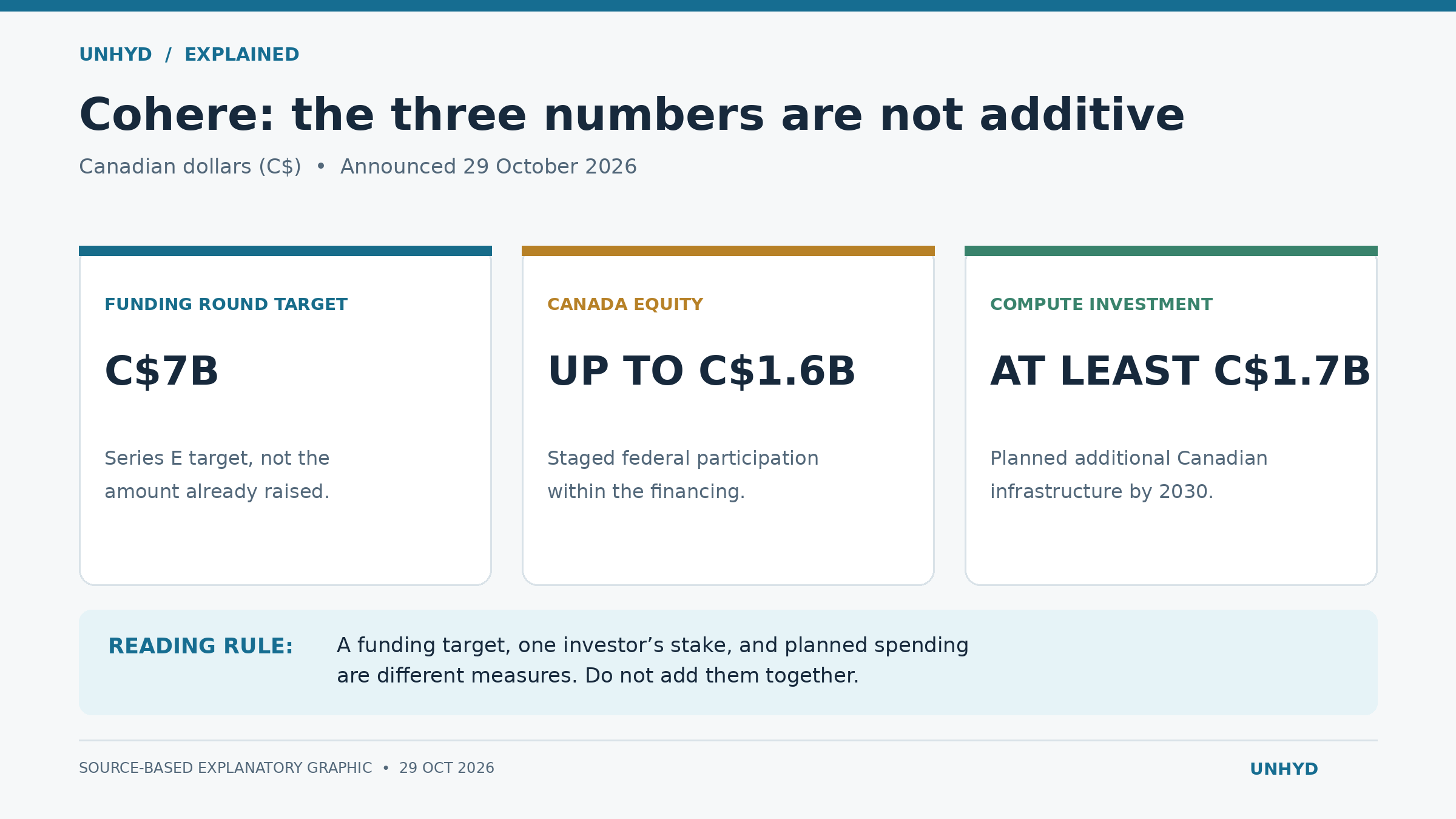
The financing target, government's maximum equity participation and planned computing investment refer to different parts of the story. The C$1.6 billion government commitment is a participant's potential contribution to the financing, not a separate amount to add on top of C$7 billion. The C$1.7 billion infrastructure commitment describes planned expenditure by 2030, not another investor's funding cheque. Adding all three would manufacture a larger total that neither Cohere nor Ottawa announced.
Reuters reported that the proposed round would value Cohere at about C$36 billion. That is a reported financing valuation, not a measure of annual revenue or a confirmed realized return for taxpayers. Reuters also said Cohere reported 165% year-over-year growth in annual recurring revenue as of the third quarter and 300 customers. Those operating figures were company-provided and were not independently audited in the reporting reviewed.
Why the government is buying equity rather than only funding a data center
Canada has already supported domestic AI computing capacity. In March 2025, the federal government finalized up to C$240 million in support for a separate Cohere-linked computing project. The new October 2026 announcement is different: Ottawa is seeking a direct financial stake in the company as it expands models, products and infrastructure.
That distinction changes the public-interest test. For an infrastructure program, officials can track the delivery of facilities, access to computing and project spending. For an equity investment, taxpayers also have an exposure to the company's commercial performance, valuation and eventual ability to generate returns. The October 29 release does not provide enough information to calculate a prospective return, identify dilution protections or evaluate an exit strategy. Those questions remain open.
Physical infrastructure is another separate test. Unhyd's earlier examination of Canada's voluntary data-center principles explained the government's expectations for electricity costs, water use, local benefits and transparency. Cohere's C$1.7 billion infrastructure promise should eventually be assessed against specific sites, construction milestones, grid access and those community impacts—not merely against its announced spending total.
What sovereign AI would mean for an actual customer
Cohere and the Canadian government frame the investment around sovereign AI: the ability of governments and businesses to exercise meaningful control over data, infrastructure and the systems they depend on. That can involve data residency, local hosting, model deployment options, legal jurisdiction and operational access. It does not automatically mean that every chip, software dependency, cloud service or financing source is domestic.
For a hospital, bank or public agency, the useful procurement questions are concrete. Where will sensitive prompts and records be processed? Who can access model logs and retained data? Can a customer deploy the model in a private environment? What happens if a supplier, cross-border service or export rule changes? These questions matter more than a broad sovereignty label, and they require product-specific contractual and technical answers.
Cohere's strategy also includes its planned combination with German AI developer Aleph Alpha. Cohere's September agreement described a transatlantic business combination subject to regulatory approvals. Its October 29 statement still listed completion among the steps ahead. It would be premature to describe every aspect of that combination as already integrated.
What to watch after the initial close
The immediate next milestone is a fuller account of the Series E financing: how much has actually closed, which investors have committed funds, and whether the target changes. For Ottawa, the relevant questions are the timing and terms of each equity tranche and how the government will report its investment. For communities and enterprise buyers, the important evidence will be new Canadian computing capacity, the promised technical jobs and verifiable deployment choices.
Canada and Cohere have made a consequential financing announcement, not a finished infrastructure project. The strongest interpretation is that Ottawa is taking an ownership position in a company it considers strategically important while attaching measurable domestic commitments. Whether that produces durable AI capacity, customer choice and a sound public investment will be determined by subsequent disclosures and delivery—not the size of the target alone.