
Learning how to compare internet plans in 2026 means looking beyond the biggest download-speed number and the cheapest introductory price. Two plans that appear similar in an advertisement can differ sharply in upload speed, equipment charges, data allowances, contract terms and what the bill becomes after a promotion ends.
U.S. internet providers must supply standardized broadband consumer labels for covered stand-alone services. Often called Broadband Facts labels, they are a useful starting point for comparison shopping. But a label is not a substitute for a written, address-specific quote, and it is not a guarantee that a particular device will receive the advertised speed.
Here is a practical way to compare the real costs and performance characteristics of the services available where you live, including how to read the federal labels and what to check before ordering.
Start with the internet providers that actually serve your address
Before comparing prices, identify which services can be installed at your location. The FCC's National Broadband Map guide explains how to search an address and review providers' reported availability, technologies and maximum advertised download and upload speeds.
The map is a discovery tool, not a promise that an installer can complete an order. Availability information comes from provider reports and can be challenged when inaccurate. Confirm serviceability, installation timing and any building-specific restrictions directly with the provider. In an apartment or condominium, ask whether the property has exclusive wiring arrangements or additional installation requirements.
Include the technologies that are realistically available, not just the familiar brands. Fiber, cable, fixed wireless, DSL and satellite can differ in upload performance, latency, congestion behavior and installation needs. Unhyd's earlier 5G-versus-Wi-Fi 7 explainer helps separate the internet connection delivered to a home from the wireless network used inside it.
How to compare internet plans using the Broadband Facts label
Look for a plan-specific label next to the offer, and save a copy or screenshot along with the date and address. Under the FCC's broadband transparency rule, labels identify key commercial and performance terms. The most useful fields are monthly price, introductory-rate duration, recurring charges, typical download and upload speeds, latency, data allowance and contract-related fees.
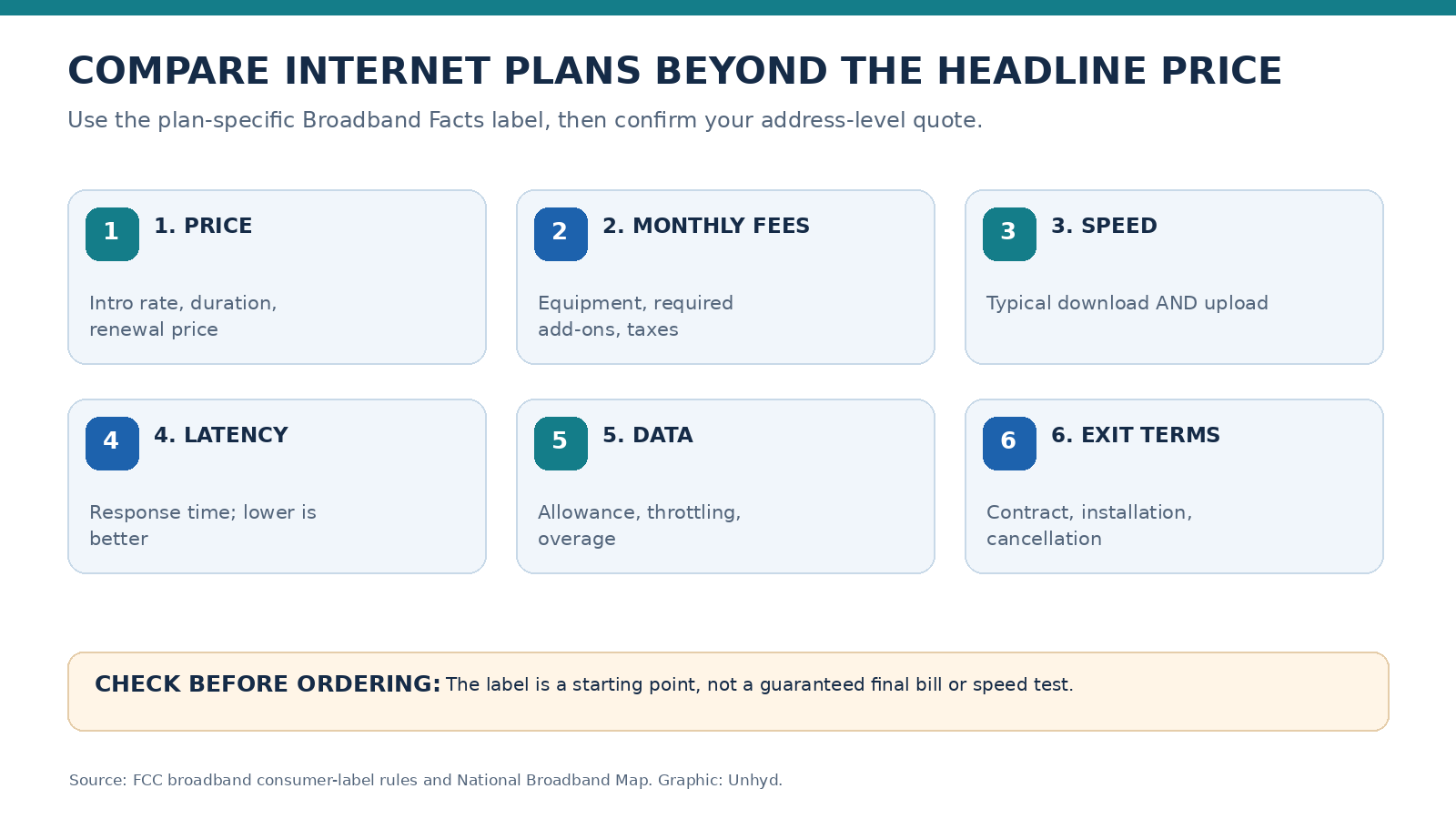
There is an important 2026 regulatory nuance. The FCC adopted amendments in July that would permit certain presentation changes, including links or icons in place of full labels at points of sale and simplified handling of some variable fees. However, the August 13 Federal Register notice stated that the instruction amending the substantive label provisions in 47 CFR 8.1(a) would not take effect until a further notice. Before relying on those new presentation rules, check for a subsequent FCC effective-date announcement; the September 14, 2026 date printed for the broader order did not itself activate that instruction. Whatever the interface looks like, request the specific label and a complete written quote.
Calculate the cost after the promotional period
A low first-year rate can obscure a higher long-term cost. Compare plans over the same period, preferably the length of time you expect to keep the service. Include recurring equipment charges, mandatory add-ons and any known one-time installation or activation costs. Check whether autopay or bundled-service discounts are conditional.
Consider a hypothetical two-year comparison, not a quote from any current provider. Plan A costs $45 a month for 12 months, then $75 for the next 12, plus $10 a month for required equipment. Its 24-month total is (12 × $45) + (12 × $75) + (24 × $10) = $1,680, or $70 per month on average. Plan B costs $62 per month for 24 months with equipment included: $1,488, or $62 per month. In this illustration, the apparently cheaper introductory offer costs $192 more over two years, before any taxes or one-time charges.
The calculation is deliberately simple. Actual offers may change, taxes can vary by location, and a price guarantee may have exclusions. Keep the assumptions beside your comparison rather than presenting an average as a provider's advertised rate.
Check upload speed and latency, not just downloads
Download speed affects receiving files, loading large updates and streaming. Upload speed matters for sending large files, cloud backups and some real-time collaboration. If two plans advertise the same download speed but substantially different uploads, they may not be equally useful for a household with remote workers or content creators.
Latency measures delay, usually in milliseconds. Lower latency can improve responsiveness in gaming and interactive calls, but a single label value does not guarantee consistent performance during congestion. Ask about typical service performance at your address and, if possible, review credible independent measurements for the local network.
Do not assume a faster router will fix a slow incoming connection. Home Wi-Fi coverage, device limitations and interference can reduce the speed experienced in individual rooms. For a fair test of an existing service, compare wired and wireless measurements at different times rather than treating one phone test as a definitive network diagnosis.
Read the data allowance and cancellation terms
A plan described as unlimited may still have traffic-management conditions or restrictions that deserve attention. Read the label and linked terms for any data allowance, additional charges, deprioritization or speed reductions. A household that regularly transfers large files has different needs from one that mainly browses and streams occasionally.
Next, identify whether there is a contract, an early-termination fee, a required equipment return or a promotional discount that disappears when another service is canceled. Ask for the total due at installation and what happens if you move. For fixed wireless or satellite service, verify the address-level installation and performance conditions; Unhyd's coverage of satellite connectivity for remote work offers additional context on the trade-offs.
Use the label as evidence, not as the entire purchase decision
The FCC's standardized format helps buyers ask comparable questions, but it cannot account for every factor affecting the experience in a specific home. Customer service, outage response, equipment quality, building wiring, congestion and local network maintenance can all matter. None should be inferred from a single speed or price figure.
Keep a record of the plan label, order confirmation, promotion terms, equipment requirements and promised installation date. If the first bill differs from the written terms, contact the provider with those records. The FCC Consumer Inquiries and Complaints Center provides a route for eligible internet-service and billing complaints after you attempt to resolve the issue with the provider.
A seven-minute checklist before you sign up
- Confirm that the provider can install the plan at your exact address.
- Save the Broadband Facts label for the specific offer.
- Write down the introductory price, expiration date and renewal price.
- Add recurring equipment charges and unavoidable fees to the total.
- Compare typical download speed, upload speed and latency.
- Read data-limit, traffic-management and cancellation terms.
- Get the final quote and any promised discounts in writing.
The best internet plan is not necessarily the fastest one or the cheapest advertised one. It is the service that meets your household's actual needs at a cost you understand, with terms you can verify. The most valuable comparison is the one that still makes sense after the promotion ends.