

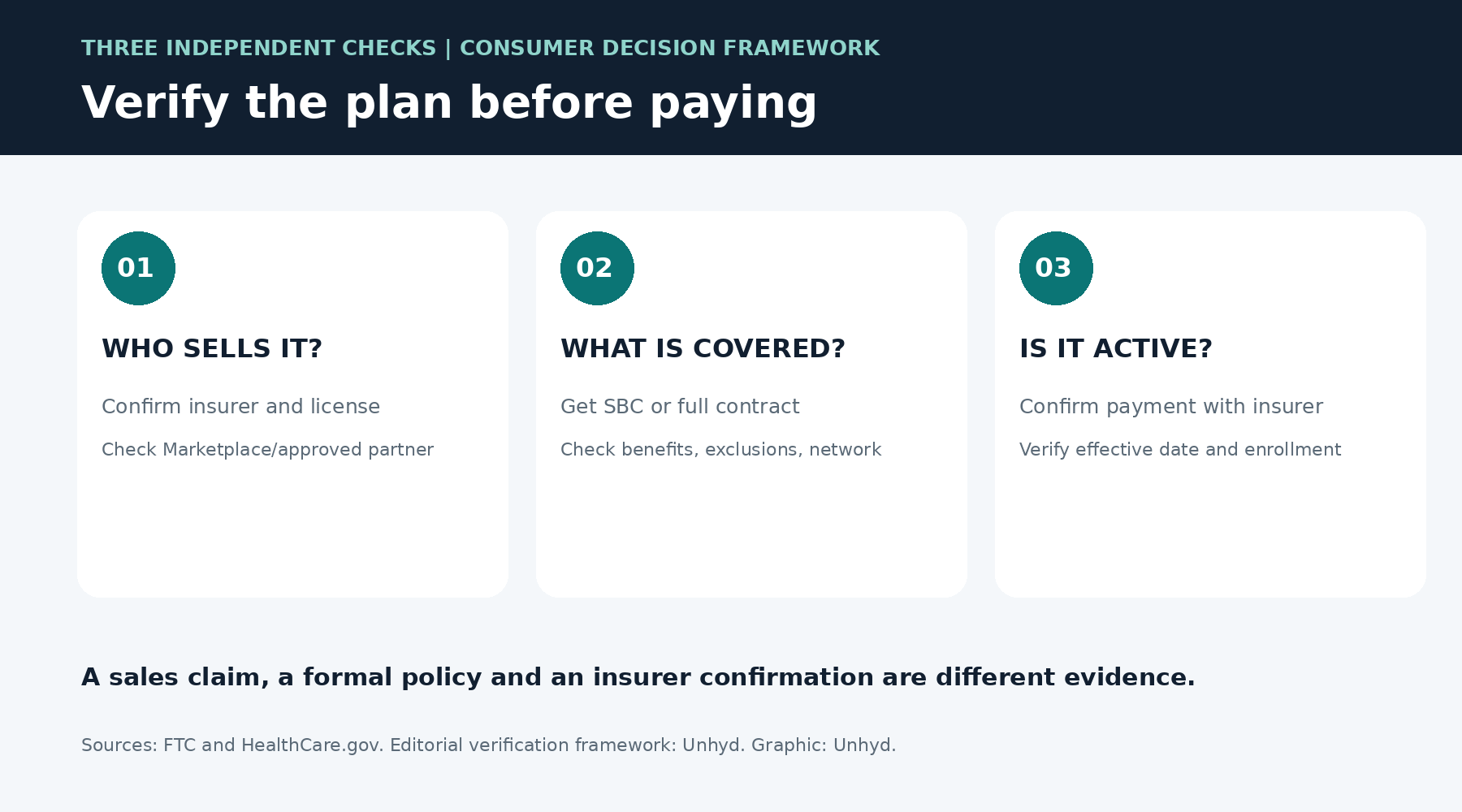
Before you verify health insurance and pay for a plan, establish three things independently: who is selling it, what the contract actually covers, and whether the insurer has activated your enrollment. A professional-looking website, a familiar insurance-company logo or a low monthly price cannot answer all three questions.
On October 29, 2026, the Federal Trade Commission said it was sending warning letters to 25 health-plan marketers and lead generators over potentially misleading advertising practices. The letters address claims about comprehensive coverage, costs and supposed enrollment rewards. The agency explicitly says the letters do not allege wrongdoing by the recipients. For shoppers, the lasting lesson is to verify the product rather than relying on a sales pitch.
How to verify health insurance: start with the insurer and seller
Start with the exact legal name of the insurer—not just the name of the website, marketing agency, association or broker. Ask for the policy's full product name, the insurer underwriting it and the state in which it is offered. If someone claims to represent a major insurer, contact that insurer through a number you find independently on its official website, not solely through a phone number in the advertisement.
The FTC's consumer guidance recommends checking with your state insurance commissioner's office to confirm that a company selling insurance is licensed. A licensed seller and a licensed insurer are related but different checks. A license does not guarantee that every advertised plan is comprehensive or that a particular broker's description is accurate.
For Affordable Care Act (ACA) Marketplace coverage, begin at HealthCare.gov's fraud-protection guidance or the official state Marketplace it directs you to. The federal Marketplace also permits enrollment through certified enrollment partner websites; not every legitimate partner has a .gov address. Confirm that the particular partner is listed as approved before sharing sensitive information.
Do not mistake a paid search advertisement for official endorsement. The FTC warned in September 2026 that misleading health-insurance advertisements can imitate government pages and may rank prominently because the advertiser paid for placement. A useful precaution is to navigate to the official Marketplace yourself, then locate approved partners through its own directory.
Checkpoint two: verify what the contract covers
The word plan does not establish that a product is comprehensive medical insurance. Some products are medical discount programs that offer access to reduced prices at participating providers. Others provide limited fixed payments for particular events. Such products may have legitimate uses, but they are not automatically substitutes for ACA-compliant comprehensive insurance. Ask the seller to identify the product category in writing.
For a major medical plan, request the Summary of Benefits and Coverage (SBC) and, where needed, the full policy or certificate. HealthCare.gov explains that the SBC is a standardized document for comparing individual and job-based health plans. It includes deductibles, cost-sharing, exclusions and coverage examples. A vague sales brochure or a list of supposed discounts is not the same document.
Compare the written answers to six questions: Is hospitalization covered? Are emergency services covered? Are prescription drugs covered, and which ones? What are the deductible and out-of-pocket maximum? Which doctors and hospitals are in-network for this exact plan? What benefits, conditions or services are excluded? If the seller cannot produce a document that answers those questions, stop and seek clarification before paying.
All qualified Marketplace plans cover categories of essential health benefits, including hospitalization, emergency services, mental health care, prescription drugs and maternity and newborn care. The details, networks, formularies and cost sharing still differ by plan. An advertisement saying “hospital coverage” does not tell you whether a limited-benefit product pays the hospital bill or only a fixed amount toward it.
Why a discount card can look like insurance without being insurance
Imagine a seller offers a hypothetical $79-per-month medical discount membership and says members can receive “up to 60% off” certain services. Those figures are invented for this explanation, not a quotation from a real company. Even if some discounts exist, a discount from a provider's listed price does not mean an insurer will pay the remaining bill, cover an emergency or cap the member's out-of-pocket expenses.
The FTC's guidance on medical discount plans recommends calling the providers on the program's list before enrollment to confirm participation. Ask the hospital or doctor's billing office whether it accepts the exact product, not merely whether it recognizes a network brand. Participation may vary by service and location.
A limited-indemnity policy is another distinct category: it may pay a specified amount after a qualifying event, leaving the customer responsible for costs beyond that payment. The exact terms govern. Neither “discount” nor “fixed benefit” necessarily means fraud, but describing either as equivalent to comprehensive coverage without support is precisely the kind of marketing issue highlighted by the FTC.
A three-document test before sending payment
Keep a copy of the advertised claim, the formal coverage document and the independent verification. This is a practical editorial framework, not a government certification system. It prevents a persuasive conversation from replacing the actual insurance contract.
For example, if an advertisement promises “all local hospitals,” look for the network and out-of-network provisions in the plan documents, then contact the insurer and the hospitals you expect to use. If a seller promises a cash reward, verify the written eligibility rules and who funds it; a reward does not prove coverage. If the sales representative says there is no deductible, confirm whether that applies to all covered services or only a narrow category.
Write down the exact plan identifier, effective date, premium, deductible, maximum covered in-network out-of-pocket spending and major exclusions. Do not assume a low premium means low total cost. Unhyd's 2027 HSA and insurance-cost analysis explains why premiums, deductibles, savings-account rules and high-cost-year exposure should be evaluated separately. That article concerns affordability; this guide's first question is whether the product is what the seller claims.
Verify the provider network and prescriptions separately
A policy can be genuine and still be a poor fit if the people and services you use are outside its network. Check the exact plan's provider directory, then call the insurer and provider's office for confirmation. HealthCare.gov's provider guidance recommends checking both sources. Network participation can change, and a hospital's participation does not automatically mean every clinician at that facility is in-network.
For prescriptions, inspect the plan's current formulary and the applicable drug tier, quantity limits, prior-authorization rules and preferred pharmacies. A medication being covered in some form is not the same as a particular copayment. When the stakes are high, request written confirmation or a plan document rather than relying on a salesperson's estimate.
Checkpoint three: confirm enrollment actually took effect
Paying a salesperson or receiving a welcome email is not the same as having active insurance. HealthCare.gov explains that Marketplace coverage generally requires the first premium to be paid to the insurance company, not the Marketplace or an enrollment assister. Payment procedures and deadlines vary by insurer.
After enrolling, sign in through your official Marketplace account and check the plan and effective date under your application and “My Plans & Programs,” when that is the applicable enrollment route. Independently contact the insurer to confirm it has your enrollment, has received the required payment and recognizes the coverage start date. If the information does not match, resolve the discrepancy before assuming a visit or prescription will be covered.
If an insurance card has not arrived, that alone does not establish that coverage is inactive; likewise, a card or digital image by itself does not guarantee that a premium was processed. The insurer's active enrollment record and the plan's effective date are more reliable. Keep payment receipts, confirmation numbers and copies of the policy.
Red flags that deserve a pause, not a snap judgment
Be especially cautious when a seller refuses to identify the underwriting insurer, offers no SBC or formal contract for a product presented as major medical coverage, demands immediate payment to a third party, promises unusual cash rewards without written conditions, or claims a government representative will cancel coverage unless you pay. These are reasons to verify, not automatic proof that every seller using a particular sales channel is fraudulent.
Marketplace Navigators and certified assisters provide enrollment help without charging consumers. Licensed agents and brokers can also help, but their role and any compensation should be clear. Official Marketplace guidance warns against sharing bank information, account passwords or security codes with unexpected callers. A legitimate enrollment application may eventually require sensitive identity information; the safe approach is to confirm the channel before entering it.
When reviewing a health-related website or application, consider the information it collects as a separate issue from insurance coverage. Unhyd's health-app privacy checklist describes how to examine permissions and data-sharing terms. Privacy assurances do not establish that an insurance product will pay a medical claim.
What to do if you already paid for a questionable plan
Do not simply stop paying or cancel an existing policy before you understand whether you have replacement coverage; an unintended gap could be costly. First contact the named insurer through its independently verified official number and ask whether the policy exists, whether it is active and what cancellation or refund terms apply. Preserve advertisements, contracts, messages and receipts.
If the seller may have misrepresented the product, contact your state insurance department and report suspected fraud to the FTC through its official reporting channel. If you provided sensitive account information to an unknown seller, contact your financial institution and consider identity-theft protection steps appropriate to the information disclosed. If you have an urgent medical need, ask a qualified coverage adviser or care provider about available options rather than relying on this general checklist.
The strongest purchasing decision is based on three independently confirmed facts: the insurer is real and appropriately licensed, the written coverage meets your needs, and the insurer confirms that enrollment is active. A price comparison is useful only after those conditions are established. The FTC's latest warning letters are a reminder that a persuasive advertisement is not an insurance contract.