SK hynix earnings released overnight show how sharply the economics of AI infrastructure have shifted toward memory chips. The South Korean manufacturer reported third-quarter 2026 revenue of 104.6155 trillion won and operating profit of 83.3338 trillion won, equivalent to an operating margin of roughly 79.7%. It also described shareholder returns totaling approximately 100 trillion won for the year. Both figures are striking; neither should be read without its accounting and timing context.
The company's official earnings announcement was distributed at 7:45 p.m. U.S. Eastern time on October 27, or the morning of October 28 in South Korea. The release labels the financial results preliminary and subject to further review. Independent coverage by the Reuters news service describes the results and the planned investor distributions.
What SK hynix earnings show about AI memory
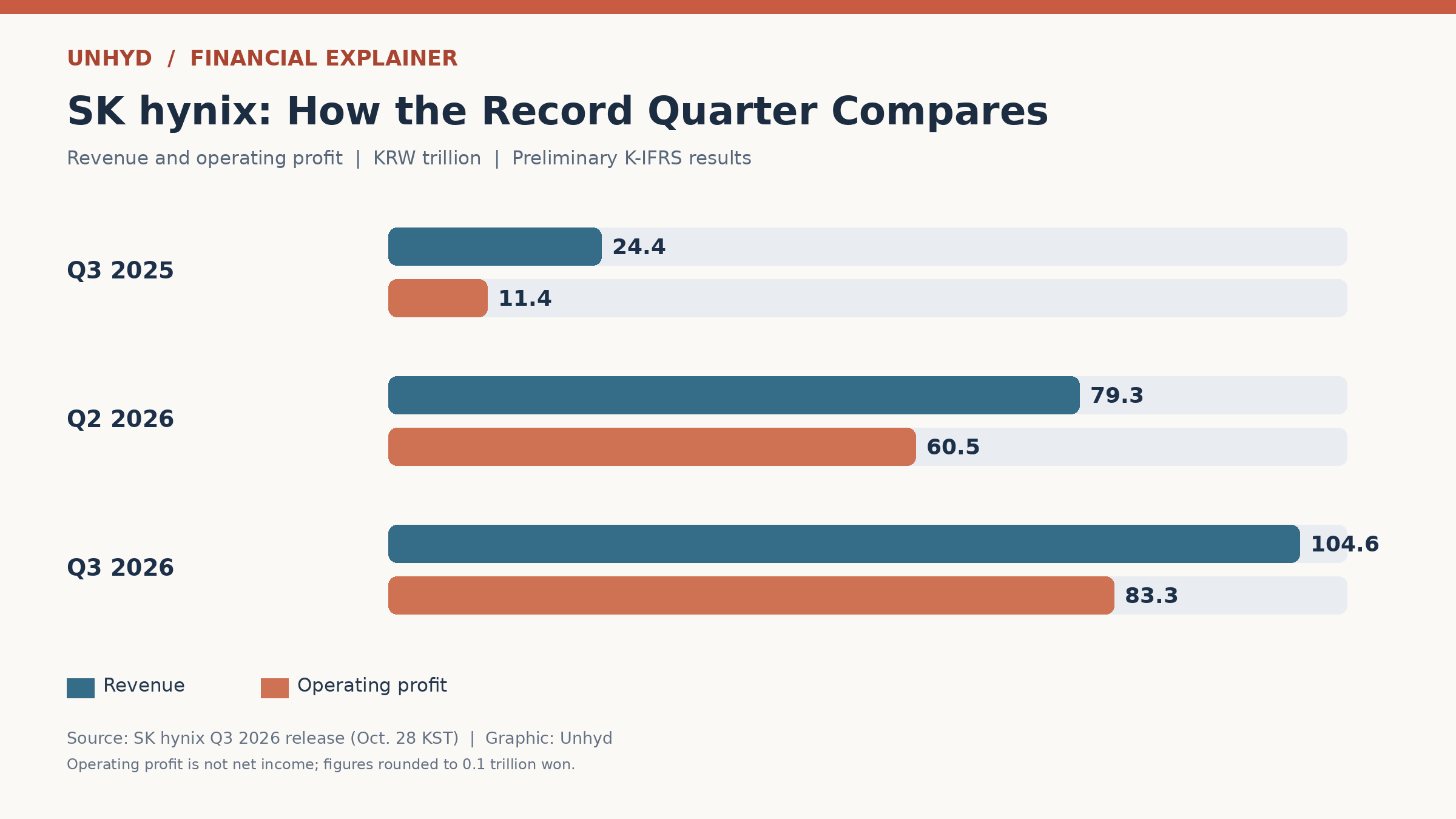
Revenue rose from 79.3187 trillion won in the preceding quarter to 104.6155 trillion won, a gain of about 32%. Operating profit increased from 60.5426 trillion won to 83.3338 trillion won, about 38% higher. Compared with the third quarter of 2025, revenue rose 328% and operating profit 632%, according to the company's preliminary K-IFRS figures.
These are not sales of AI software. SK hynix makes memory products including DRAM, high-bandwidth memory (HBM) and NAND flash. HBM is especially important to large AI accelerators because those systems need to move substantial quantities of data rapidly between memory and computing hardware. Stronger HBM demand, server DDR5 sales and rising prices across important memory categories helped produce the quarter.
One caution is essential: operating margin is operating profit divided by revenue, not net profit divided by revenue. SK hynix's reported net income was 39.7756 trillion won, down about 58% from the previous quarter's 93.9226 trillion won despite the increase in operating profit. The earnings release does not provide enough explanation in the excerpted financial table to attribute that entire sequential net-income decline to any one factor. Investors should not substitute one profit measure for another.
The 100 trillion won shareholder-return plan is not all new cash
SK hynix says it intends approximately 100 trillion won in shareholder returns for fiscal 2026, including at least 30 trillion won in dividends and more than 60 trillion won in repurchases and cancellations. Those are the company's stated annual objectives, not a claim that every payment and cancellation has already been completed.
Crucially, a 40 trillion won buyback announced in August was completed last week, the company says, and the shares are expected to be cancelled. The board also approved a 14 trillion won third-quarter cash dividend and a further 20 trillion won repurchase. But only 10 trillion won of that newly approved repurchase is designated for cancellation and shareholder return; the other approximately 10 trillion won is intended for employee compensation and is explicitly excluded from the company's shareholder-return total.
That distinction matters when comparing headlines. Adding every announced buyback to the annual target without checking whether it was previously announced, already completed or excluded would double-count activity. The company also says part of the special dividend reflects gains from its investment in Japanese memory maker Kioxia, rather than operating profit from selling chips alone.
What the supply agreements do—and do not—guarantee
SK hynix reports long-term agreements with 14 major customers, including large cloud providers. It says contracted volumes represent more than half of total production capacity for 2027 and 2028. That is a meaningful indicator of customer commitments, but it is not the same as saying every memory chip the company could produce through 2029 has already been sold under a fixed-price contract.
The company describes a pricing mechanism that can reflect market conditions within agreed ranges. That may provide some protection against volatility, while leaving final outcomes dependent on volumes, product mix, customer needs and future market prices. Its forecast that memory demand could outstrip supply through 2030 is management's forward-looking assessment, not a verified fact about the next four years.
There are also practical manufacturing constraints. SK hynix says it plans to ramp its M15X facility and expects HBM4 to overtake HBM3E in both shipments and revenue during the fourth quarter. The ability to turn demand into delivered products depends on fabrication capacity, yields, packaging, equipment and qualification by customers. Unhyd previously examined the equipment side of this problem in its analysis of ASML's chipmaking bottleneck.
Why the quarter matters beyond SK hynix stock
Memory is a different layer of the AI supply chain from the graphics processors used for training and inference. Both are necessary, but they are not interchangeable products. Unhyd's earlier NVIDIA earnings analysis showed how sales of accelerator systems reflect investment in AI computing; SK hynix's results show how that investment can create exceptional pricing power for an upstream component supplier.
For cloud operators and enterprises, tight memory supply may influence hardware availability and the cost of deploying new systems. It does not establish that every AI service will become more expensive or that all memory manufacturers will earn comparable margins. Contract structures, competing suppliers, product transitions and customer spending decisions can change the picture.
The latest quarter also highlights a mismatch between near-term financial results and long-term investment narratives. The 83.3338 trillion won operating profit is a reported quarterly result. The 2030 shortage outlook and next year's capacity expansion are projections. The 100 trillion won return program mixes completed actions, board-approved actions and annual targets. Each deserves a different degree of certainty.
What to watch next
The most useful checkpoints are the final reviewed financial statements, execution of the newly authorized dividends and buybacks, progress on HBM4 production, and whether contracted demand translates into deliveries at sustainable margins. Customers' capital-spending decisions and competing memory suppliers will matter as much as management's confidence today.
SK hynix's quarter is evidence of a real, highly profitable market for memory used in AI systems. It is not proof that the current pricing environment will last indefinitely or that every announced shareholder distribution is already in investors' hands. Separating those facts from expectations is the most useful way to read the record results.