
What is a 10-K? It is the detailed annual report that most U.S. public companies file with the Securities and Exchange Commission. Unlike a short earnings headline, a Form 10-K presents the company's business, significant risks, management's explanation of results and audited financial statements. Knowing where to look can turn an intimidating filing into a practical research tool—even if you are not an accountant.
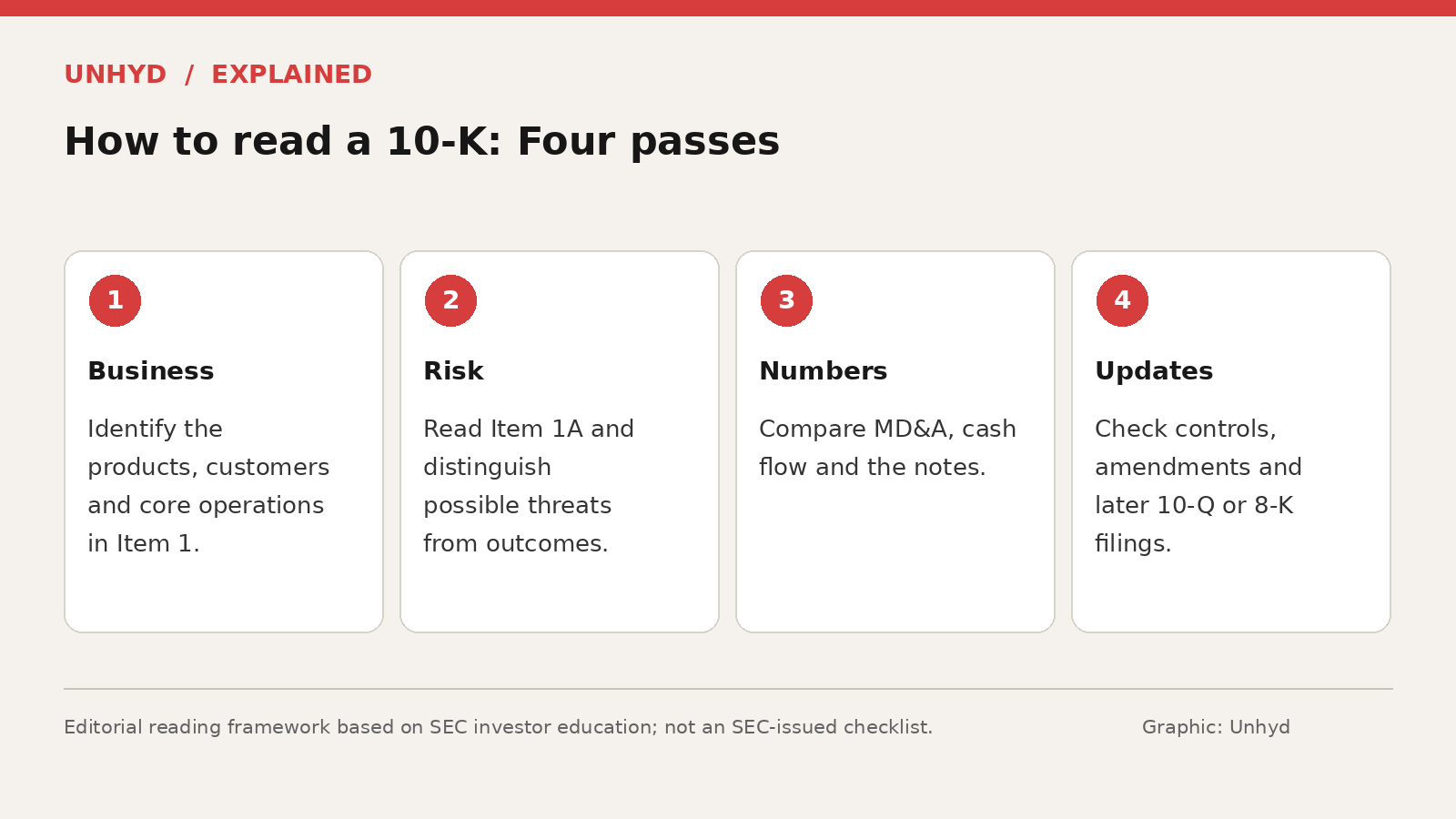
The best way to read a 10-K is not necessarily to begin on page one and proceed to the end. Start with the business and risk sections, examine management's explanations, check the audited numbers, and then compare the findings with more recent filings. The SEC's investor bulletin on Form 10-K and 10-Q explains what these reports contain. The four-pass method below is an Unhyd editorial reading framework, not an SEC-issued rating system.
What is a 10-K, and what makes it different from an earnings release?
An earnings release usually highlights results the company wants investors to notice: revenue, earnings per share, guidance and management comments. A Form 10-K supplies a much wider record. It includes audited annual financial statements and descriptions of the business, major risks and management's analysis. A colorful annual report to shareholders may contain much of the same information, but it is not automatically identical to the filed 10-K.
Be careful with time periods. A company can release quarterly results months before filing its next annual report. The 10-K covers a fiscal year, which may not end on December 31. It also does not instantly incorporate every event that occurs after the filing date. For developments between annual reports, check Forms 10-Q and 8-K, as the SEC's EDGAR guide advises.
Find the right filing on EDGAR before reading it
Go to the SEC's public EDGAR search and search by company name or ticker. Check that you have chosen the correct company, especially when names are similar. Filter the filing type to 10-K and open the most relevant reporting year. A 10-K/A is an amendment; it may modify disclosures in the original document. For the current quarter, use a 10-Q. A material corporate event may appear in an 8-K before either periodic filing is updated.
Verify the filing date, fiscal period and report type. A search-engine snippet or third-party summary can be useful for locating a document, but the primary source for a claim about what a company filed is the actual filing. If you download a copy, keep the accession number or EDGAR URL so another reader can reproduce your research.
Pass one: Understand the business in Item 1
Item 1, Business, describes principal products and services, markets, operations and relevant business conditions. Read it with a few concrete questions in mind: What does this company actually sell? Who pays it? Which products or customer segments matter most? What operating constraints or seasonal patterns could affect results?
Then distinguish a claim of opportunity from evidence of an accomplished result. A company may say an addressable market is large or an expansion is planned. That statement does not tell you whether demand has translated into revenue, cash or signed contracts. Compare the business description against reported segment results and management's later explanations. Unhyd's analysis of SK hynix's reported earnings illustrates why completed actions, guidance and management targets should be treated as different kinds of evidence.
Pass two: Read Item 1A without treating every risk as a prediction
Item 1A, Risk Factors, summarizes material risks described by the company. A risk disclosure is not a forecast that an adverse event will happen. It is a description of exposure readers should understand. Some risks affect an entire industry; others concern one company's customers, financing, regulation, cybersecurity or reliance on suppliers.
Look for changes between years. Did a formerly general risk become more specific? Did a company introduce a new dependence on one market or project? Conversely, did the filing explain how a previously disclosed concern was resolved? Risk sections can be extensive and are sometimes written conservatively, so avoid concluding that the longest risk section necessarily identifies the weakest company.
For an original analysis, a useful method is to connect a risk to the company's actual reported financial or operating exposure, with the assumptions clearly shown. Do not invent probabilities or rank a company's risks numerically unless the source supports that exercise.
Pass three: Compare management's account with the financial statements
Item 7, Management's Discussion and Analysis (MD&A), explains management's perspective on results, liquidity and trends. Item 8 contains Financial Statements and Supplementary Data, including audited statements and notes. Read the explanation and the numbers together.
Begin with three statements. The income statement reports revenue and expenses over a period. The balance sheet shows assets, liabilities and equity at a point in time. The cash-flow statement reconciles movements in cash across operating, investing and financing activities. A profitable company can still face cash pressures; a cash-rich quarter can also reflect borrowing or asset sales rather than stronger recurring operations.
Consider an explicitly hypothetical company whose annual revenue rises from $100 million to $112 million while operating profit falls from $10 million to $8 million. Revenue increased 12%, but operating margin fell from 10% to about 7.1%. A headline about growing sales alone would miss the margin compression. That simple calculation does not establish the cause: the MD&A and notes may point to input costs, product mix, restructuring or other factors.
Read footnotes for accounting policies, significant judgments, debt maturities, customer concentration and commitments. Compare the current year with prior periods using consistent definitions and units. A non-GAAP measure in a press release should not silently replace a GAAP figure from the filing; the reconciliation and the reason for the adjustment matter.
Pass four: Check controls, auditor language and what changed afterward
Item 9A addresses Controls and Procedures. The report can disclose management's conclusions about disclosure controls and internal control over financial reporting, including identified material weaknesses. A weakness does not automatically establish that every reported number is false, but it is important context about the reliability and oversight of financial reporting.
Review the auditor's report and the notes around any qualified opinion, emphasis, going-concern issue or accounting-policy change. Do not assume that the SEC has endorsed a company's business plan because its filing appears on EDGAR. The SEC explains that companies prepare their own filings and regulators do not vouch for every statement's accuracy.
Finally, look at the next available 10-Q, relevant 8-Ks and amendments. An old 10-K is still valuable background, but a later acquisition, financing, lawsuit or revised outlook can materially change the picture. This is particularly important when an analysis is being published many months after the fiscal year ended.
A practical 20-minute reading order
For a first pass, use five minutes to verify the reporting period and read Item 1. Spend five minutes on the most company-specific risks in Item 1A. Spend another five on MD&A and key financial statements, and the final five on footnotes, controls and material subsequent developments. This is a quick orientation, not a substitute for reading the entire report before a high-stakes decision.
Keep a simple evidence ledger with the filing URL, item number, reporting period, quoted or calculated figure, and an unresolved question. If you cannot reconcile a headline claim with the filing, say so rather than smoothing over the discrepancy. For investors, the ledger makes comparisons more rigorous. For journalists, it reduces the chance of publishing a persuasive but incomplete company narrative.
What a 10-K can tell you—and what it cannot
Knowing what is a 10-K and how to navigate one gives readers a direct route to primary corporate disclosures. It can show what a company reported, which risks it identifies, and how management describes changes in the business. It cannot guarantee future performance, predict a stock price, or independently verify every claim in management's account.
The useful habit is to start with the filing, compare explanations with the statements, record the limitations, and check what happened next. That is a better foundation for business analysis than relying on the earnings headline alone.