
The HCLTech–Cohere sovereign AI partnership announced on November 17, 2026, is a test of whether the next wave of enterprise artificial intelligence will be sold primarily as a model subscription or as a system that organizations can govern within their own legal and operational boundaries. The announcement identifies two priority markets, Canada and Germany, but it does not establish that any customer deployment has gone live.
In its November 17 release, HCLTech said it would become one of Cohere's preferred global systems integrator partners in Canada and Germany. The companies intend to combine Cohere's North agentic AI platform and models with HCLTech's consulting, implementation and industry expertise. They also say they aim to expand the arrangement worldwide. Those are announced intentions and partnership terms, not audited implementation results.
What has actually been announced?
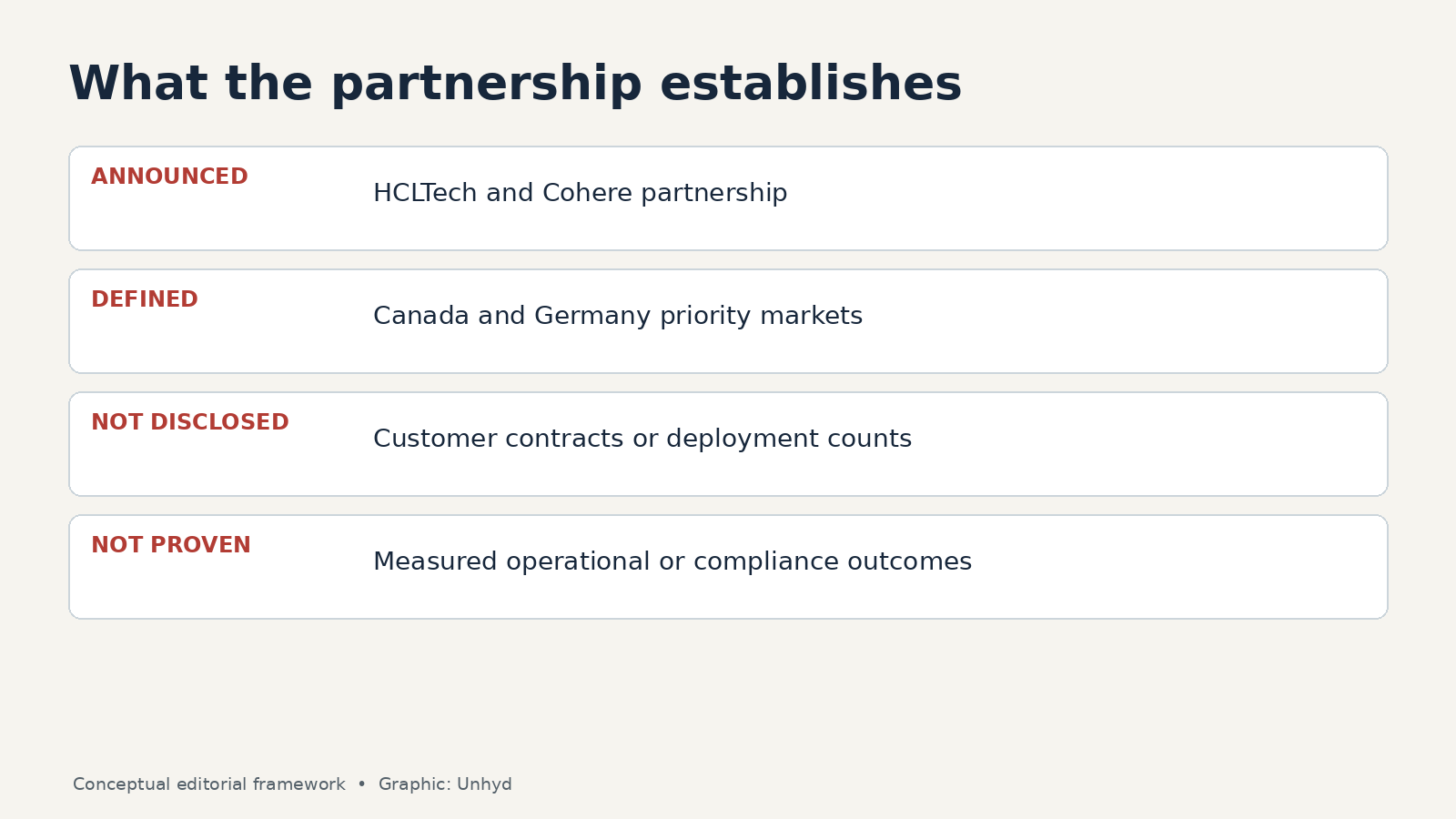
There are three concrete elements. First, the companies have named each other as partners. Second, they have identified Canada and Germany as initial priority markets. Third, they have described the technology and services each intends to contribute. The release does not disclose the contract's financial value, an exclusivity provision, customer count, delivery timetable or service-level commitments. None should be inferred from the language of the announcement.
That distinction matters because an integrator partnership can make a product easier to sell and deploy without proving that it is already widely adopted. HCLTech's role is particularly relevant in regulated enterprises, where procurement, identity management, data integration, audit records and operational support may determine whether a technically capable AI model can enter production.
Why Canada and Germany?
The announcement describes both countries as important markets for HCLTech and for sovereign AI. Their selection is consistent with the broader emphasis on local governance and regulated workloads, but the companies do not publish a jurisdiction-by-jurisdiction compliance certification in the release. The decision to target a country is not equivalent to approval by that country's regulators.
Microsoft's digital-sovereignty guidance separates data controls, operational controls and broader governance. That framework reveals the central implementation question: a system can keep some information in a specified region while still depending on external administrators, keys, software updates or network services. Local storage is one control, not a complete sovereignty guarantee.
The product is only one part of the deployment
Cohere has described its effort to support privately operated models and locally deployed North instances in its March 2026 NVIDIA collaboration announcement. That earlier technical direction helps explain the new services partnership, but it does not establish the precise hardware, hosting model or security architecture of any future HCLTech customer project.
A regulated buyer needs to examine the entire workflow. A model may run in a private environment while a logging service, document connector, monitoring system or administrative console transmits information elsewhere. An agent can also take actions in enterprise software, making authorization boundaries and rollback procedures as important as the model's text-generation performance.
HCLTech's stated value proposition is implementation expertise across complex organizations. Whether it delivers measurable benefits will depend on customer-specific design, training, testing and ongoing operation. Those are potential outcomes, not results reported in the announcement.
Four claims that must not be conflated
Partnership: The companies have announced a commercial relationship. Market priority: Canada and Germany are named as initial focus areas. Technical capability: Cohere markets private and local deployment options. Customer outcome: No audited adoption, uptime, cost-saving or compliance result is provided for this partnership. Each claim requires different evidence.
For a useful comparison, ask whether a deployment keeps prompts and outputs in the selected jurisdiction; who holds encryption keys; whether privileged administrators are local and independently audited; whether external dependencies remain; and what happens if a network connection or provider relationship fails. A product brochure is not a substitute for architecture documentation and customer-specific testing.
What would demonstrate progress?
The first meaningful milestone would be a named customer deployment with an explicit architecture and operational scope. A second would be independently reviewable controls or certifications applicable to that deployment, rather than a generic platform claim. A third would be measured outcomes: successful task completion, security findings, human-override effectiveness, latency, cost and continuity during outages.
These are proposed evaluation criteria, not promised HCLTech or Cohere deliverables. They are useful precisely because the announcement does not yet provide them. Unhyd previously examined Cohere's Canadian financing, where financing targets and committed funding also needed to be distinguished from completed outcomes. The same evidence discipline applies to a technology partnership.
The larger implication
The HCLTech–Cohere agreement suggests that enterprise AI competition is expanding beyond model quality into deployment control, integration and jurisdiction-specific operations. That is a reasonable interpretation of the companies' stated strategy, not proof that one vendor has achieved sovereign AI or that customers will switch platforms.
The test is not whether the phrase “sovereign AI” appears in a press release. It is whether a particular customer can demonstrate where its information goes, who can control the system, how failures are handled and which obligations can be independently verified. Until those details are available, this remains a partnership announcement with a clear commercial direction and important unanswered implementation questions.