
AI and freelance work are often discussed as a contest between automation and human labor. But the more revealing question may be how a client defines the job. A November 10, 2026 research release from OpenAI and Upwork describes AI-related freelance projects that combine a broader range of tasks and carry larger fixed-price budgets and more hours than other projects. That is evidence of changing project design, not proof that freelancers as a group are earning more—or that AI caused the shift.
The study, titled The Rebundling of Freelance Work in the AI Age, draws on Upwork job postings and ChatGPT activity. Its most useful insight is not a headline about replacement. It is the distinction between a task that software can help complete and a project that a client still needs someone to assemble, manage, verify and deliver.
What the new research actually measured
The researchers compared patterns in ChatGPT usage with categories of work appearing in Upwork postings, then examined changes in AI-related freelance briefs over time. These are different kinds of evidence. ChatGPT activity reflects uses of one AI service. Upwork postings reflect advertised client demand on one freelance marketplace. Neither is a complete census of work, employment, paid contracts or realized freelancer earnings.
OpenAI reports that, among 63 matched work categories, 43 followed a pattern in which activities more prevalent in ChatGPT tended to lose share on Upwork, while activities less prevalent in ChatGPT tended to gain share. The other 20 categories followed the reverse pattern. The finding is suggestive, but it is not a controlled estimate of jobs displaced by AI.
There is a crucial denominator problem: a category can lose share even if the absolute number of postings in that category stays flat or grows more slowly than the overall marketplace. Without the corresponding absolute counts, a share movement alone cannot establish that fewer people were hired for that activity.
A transparent check on the headline figures
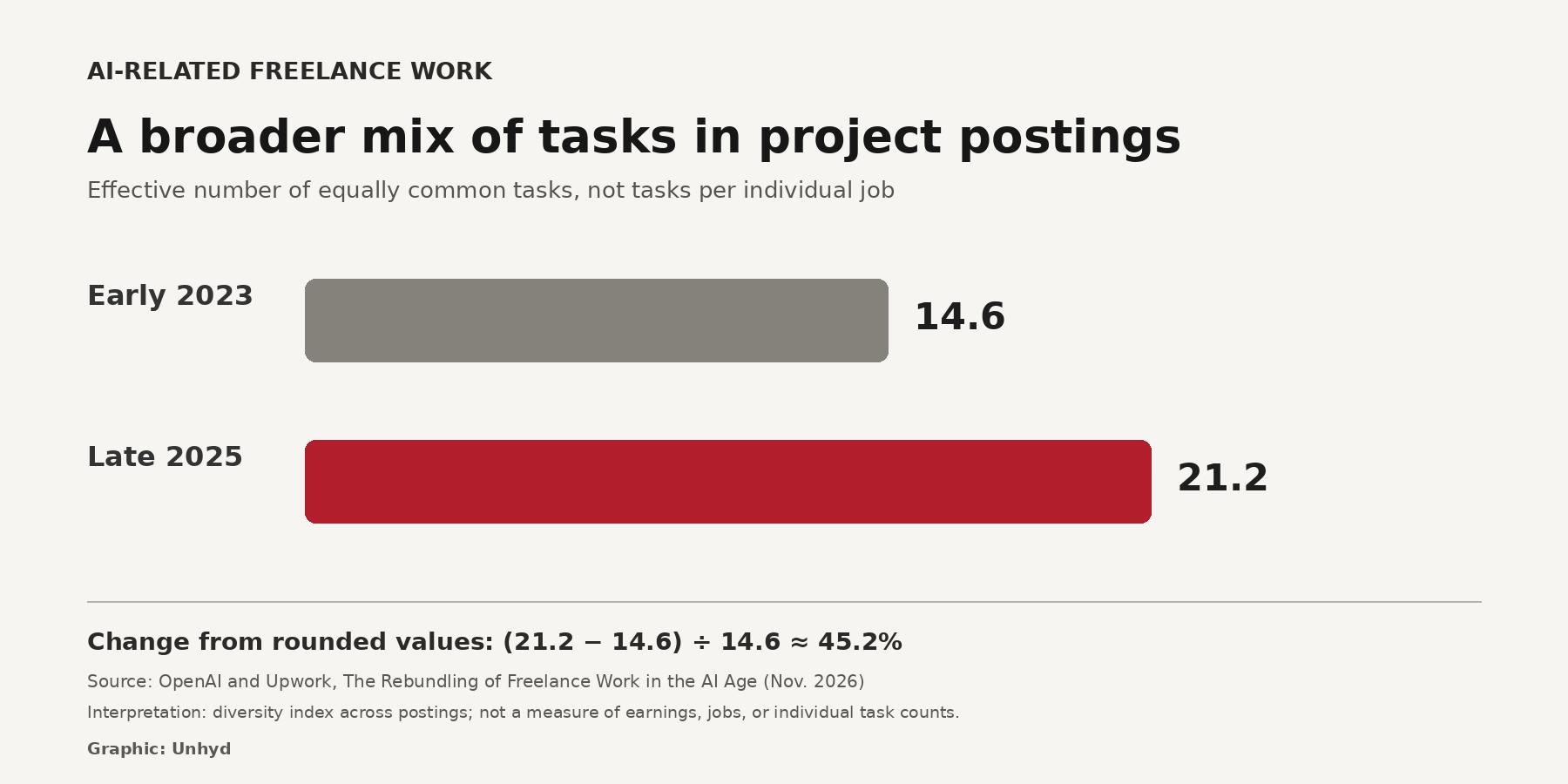
The researchers say the mix of tasks in AI-related postings became 45% more diverse between early 2023 and late 2025. Their published summary illustrates the change as the equivalent of approximately 14.6 equally common tasks at the beginning and 21.2 at the end. Calculating from those displayed rounded values gives (21.2 − 14.6) ÷ 14.6 × 100 = approximately 45.2%. That arithmetic is consistent with the reported 45%, allowing for rounding. It does not mean the typical individual job listing literally contained 21 tasks.
The measure is a diversity index expressed as an effective number of equally common tasks across the analyzed mix. It is not a count of the skills required in every job. A client seeking video generation, editing and motion graphics in one brief illustrates how formerly separate services can be bundled into one deliverable, but it cannot tell us how frequently all clients do this or whether a freelancer can command a higher hourly rate.
The researchers also report larger fixed-price budgets and more hours in AI-related projects, while posted hourly rates were similar to those for other work. Their comparison adjusts for type of work and posting month. This is an important qualification: a higher project budget can simply purchase more work. A larger contract is not necessarily a wage premium, a productivity gain or greater profit after software subscriptions, revisions and unpaid coordination.
Why project scope matters more than a single AI skill
Consider two hypothetical briefs. One asks for a short promotional video. The other asks for a campaign deliverable that combines AI-generated footage, human editing, motion graphics, brand review and final export. The second brief could have a higher budget because it contains more work and coordination. This example illustrates the mechanism described in the study; it is not a sampled Upwork contract or a measured comparison.
For a freelancer, the strategic question is therefore not only whether to learn a particular model or prompt technique. It is whether they can reliably deliver an outcome across several stages: scoping the problem, selecting tools, obtaining permissions, checking factual and creative quality, managing revisions and handing off usable work. The study supports looking at combinations of tasks. It does not prove that any specific training course, tool or occupation will generate better earnings.
For clients, the same distinction cuts the other way. Bundling several services into one brief may simplify vendor management, but it can also hide responsibility. A clear scope should identify the final deliverable, who supplies source materials, who checks accuracy and rights, how many revision rounds are included, and which activities require human approval. Those requirements matter whether AI is used or not.
What the data cannot tell us
First, this is platform-specific observational research. Upwork's client mix, pricing, geographic reach and category system may differ substantially from salaried employment, local agencies, independent consultants working through referrals or other marketplaces. Findings about postings should not be generalized into a universal labor-market forecast.
Second, the timing and comparison windows vary across figures. The summary's task-diversity measure covers early 2023 to late 2025; its project-budget analysis uses Upwork data through April 2026; and the presentation of ChatGPT task shares draws on a different observation window. Those measures describe related aspects of the market but cannot be treated as a single synchronized experiment.
Third, the research comes from two organizations with direct interests in AI adoption and freelance marketplace activity. That does not invalidate the evidence. It does make the study design, definitions, denominator choices and independent replication especially important. The underlying full research report should be the reference for methodological review, not an assumption that the public summary establishes causality.
Fourth, the reported similarity in posted hourly rates does not measure take-home income. Actual pay can differ from posted rates; project budgets can be negotiated; and time spent finding work, reviewing AI outputs or correcting mistakes may not be billable. The public summary does not establish how these costs changed.
A practical framework for reading an AI freelance brief
Before comparing an AI-related project with a conventional one, separate four dimensions: task mix (what work is requested), scope (how many deliverables and revisions), price unit (hourly rate versus fixed project budget), and outcome (what the client receives and accepts). Comparing a large fixed-price package with a narrow hourly assignment without controlling for these differences produces a misleading result.
Freelancers can use the framework to decide whether a brief is commercially viable. Estimate each production stage, add review and revision time, document software and licensing costs, and specify acceptance criteria. Clients can use the same framework to avoid assuming that an AI tool automatically eliminates the human work required to integrate and validate outputs.
There is a related lesson for businesses using AI tools internally. Unhyd’s earlier analysis of Workday recruiting data found a different, enterprise-focused signal about demand for automation and engineering skills; it should not be combined numerically with Upwork marketplace postings. An organization may automate pieces of writing, coding, design or analysis without eliminating the need to define objectives, integrate systems, check results and own decisions. That is an interpretation consistent with the observed rebundling pattern, not a direct measurement of company staffing changes.
The takeaway: changing work packages, not a settled employment verdict
The OpenAI–Upwork findings support a narrower and more useful conclusion than either “AI is replacing freelancers” or “AI is making every freelancer richer.” The mix of posted work is changing, AI-related project descriptions are combining a wider range of tasks, and larger project budgets may reflect broader scopes rather than higher rates. The available evidence cannot establish the net number of jobs created or lost, or who ultimately captures the value.
For people buying or selling freelance services, the actionable question is what a completed project now requires. The best comparison is not AI versus no AI in the abstract. It is the same outcome, with the same quality standard and clearly defined scope, measured against actual time, cost and responsibility.