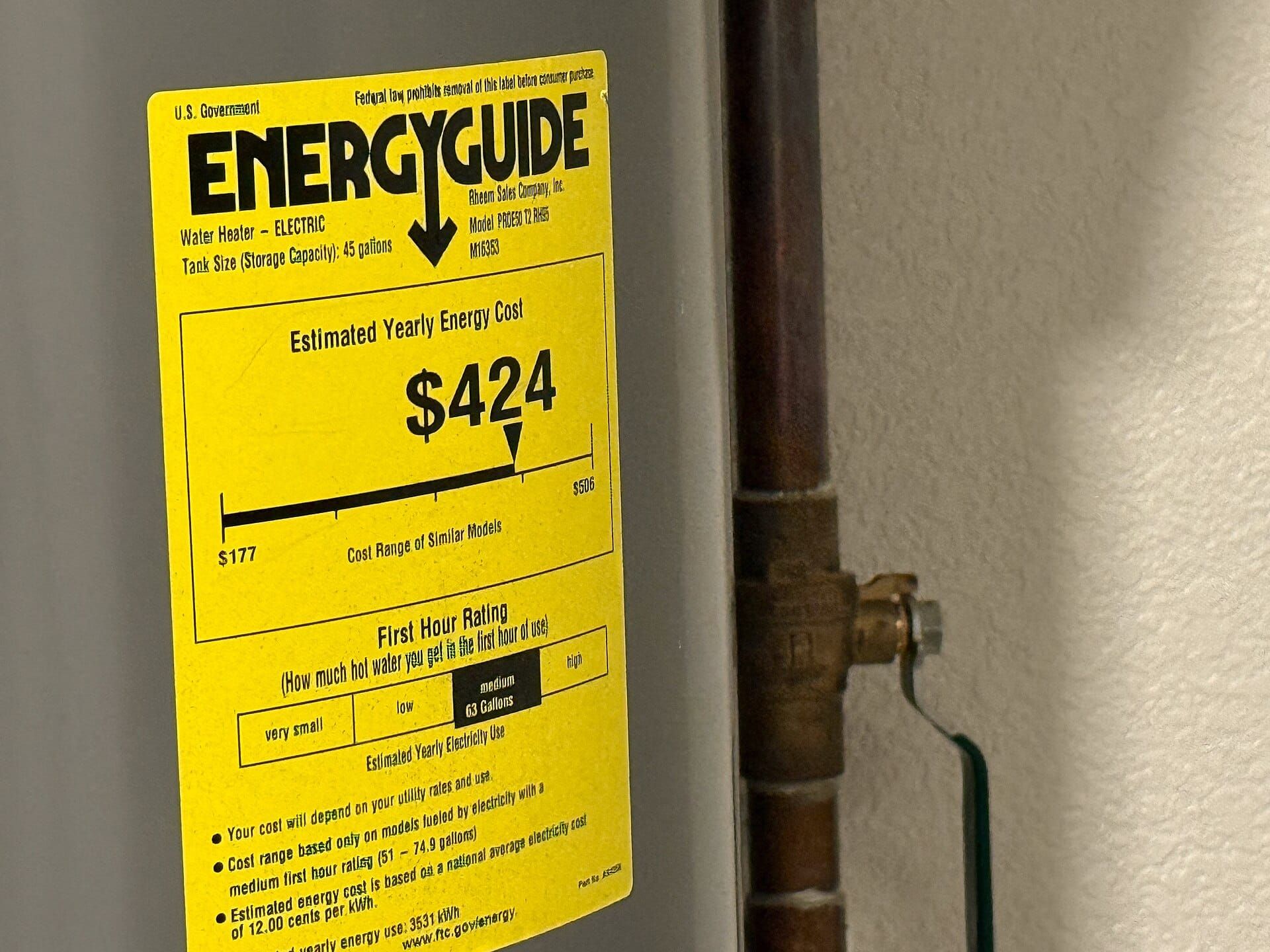
An EnergyGuide label can help you compare appliances, but its estimated annual dollar cost is not a promise about your utility bill. The yellow label uses standardized assumptions so buyers can compare similar products. To make a useful buying decision, read the energy-use figure, adjust for your local price, and consider how long you expect to own the appliance.
Start by comparing similar appliances
Before comparing label numbers, check capacity, appliance type and major features. A large refrigerator and a compact model serve different needs; the smaller annual electricity estimate does not automatically make one the better purchase. The Federal Trade Commission's EnergyGuide shopping guidance explains that the label compares a product's energy use with similar appliances.
Look for the model number, capacity and the comparison range. That range is not a national ranking of every product sold. It is intended to put a particular model's estimated consumption or cost alongside comparable models. The exact fields vary by appliance category, so do not assume every EnergyGuide label displays the same measures.
Understand the two numbers: energy and dollars
For an electric appliance with an annual kilowatt-hour estimate, the physical consumption figure is useful when adjusting for local rates. The displayed yearly dollar estimate generally reflects standardized energy prices and usage assumptions rather than the price charged by your utility. The FTC warns that actual operating cost depends on local energy prices and how you use the product.
For example, suppose a hypothetical refrigerator uses 400 kilowatt-hours annually. At an illustrative electricity price of $0.15 per kilowatt-hour, 400 × 0.15 = $60 per year. At $0.30 per kilowatt-hour, the same consumption becomes $120. These are transparent arithmetic examples, not current nationwide rates or verified figures for a particular model. Use your own bill's relevant per-kWh price, remembering that tiered rates, fixed charges and time-of-use plans can complicate the estimate.
Calculate total ownership cost, not just sticker price
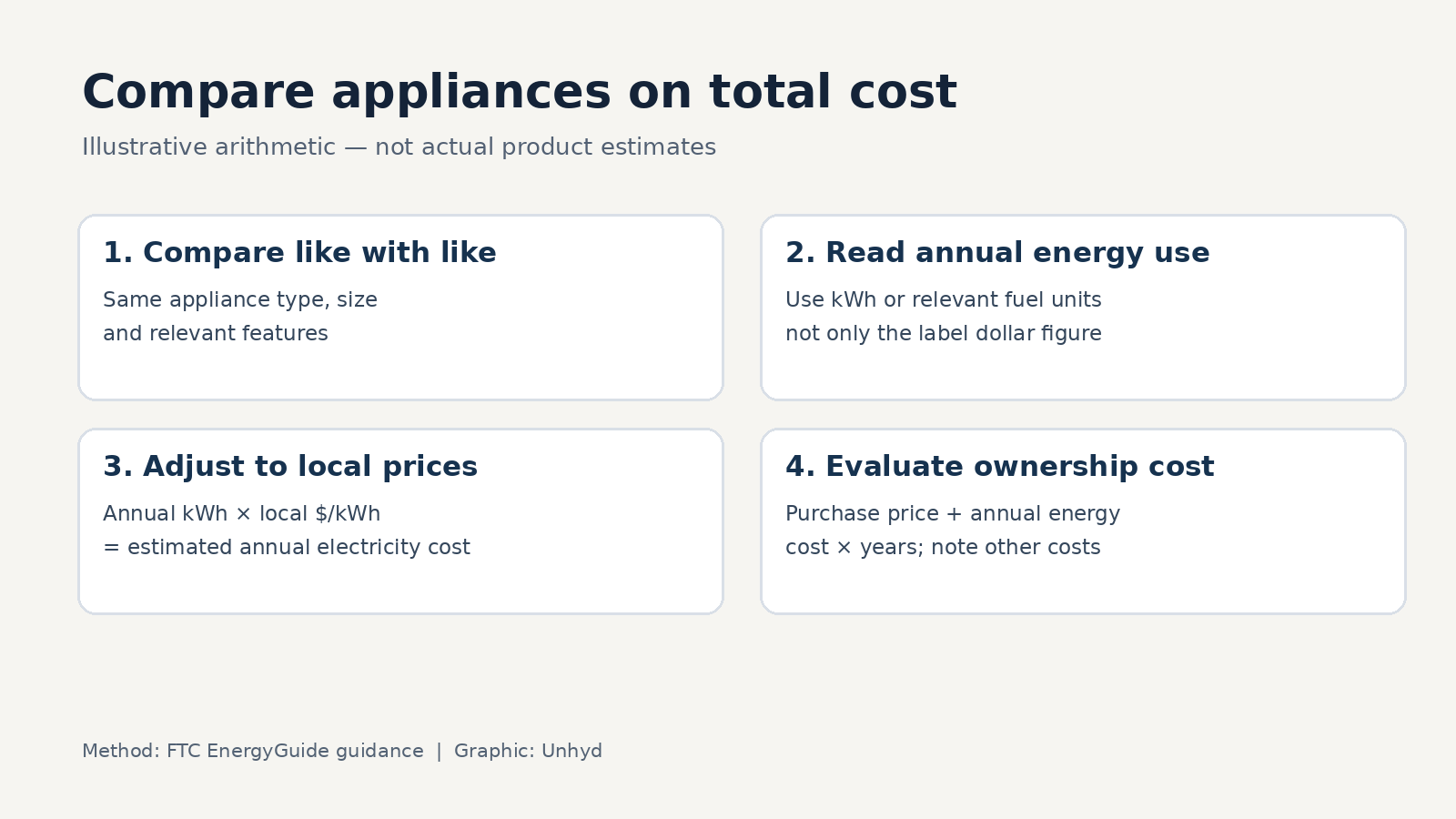
For a simplified electricity-only comparison, add purchase price to estimated annual electricity expense multiplied by expected years of use. Suppose hypothetical Appliance A costs $700 and uses 400 kWh yearly, while B costs $850 and uses 300 kWh. At $0.20/kWh, annual electricity cost is $80 versus $60. Over eight years, the simplified totals are $1,340 for A and $1,330 for B. The $150 higher purchase price is nearly offset by $160 in modeled electricity savings.
That comparison deliberately excludes repairs, financing, maintenance, installation, disposal, taxes, possible water or fuel costs, price changes and the time value of money. A buyer should include those when material. It also assumes identical utility rates, years of service and usable capacity. The point is not that B always wins, but that the purchase-price difference and annual energy difference must be evaluated on a common basis.
When the label does not tell the whole story
A washer may differ in water use and drying effects. A heat pump or air conditioner may have seasonal performance and installation requirements. A water heater's fuel source and household demand affect comparisons. Some labels use efficiency ratings rather than the same dollar-based presentation. The FTC's manufacturer guidance describes the regulated categories and the use of Department of Energy test procedures.
The Energy Labeling Rule establishes standardized disclosures; it does not guarantee actual savings in a specific home. Installation, climate, maintenance, usage patterns and local prices can all matter.
EnergyGuide and ENERGY STAR are different
EnergyGuide provides comparison information about estimated consumption or efficiency for covered products. ENERGY STAR identifies products that meet applicable efficiency criteria under a separate program. The FTC explicitly distinguishes the two in its consumer guidance. An ENERGY STAR mark may be useful, but it does not replace reading the EnergyGuide estimate and comparing the appliance's capacity, price and fit.
A five-minute decision worksheet
Record the exact model number and capacity for two or three realistic candidates. Copy their energy-use estimates in comparable units. Obtain your relevant local electricity or fuel price and calculate an estimated annual operating cost. Add each purchase price and evaluate at a common ownership horizon. Then check installation, maintenance, warranty, physical fit, service availability and any water-use differences.
If the results are close, show a range rather than a single precise forecast. Recalculate using a higher utility rate or shorter appliance life to see whether the ranking changes. A small estimated cost advantage is not a guarantee of real savings; the more valuable outcome is understanding which assumptions drive the choice.
Where to find a missing label
The FTC advises checking inside the appliance or looking on the retailer's or manufacturer's website if a label is not visible. Use the exact model identifier: a product family may contain variants with different energy consumption. Save the label alongside the product specification sheet so the assumptions can be checked before purchasing.
The best use of EnergyGuide is not to find the lowest number on a yellow sticker. It is to compare similar appliances using consistent units, local prices and a realistic period of ownership, while acknowledging the costs that standardized test labels cannot predict.