
Learning how to compare health insurance plans begins with a question the monthly premium cannot answer: which plan will cover the care you actually need at a cost you can manage? A reliable comparison checks provider access and covered medicines first, then models annual spending under both expected and expensive-care scenarios. A lower premium can be attractive, but it is only one part of a plan's price.
First, compare coverage for the same people and year
Put two or three specific plan options side by side. Use the same coverage year, household members, location and expected treatment needs. Write down each plan's exact name and identifier, not just its insurer or metal level. Two products sold by the same company may use different networks or prescription lists.
Before doing any arithmetic, identify non-negotiable care: a clinician you want to keep, a hospital you expect to use, a recurring prescription, or a service you already know you need. For each plan, verify those items against its current documents and the insurer's information. HealthCare.gov explains that shoppers can consult plan summaries, directories and covered-drug lists while comparing options.
This order matters. A superficially inexpensive plan may be a poor comparison if it excludes a necessary medication or does not include the clinician a household relies on. Do not treat two plans as equivalent until their relevant coverage has been checked.
Understand the five cost terms without double-counting
Premium: the amount paid to maintain coverage, usually monthly, whether or not anyone visits a doctor. Deductible: the amount paid for certain covered services before the insurer starts paying its share, subject to the plan's rules and exceptions. Copayment: a fixed amount, such as a charge for an office visit. Coinsurance: a percentage of an allowed cost for a covered service. Out-of-pocket maximum: the plan's limit on specified qualifying cost-sharing expenses for covered in-network services during the plan year.
These figures do not stack in the way a simple shopping receipt does. Deductibles, qualifying copays and coinsurance generally count toward the applicable out-of-pocket maximum; adding the full deductible on top of that maximum would typically count the same exposure twice. Premiums are separate and do not count toward that limit. HealthCare.gov's out-of-pocket maximum explanation also distinguishes excluded expenses, including services not covered by the plan and certain out-of-network charges.
A plan may have separate medical and prescription deductibles, distinct in-network and out-of-network limits, and individual versus family maximums. Check exactly which amount applies to the people and services in your calculation. Some qualifying preventive services may be covered without paying a deductible; other services on the same visit can still produce a charge under the plan's terms.
Read the Summary of Benefits and Coverage before assuming a copay applies
The Summary of Benefits and Coverage, or SBC, is a standardized document designed to make plan terms easier to compare. Insurers and job-based plans must make it available. It identifies major cost-sharing arrangements and includes standardized coverage examples for diabetes care and childbirth. Those examples are illustrations, not predictions of your own costs. HealthCare.gov describes the SBC and how to obtain it.
Open the actual SBC for each shortlisted plan, not a generic brochure for the insurer. Look for the answers to several practical questions. Does the specialist copayment apply before the deductible, or only after it? Is laboratory work billed separately from the office visit? Are imaging, rehabilitation, mental-health visits or specialty medicines subject to coinsurance? Does an expensive prescription need prior authorization or step therapy? Are referrals required? Check the full policy or certificate of coverage when the summary does not resolve an important question.
If an answer is absent, write unknown in the comparison rather than filling it with a guess. A plan with uncertain coverage should not be awarded a precise projected cost simply because its premium is known.
Verify provider networks and prescription coverage separately
Search the directory for the exact plan and network, then contact both the insurer and the provider's billing or scheduling team. Confirm participation for the coming coverage period and, when relevant, the specific location. A hospital being listed in-network does not establish that every physician who practices there participates in the same network.
For medicines, check the drug's exact name, dose and formulation in the current formulary. Record its tier, any deductible treatment, quantity limits, prior-authorization requirements and preferred pharmacy rules. If a treatment is likely to change, ask what happens to coverage when the prescription is adjusted. HealthCare.gov's plan selection guidance provides a starting point for checking doctors, facilities and prescription drugs.
Network and formulary details can change, so save the date and source of each confirmation. This is not a promise that a provider will remain in-network or that the insurer will pay every claim. It is a practical record of what was represented when you compared plans.
Build an expected-year estimate from your likely use of care
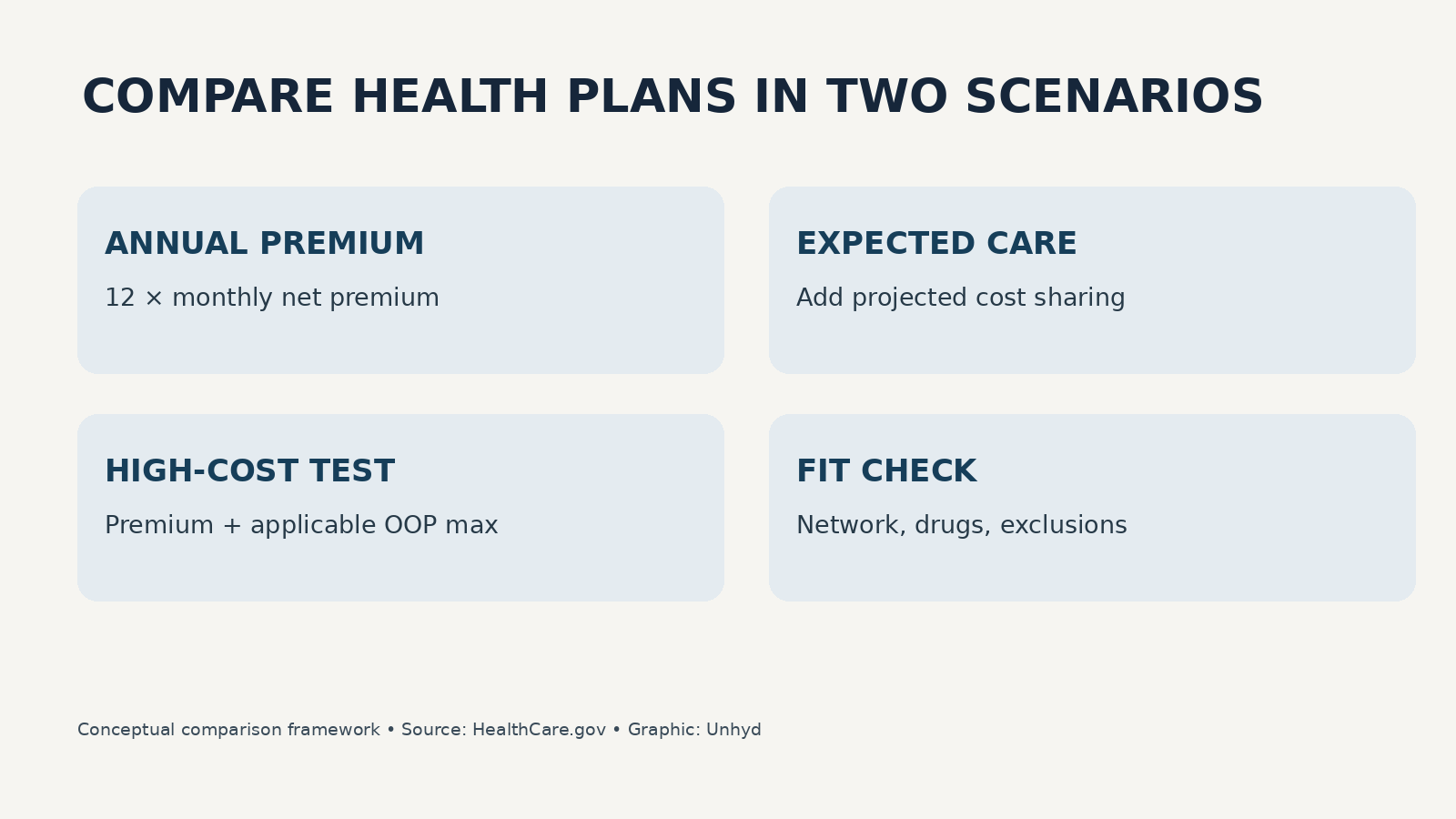
Start with annual net premium = actual monthly premium after any applicable financial assistance × 12 for a full year of coverage. Then estimate the out-of-pocket charges for the same likely services under each plan: primary-care appointments, specialist visits, regular prescriptions, therapy, tests or other anticipated treatment. Apply the actual deductible and cost-sharing rules to each service rather than adding every plan limit together.
Consider a purely hypothetical plan with a $410 net monthly premium. Suppose its confirmed terms charge $30 per primary-care visit, $65 per specialist visit and $20 for a recurring monthly prescription, all without further deductible charges for those specific services. Three primary-care visits, two specialist visits and 12 prescriptions would produce:
- Annual premiums: 12 × $410 = $4,920.
- Three primary-care visits: 3 × $30 = $90.
- Two specialist visits: 2 × $65 = $130.
- Twelve monthly prescription fills: 12 × $20 = $240.
- Illustrative total for these specified costs: $5,380.
That $5,380 is not a quote or an overall forecast. The example excludes unexpected care, laboratory fees, treatment not listed above, uncovered charges, and any deductible or coinsurance expense not triggered by the stated assumptions. A different plan design could produce a different result from the identical care pattern. The method is useful because it forces readers to record what is known and what is missing.
Run a separate high-cost stress test
Next, calculate annual premiums + the applicable in-network out-of-pocket maximum for each plan. For example, a hypothetical plan with $4,920 in annual premiums and an $8,300 applicable maximum has a $13,220 premium-plus-maximum comparison figure.
This is a defined stress-test measure for covered, qualifying, in-network costs—not the most a person could ever spend, and not a prediction of what a costly year will involve. Out-of-network services, uncovered items, certain non-qualifying charges and other plan-specific costs may fall outside that figure. Family and individual limits must be handled correctly. As HealthCare.gov advises, both likely use and the potential impact of greater care need to inform an annual cost comparison.
Compare the expected-year estimate and the high-cost stress test on separate lines. If one plan wins the first calculation and another wins the second, that is a trade-off to examine, not a contradiction or proof that one is universally best. Readers interested in the narrower connection between savings-account eligibility and the premium-plus-maximum calculation can see Unhyd's analysis of 2027 HSA limits and health-plan costs.
Apply premium assistance and cost-sharing reductions correctly
For Marketplace coverage, compare the amount the household may actually pay, rather than a full-price premium displayed before eligibility has been determined. Premium tax credits depend on household circumstances and applicable rules; eligibility and amounts should be checked through an official Marketplace application rather than assumed from an online example.
Some Marketplace applicants qualify for cost-sharing reductions that can lower deductibles, copayments, coinsurance and out-of-pocket maximums. HealthCare.gov explains that the usual income-based extra savings require choosing an eligible Silver plan. Comparing an unsubsidized Bronze plan with a cost-sharing-reduction Silver option without incorporating those differences can produce a misleading conclusion.
Metal categories describe general cost-sharing patterns, not the quality of clinicians or the precise price every household will pay. Compare each plan's actual terms and network. If coverage is through an employer rather than a Marketplace, use the employer's actual employee premium contributions and the applicable plan documents.
The eight-field shortlist worksheet
Before choosing between plans, create a short worksheet with one column for each exact plan. For each candidate record the following, and mark any missing entry unverified:
- Plan identity: company, exact plan name, identifier, coverage year and network.
- Annual net premium: what the household would pay for twelve months under its actual eligibility.
- Essential provider fit: current confirmation for physicians, facilities and expected treatment locations.
- Prescription fit: formulary coverage, tiers, restrictions, pharmacy rules and estimated recurring costs.
- Deductibles: relevant individual, family, medical and drug deductibles.
- Service cost sharing: copays, coinsurance, referral rules and services subject to the deductible.
- Expected-year spending: premiums plus estimated charges for the same anticipated care pattern.
- High-cost stress figure and caveats: annual premium plus applicable in-network maximum, with exclusions and unverified terms noted.
Do not award the lowest premium an automatic victory. A plan should be screened out—or investigated further—if it does not meet an essential coverage requirement. Once the remaining choices are meaningfully comparable, the two cost scenarios show which risks each household would be accepting.
Before enrolling: confirm the product is insurance, not only a discount program
A polished sales page or inexpensive membership is not proof of comprehensive insurance coverage. Ask for the exact insurer, policy name, SBC, enrollment pathway and written benefits before paying. Unhyd's separate guide to verifying health insurance before enrolling explains how to distinguish genuine coverage from misleading discount or limited-benefit offers.
Finally, keep copies of the documents and dates you used for the comparison. Recheck the directory and formulary when enrolling, especially if a particular clinician or medication drove your choice. If you cannot verify a decisive item, make that uncertainty visible in the decision instead of treating the cheapest apparent option as the most affordable plan.
This guide provides general information about plan comparison, not individualized insurance, legal, tax or medical advice. Actual coverage, costs, eligibility and rights depend on the policy, market, year and household circumstances.