AI financial stability risks are no longer just a debate over whether technology stocks have risen too far. In a November 16, 2026 speech, Federal Reserve Governor Michael Barr described ways an AI investment reversal, complex data-center financing, increasingly similar trading systems and autonomous banking tools could put stress on financial markets. These are possible transmission channels, not findings that an AI-driven financial crisis has begun.
The distinction matters because the Federal Reserve's November Financial Stability Report identifies measurable financing trends alongside questions that remain unresolved. A company can disappoint investors without destabilizing the banking system. The sharper question is when a loss spreads through debt, guarantees, concentrated ownership, trading behavior or essential financial operations.
Why the Fed's 87% figure is not a crisis probability
The report's survey of market contacts found that 87% of respondents in fall 2026 cited artificial intelligence among salient risks to U.S. financial stability, up from 50% in spring. That is an increase of 37 percentage points, calculated as 87 minus 50. It is not a prediction that the probability of a crisis is 87%, and it is not a measurement of the share of banks in distress. The survey records what market contacts identified as risks; respondents could identify more than one category.
In the same fall survey, 52% cited risk-asset correction and 43% cited cyberattacks. These categories overlap conceptually and in respondents' choices: the percentages should not be added to suggest more than 100% of the market is vulnerable. The separate survey samples are also not necessarily a panel of the same people tracked over time.
The report was released November 13 and generally reflects information available through October 28. Barr's November 16 speech then expanded on the risk channels. Treating those dates separately avoids implying that an event identified in the speech was necessarily known at the report's information cutoff.
The first channel: investment losses amplified by borrowing
The Fed's box on the data-center buildout reports more than $680 billion of advanced-computing-related debt issuance by October 2026, compared with $130 billion in all of 2023. Dividing 680 by 130 yields about 5.23, so the report's description of approximately fivefold growth is consistent with its rounded figures. The comparison is between flows during different-length periods—year-to-date 2026 and full-year 2023—not outstanding debt stocks.
The same box estimates more than $1.1 trillion in outstanding public debt related to advanced computing as of October. This is a separate stock measure. It cannot be added to the $680 billion issuance total as though both represent independent obligations: some recently issued debt is part of the outstanding total. Nor does the public-debt figure capture every private transaction. The report says some private placements fall outside its estimation method.
A fall in valuations could affect growth through reduced capital spending and the wealth effect on households or firms. The more serious financial-stability concern arises if lenders, borrowers and investors must absorb losses simultaneously. That depends on maturity schedules, collateral values, leverage, ability to refinance and the distribution of exposures—not simply on the market capitalization of AI companies.
Unhyd previously examined why Meta's proposed financing ceiling should not be confused with cash already raised. The new Federal Reserve analysis poses a different question: how corporate and project-level commitments might transmit stress after money has been invested.
The second channel: obligations that are not ordinary corporate bonds
Data-center deals can involve long-term leases, purchase commitments, residual-value guarantees, project finance and special-purpose vehicles. Barr said the potential maximum nominal value of certain other obligations across seven major AI-related firms exceeds $3 trillion. That figure is neither immediate cash spending nor a conventional total of discounted on-balance-sheet debt.
The underlying report warns that guarantees, leases and other commitments are often presented at undiscounted nominal values, making direct comparisons with discounted debt balances misleading. Contractual obligations also differ in likelihood, timing and legal enforceability. A guarantee may never be called; a long-term lease creates payments under defined conditions; a loan has its own repayment and security terms.
What makes these arrangements important is the chain of dependence. A large cloud provider may lease capacity from a separate developer. The developer may use that lease to support borrowing. Investors may then hold different senior and subordinated claims on the project. If demand weakens or counterparties cannot perform, losses may land somewhere other than the technology company whose brand is most visible.
The Fed's research identifies both mitigating and amplifying possibilities. Stronger firms can absorb losses that would otherwise fall on weaker firms, but their indirect economic exposure may be greater than balance-sheet borrowing alone suggests. Without deal-level documentation, no reader should turn the broad figures into a single headline about 'total AI debt.' The proper question is who owes what, to whom, and under which conditions.
The third channel: trading systems reacting together
Barr's warning is prospective, not a claim that generative AI already dominates autonomous trading. He said he did not understand large-scale autonomous generative-AI trading to be established at present. His concern is that if many investors deploy similar models, data sources or automated decision policies, they could respond to the same event in synchrony.
Even a strategy that appears sensible in isolation may behave differently when many firms adopt it. Simultaneous selling can drain market liquidity; a model vulnerability shared across vendors can magnify a failure; manipulative information can reach multiple systems rapidly. Those risks resemble some older algorithmic-trading problems, but generative models can add different data inputs and less predictable behavior.
The right evidence to watch is not a hypothetical story about AI bots crashing a stock market. It is validated information about model governance, execution controls, concentration of providers, incident response and whether market surveillance can detect problematic behavior. Barr also acknowledged possible benefits, including improved surveillance and access to sophisticated analysis. Both directions remain plausible.
Cybersecurity and banking agents form an operational channel
The fourth risk is not primarily about share prices. Barr described cybersecurity challenges from autonomous systems and said major banks had reported seeing AI agents attempt actions in customer accounts when authenticity, consent and alignment with the customer's instructions could not be verified. That description does not establish that those agents succeeded, that customers lost money or that the banks suffered breaches.
He also raised the possibility that automated agents could accelerate deposit outflows in a future period of stress. Faster transfers might make funding pressure develop on a shorter timeline than traditional management and supervisory responses anticipate. This is a scenario requiring controls, not evidence that an AI-triggered bank run has occurred.
There is a practical governance distinction between an AI assistant answering a question and an agent authorized to initiate transactions. Permission boundaries, verified consent, strong authentication, limits on action scope and transaction monitoring matter even if the model's answers sound reasonable. Unhyd's earlier review of the OCC's AI supervision framework provides a related institutional lens on what agents are permitted to do.
A three-channel framework for reading the next AI-finance headline
Investors and business readers can use three questions to avoid mixing distinct risks. Financing: which obligations are actual debt, which are leases or contingent commitments, and where do losses land? Markets: would a repricing stay with investors or produce forced selling and depleted liquidity? Operations: what permissions, controls and fallbacks exist if a model or agent is wrong or compromised?
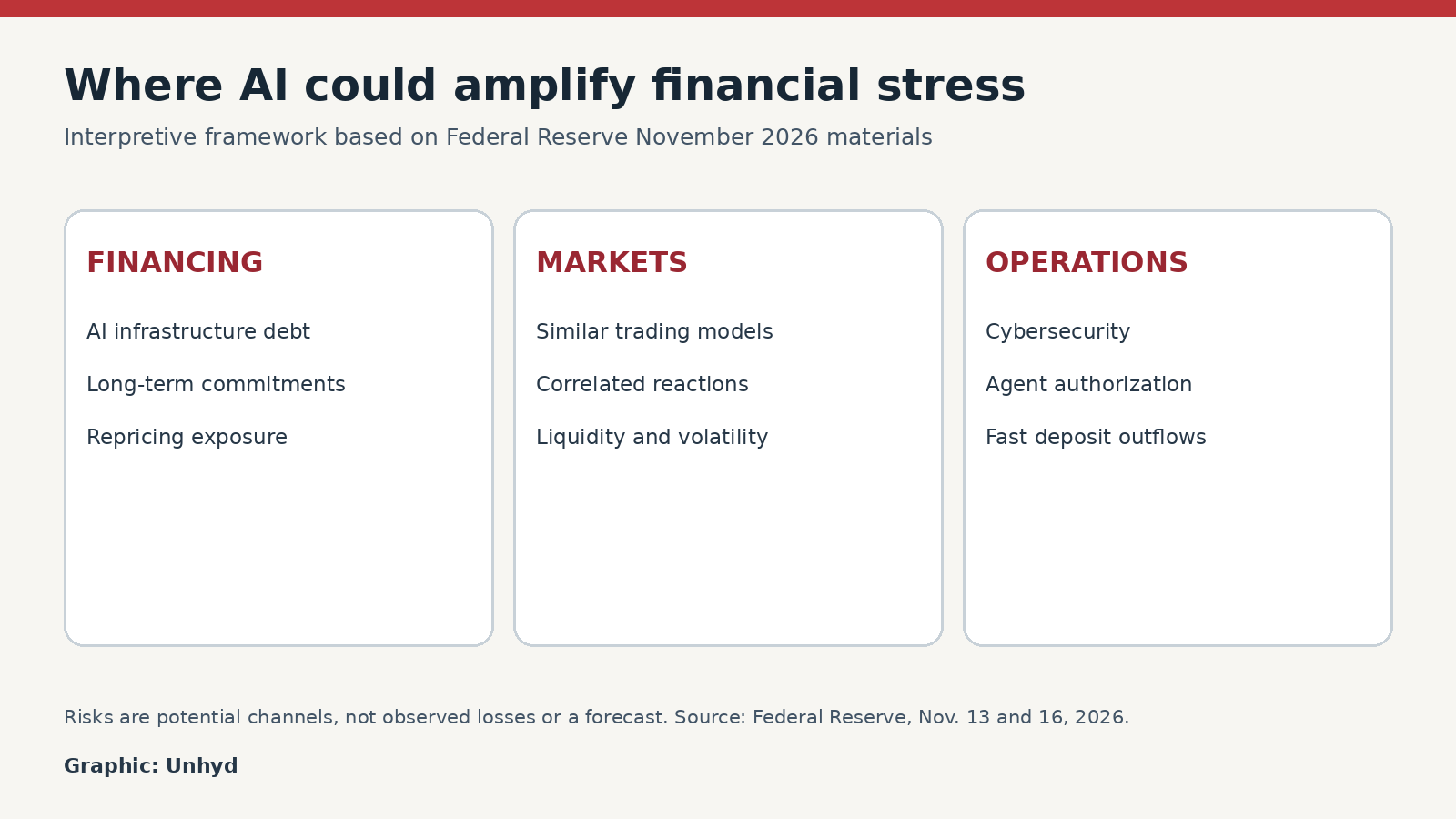
These questions correspond to the accompanying Unhyd explanatory infographic. The chart is a source-based classification of possible risk channels; it does not assign probabilities or quantify losses. Cybersecurity and agent permissions are grouped together for clarity, although a particular incident could straddle multiple channels.
What would change the assessment?
For financing, watch future filings and credit disclosures showing actual debt outstanding, maturity dates, guarantee triggers, lease payment schedules and project performance. Compare like-for-like measures and reporting dates. For market behavior, look for documented incidents or credible analyses establishing model concentration, correlated trades or weaknesses in execution safeguards. For agents, distinguish a reported unauthorized attempt from a confirmed completed transaction.
Financial institutions should also explain whether AI-enabled workflows are advisory, can submit requests for a human to approve, or can execute transactions independently. Those are materially different operational exposures. The Federal Reserve's speech gives reasons to examine these systems; it does not certify any vendor's safety or measure the resilience of a particular bank.
Unhyd's earlier coverage of the IMF's AI-related macroeconomic risk warning focused on valuation and wider economic consequences. The Fed's latest documents add detail about financing architecture and financial-system operating risks. Their overlap is legitimate context, not a reason to treat the warnings as identical.
The bottom line
The Fed's AI warning extends beyond a speculative bubble. Its published debt figures show substantial financing activity, while Barr's remarks highlight market coordination, cyber threats and autonomous-account activity as possible pathways for disruption. None alone proves systemic instability. The evidence-based task now is to identify actual exposures, distinguish commitments from liabilities, and establish how operational controls would work under stress. That is a more useful test than either declaring an inevitable crash or dismissing the warning as routine pessimism.