
LangChain’s $300 million Series C, announced November 13, 2026, puts a $3 billion valuation on a company building infrastructure for AI agents. The important question is not simply whether investors believe agents will grow. It is which parts of the agent stack businesses may pay to control, and which parts remain dependent on external models, cloud services and customer adoption.
The company says the financing was led by CapitalG, with GIC and DFJ Growth joining and IVP and Sapphire Ventures participating. The funding and valuation are company-announced transaction terms, not a public-market appraisal or independent proof of product performance. The announcement describes an ambition to let organizations own their intelligence while remaining free to choose models and infrastructure. That promise needs to be broken into operational claims that customers can test.
What the funding numbers do—and do not—mean
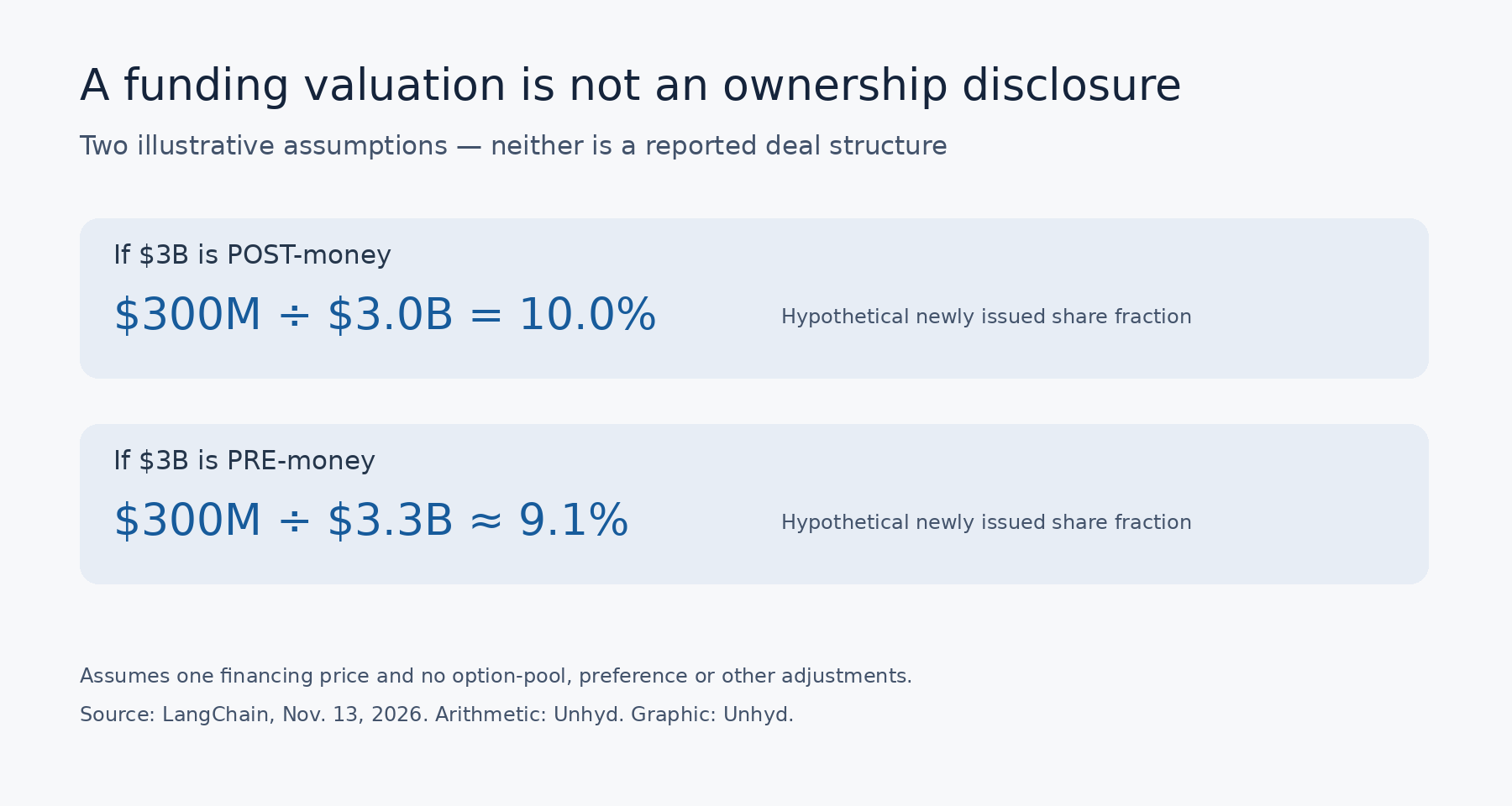
The company reports $300 million raised and a $3 billion valuation. Dividing $300 million by $3 billion gives 10%, but that is not a verified ownership percentage. If $3 billion were a post-money equity valuation, and if all $300 million bought newly issued shares at one price without other adjustments, the arithmetic would imply roughly 10% of post-money equity. The announcement alone does not establish all those assumptions. It does not disclose a cap table, liquidation preferences, debt, option-pool changes or investor rights.
Under the alternative assumption that $3 billion were a pre-money valuation, the simplified post-money value would be $3.3 billion and $300 million divided by $3.3 billion would equal approximately 9.1%. Neither scenario is a reported ownership outcome. Both are sensitivity calculations showing why valuation headlines cannot be converted directly into ownership, revenue or cash available for operations.
A financing is also not a product-quality test. Investors may be pricing future market opportunity, technical positioning, execution capacity or other factors. Without verified revenue, retention, margin and customer-outcome data, a reader cannot infer the company’s commercial efficiency from the financing amount.
The distinction between model choice and operational control
An enterprise AI agent is more than a prompt sent to a model. A deployed workflow may retrieve company records, invoke external tools, route a request, seek human approval and write changes into business systems. Each step creates questions about access, evidence, reliability and cost. LangChain’s announcement emphasizes model flexibility, control over data and infrastructure, and governance. Those are supplier claims about a platform direction, not measured guarantees for every deployment.
Model flexibility means a business may be able to change which underlying model handles a task. It does not by itself mean that the organization can move every workflow without rewriting prompts, connectors, evaluation cases, permissions or observability integrations. The migration cost is an empirical question. A buyer should test the same representative tasks with two models and compare results, traces, human interventions and total cost under consistent conditions.
Data control is similarly multidimensional. Where are inputs stored? Which service sees retrieved documents? Who can inspect traces? How long are records retained? Can an organization export them in a usable format? A contract may answer some questions; architecture and independent security testing answer others. An enterprise should not treat the phrase “own your intelligence” as a substitute for a data-flow diagram.
A five-part buyer test for agent infrastructure
First, test portability: select a realistic workflow, substitute an alternative model, and document what must change. Measure accuracy and cost against the same task set. A claim of model neutrality is stronger when a customer can reproduce it without relying on a vendor demonstration.
Second, test evidence: can a reviewer reconstruct the sources and tool calls that led to an answer or action? A fluent response is not enough when the agent handles sensitive records or customer communications. Unhyd’s existing AI agent evaluation guide explains how to score outcomes, tool trajectories and grounding separately.
Third, test authority: does the system enforce a difference between reading information, drafting an action and executing it? Human approval should be attached to the exact action, recipient and parameters, not merely to a generic summary. Unhyd’s coverage of Microsoft’s proposed agent controls provides a contrasting vendor-specific approach, while leaving actual effectiveness to be demonstrated.
Fourth, test economics: track the full cost of model calls, infrastructure, tracing, review, failures and maintenance per successfully completed task. Comparing subscription prices without accounting for rework can produce a false savings claim. Fifth, test exit: export logs, evaluation data, prompts and configurations and determine whether another team could reproduce the workflow without the original platform.
Why the control layer matters—and why its market is not yet proven
As AI systems move from generating suggestions to performing actions, the organization needs a way to define acceptable behavior, observe what happened and investigate exceptions. This is a defensible reason for agent orchestration and evaluation tools to exist. It does not establish that any particular vendor will become indispensable, or that the category’s pricing power is durable.
There is a potential tension in the business model: a platform promising customer flexibility must also offer enough differentiated functionality that customers choose to keep paying for it. An enterprise may value governance and tracing, yet still demand open export formats and the ability to change model or hosting provider. Customers should ask whether the platform reduces switching costs in practice or simply moves dependence from a model provider to an orchestration provider.
Independent reporting on the funding corroborates the broad financing announcement, but the strongest evidence for LangChain’s strategic ambitions remains the company’s own November 13 statement. Product claims, future hiring or customer examples should be treated as statements from interested parties until independently substantiated. The announcement does not provide a controlled comparison demonstrating that LangChain deployments outperform alternatives.
What to watch after the announcement
The most useful follow-up evidence would be customer-retention disclosures, independently reproducible workflow evaluations, pricing and migration documentation, export and governance capabilities, and actual enterprise outcomes. Those measures would help distinguish a growing market from a defensible business. Customers should also ask how the system behaves when tools fail, retrieved material contains hostile instructions, or an approver rejects a proposed action.
The November 13 funding is consequential because it signals investor support for the software layer around AI agents, not only the models beneath them. But the strongest conclusion is narrower than a triumphal funding headline: businesses are being offered a way to manage agent behavior across models, and they need evidence that those controls work, remain portable and justify their cost. That is the test that matters after the valuation announcement.
Sources and methodology
Primary source: LangChain’s November 13, 2026 Series C announcement. Context: The Wall Street Journal’s financing report. The 10% and 9.1% figures above are transparent hypothetical calculations, not reported equity ownership. No interviews, hands-on product tests or private financial records were obtained.