

ASML reported €11.7 billion in third-quarter sales on Wednesday, October 14, and delivered a warning that reaches well beyond its own earnings: the Dutch company's currently planned production capacity may not satisfy customers' demand for advanced chipmaking equipment in either 2027 or 2028. The ASML Q3 2026 earnings release points to a new pressure point in the AI investment boom—not the demand for chips alone, but the machinery required to manufacture them.
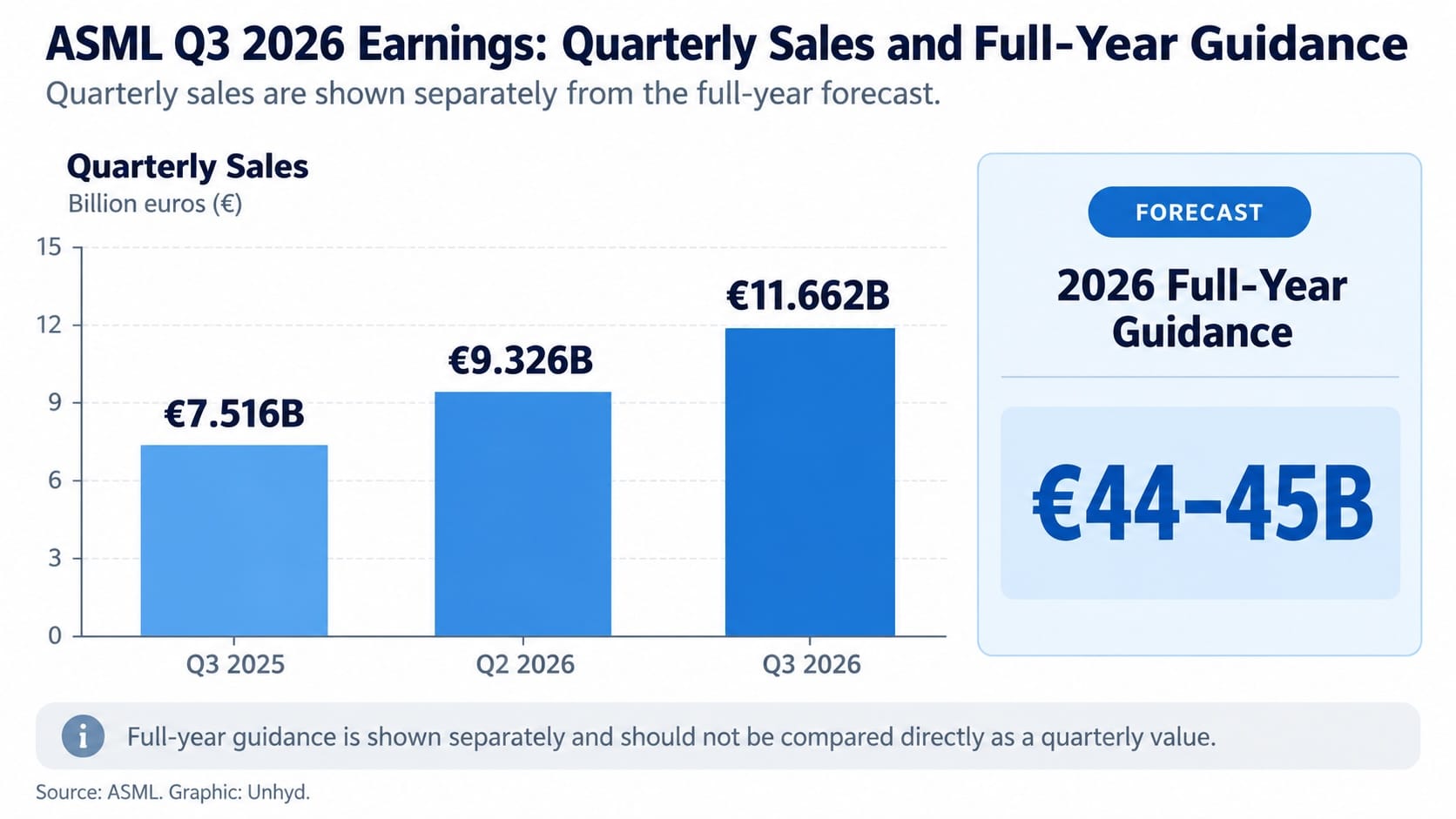
ASML said third-quarter net income reached €4.96 billion and its gross margin climbed to 57.5%. It now expects full-year 2026 sales of €44 billion to €45 billion. Chief executive Christophe Fouquet said some customers are expressing interest in placing equipment orders as far ahead as 2029 and 2030. That is a statement about the visibility of prospective demand, not confirmation that every future order has been booked or that every proposed chip factory will be built.
What ASML's Q3 2026 earnings actually show
The company's quarterly figures provide a useful way to separate what has happened from what management expects next. Net sales rose from €9.326 billion in the second quarter to €11.662 billion in the third, an increase of approximately 25% quarter over quarter. New lithography systems sold rose from 86 to 113. Installed Base Management sales—the business of servicing and upgrading equipment already in customers' factories—grew from €2.762 billion to €3.289 billion.
Those figures describe completed activity. They show stronger equipment deliveries, more revenue from existing machines and improved profitability. They do not, on their own, establish how many machines will be delivered two years from now. The distinction matters because today's revenue is a historical result; tomorrow's capacity depends on manufacturing schedules, suppliers, customers and construction projects that can change.
For perspective, ASML reported €7.516 billion in sales and €2.125 billion in net income for the same quarter of 2025. Comparing those figures with the latest results gives roughly 55% year-over-year sales growth, while quarterly net income more than doubled. Both comparisons come from ASML's 2025 report and its new release, rather than a third-party forecast.
Why one equipment maker matters to the AI chip supply chain
ASML does not design the AI models people use, and it does not manufacture the finished processors sold by chip designers. Its role comes earlier. Lithography equipment helps semiconductor manufacturers project intricate patterns onto silicon wafers, enabling the transistors and connections that make modern chips possible. ASML is the only commercial supplier of extreme ultraviolet, or EUV, lithography systems used for some of the most advanced manufacturing steps.
That position makes ASML an unusually revealing vantage point. Demand for a new accelerator eventually becomes demand for fabrication capacity; additional fabrication capacity can require more lithography tools. But the relationship is not one-for-one. Chipmakers can improve yields, change product mixes, add shifts, upgrade existing systems or delay factory projects. A large order pipeline therefore signals expectations about future production, not a precise forecast of chip availability.
There is another less obvious point in the earnings release. ASML's €3.289 billion in Installed Base Management sales was not a side note. Upgrades to equipment already in operation can help customers obtain more output without waiting for an entirely new machine. That matters when new-tool capacity is constrained: improving the productivity of an installed system may be faster than expanding the physical fleet.
The 2027 and 2028 warning is about planned capacity
Fouquet said the company's currently planned supply for 2027 and 2028 would not fully meet customers' demand as ASML now understands it. Management is investigating how to increase capacity for 2028 beyond a previously communicated 30% expansion. These are forward-looking assessments made by the company, not independent measurements of a global shortage that has already occurred.
The timing is important. Manufacturing highly specialized lithography systems requires precision components, engineering expertise and coordination across suppliers. Even if buyers want more machines, production cannot necessarily accelerate at the pace of a software launch. ASML's warning suggests that equipment availability could become a constraint for chipmakers trying to convert ambitious AI investment plans into working fabrication lines.
It also complicates a simple story in which more spending automatically creates more compute. Unhyd's reporting on Microsoft's Maia 300 infrastructure plan describes demand from a company designing its own AI accelerators. ASML's results illuminate a different layer: the manufacturing tools needed by foundries and other chip producers. More chip designs do not immediately mean more physical manufacturing capacity.
What the new guidance says—and what it does not
ASML expects fourth-quarter sales of €14.2 billion to €15.2 billion and a gross margin of approximately 57%. Its full-year sales outlook of €44 billion to €45 billion implies a strong finish to 2026, but the range is guidance, not revenue already earned. The company's results are also not a comprehensive measure of worldwide AI spending: lithography systems serve many kinds of semiconductors, including devices that have little to do with generative AI.
Independent coverage of the results has emphasized the same capacity tension. The Financial Times reported that customers are seeking equipment further into the future as AI-driven semiconductor investment accelerates. Such reporting provides outside context, while the exact quarterly figures and management outlook remain attributable to ASML.
Investors should also avoid confusing revenue growth with an unconstrained business. Higher demand can strain suppliers and delivery schedules; expanding production can require capital and personnel; and orders may be rescheduled if customers revise their plans. None of these uncertainties negates the reported quarter. They define the questions that remain after an exceptionally strong set of results.
Why this matters beyond ASML's share price
The AI infrastructure story is often told through the sales of chips and servers. Unhyd's earlier analysis of NVIDIA's infrastructure earnings examined one end of that spending cycle. ASML sits nearer its manufacturing foundation, where the ability to increase supply is measured in factories, components and equipment throughput rather than in new product announcements.
For businesses buying AI services, the implication is indirect but important. If production capacity cannot expand as quickly as demand, hardware costs and deployment schedules may remain under pressure. That does not establish what any particular cloud service will charge or how long a specific model will take to run. It does suggest that the physical limits of semiconductor manufacturing deserve as much attention as headline AI benchmarks.
The next evidence to watch is concrete: ASML's future machine shipments, installed-base upgrade sales, any revised capacity plan for 2028, and customers' actual capital spending. Today's announcement shows a company delivering more equipment and anticipating still greater demand. Whether the industry can translate those expectations into sufficient chipmaking capacity is the question its earnings leave open.