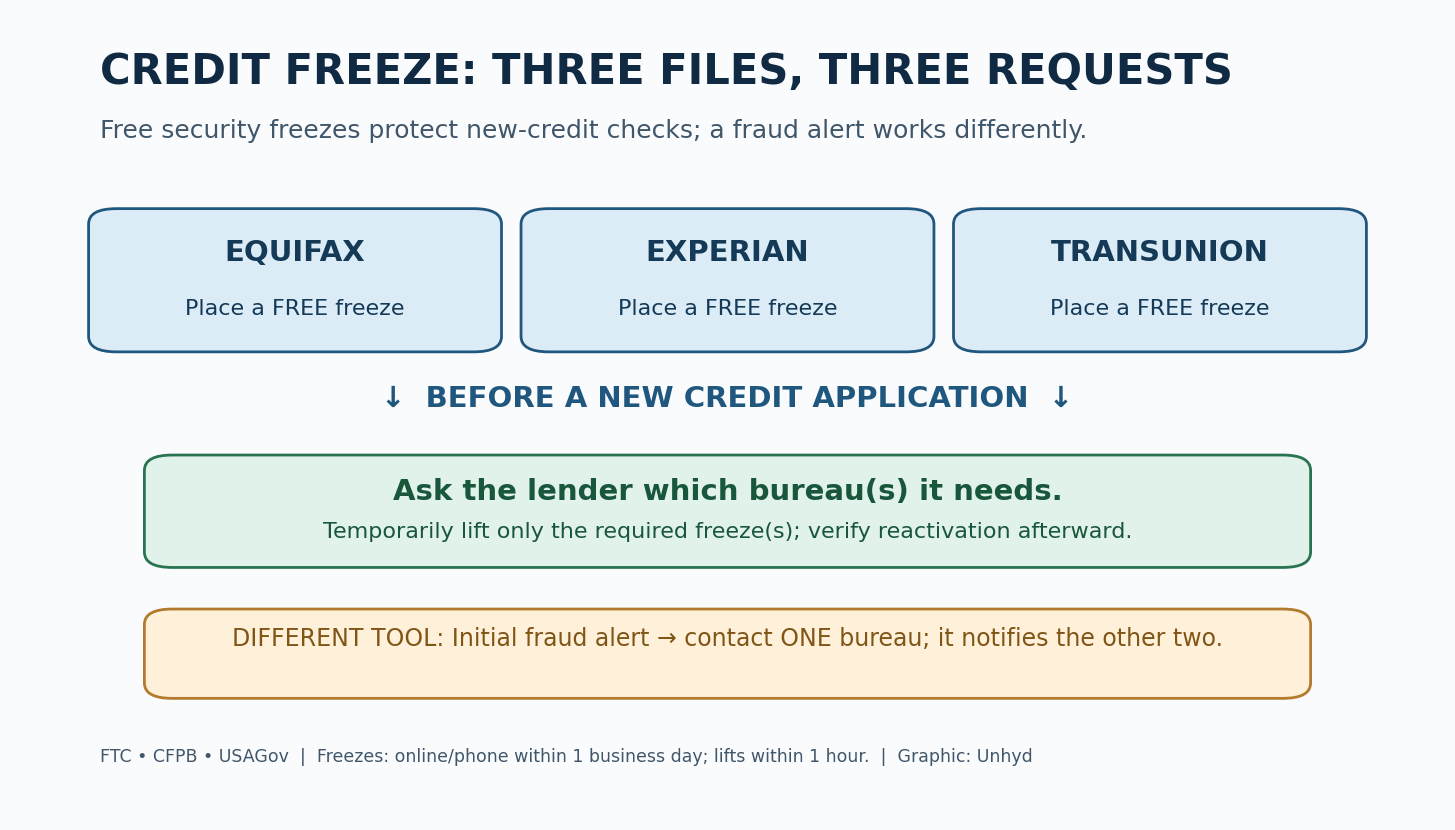
Learning how to freeze your credit for free starts with one detail that is easy to miss: there is no single switch that freezes all three nationwide credit reports. You must request a security freeze separately from Equifax, Experian and TransUnion. The freeze is free under federal law, can stay in place until you lift it and does not lower your credit score. It is useful protection against many fraudulent new-credit applications, but it is not a substitute for monitoring existing accounts.
The Federal Trade Commission and Consumer Financial Protection Bureau explain the legal protections. The practical challenge is knowing which action to take now, what to save afterward, and how to reopen access briefly when a legitimate lender needs to check your file.
How to freeze your credit for free at all three bureaus
Use the official security-freeze service of each nationwide bureau. You may be asked to create a free account or verify your identity. Keep your name, date of birth, current address and other identifying details available, but enter them only on the bureau's genuine website or through a phone number independently confirmed on its official site. Avoid links in unexpected texts or emails claiming to be a credit bureau.
- Equifax: Start with Equifax's security-freeze page or its myEquifax service. Choose the free security freeze, not an unrelated paid monitoring offer.
- Experian: Use Experian's official freeze service and follow the current instructions to place a free freeze on the Experian file.
- TransUnion: Use the TransUnion Service Center to add a freeze to that bureau's file. TransUnion explicitly states that freezing there does not freeze the other bureaus.
Confirm the status at each bureau and save the confirmation or reference number along with the account-recovery method. A password manager can help you retain separate login details. You do not need to buy a credit-lock subscription to obtain the legal protection of a free security freeze.
Official interfaces change. If a menu label in an older tutorial differs from what you see, locate the bureau's current “security freeze” section rather than clicking a payment prompt. The USAGov guide also provides an independent government route to the three bureaus.
What a freeze blocks—and the important things it does not
A security freeze restricts access to a credit file by prospective creditors. That can stop an identity thief from obtaining a new credit card or loan when a lender needs the frozen report to approve it. It can also interrupt your own legitimate application until you lift the relevant freeze. It does not close your existing credit cards, erase debt, remove negative credit information or guarantee that no one can misuse your identity.
Existing creditors and certain other entities may still access a frozen report under legal exceptions. The CFPB also explains that the federal security-freeze requirement does not apply in the same way to employment, tenant-screening or insurance report requests. Ask the organization conducting a check what information it needs instead of assuming a freeze will block every type of screening.
A freeze does not stop someone who already has access to an existing account from making unauthorized transactions. If you suspect account takeover, contact the institution, review activity and strengthen the sign-in and recovery process. Unhyd's SIM-swapping prevention guide addresses a different attack path involving mobile numbers and account recovery.
How quickly must a bureau freeze or unfreeze your report?
Under the federal rules summarized by the CFPB and USAGov, a nationwide bureau must place a requested freeze within one business day after receiving a request by secure electronic means or telephone. For requests by mail, the deadline is three business days after receipt. The bureau must send confirmation and explain how to remove the freeze.
When you request a lift or removal online or by telephone, the bureau must act within one hour. For mailed lift requests, the deadline is three business days after receipt. Those are legal maximum processing periods, not promises that every lender's own systems will update at the exact same moment. Allow a practical buffer before a time-sensitive application.
A freeze stays in place until you remove or temporarily lift it. It does not expire automatically after a year. This differs from an initial fraud alert, which generally lasts one year unless renewed.
How to temporarily lift a freeze before applying for credit
Before applying for a mortgage, car loan, credit card or another product that may require a credit report, ask the lender which bureau or bureaus it expects to use. If the lender can identify one, the FTC says you can temporarily lift that bureau's freeze rather than automatically lifting all three. If the lender uses more than one, lift the necessary files.
Sign in to the relevant bureau's official freeze service, choose a temporary lift if offered, and select dates that cover the application and any expected follow-up checks. Confirm that the lift is active, then submit the application. Keep the confirmation and verify that the freeze is back in place after the window ends.
If you cannot determine which bureau will be used, ask the lender directly. Do not assume every lender pulls the same report. A temporary lift is generally preferable to permanently removing the freeze when the access need is short-lived, because it provides a clear return to protection.
Credit freeze, fraud alert and credit lock: choose the right action
These terms are often used together, but they do different things. A security freeze restricts access to your credit file for many new-credit checks. You must contact all three bureaus separately for broad coverage. A fraud alert tells creditors to take additional steps to verify identity before granting credit; it does not block access to the report. For an initial fraud alert, you contact one nationwide bureau, which must notify the other two.
A credit lock is a bureau product or feature, sometimes bundled with paid monitoring. The CFPB says locks are no more effective than free security freezes for the purpose of controlling credit-file access. Product features and pricing can change, so the relevant consumer decision is whether a paid feature provides something genuinely useful beyond the free statutory freeze.
Someone who suspects identity theft may choose a freeze and a fraud alert together. The FTC says an initial alert is available to people who believe they may be victims; an extended alert has additional documentation requirements and lasts seven years. The choice depends on whether the priority is preventing a new credit check, prompting identity verification, or responding to an already documented incident.
Should you freeze a child's credit?
Children can be targets of identity theft even if they have never applied for credit. Federal law provides a protected-consumer freeze for children under 16 and certain people under guardianship. If a child has no credit file, the bureau can create a protected record for the purpose of freezing it. This is different from opening a credit account in the child's name.
A parent or legal guardian should consult each bureau's protected-consumer instructions because identity and guardianship documents may be required, and online self-service options may differ from adult freezes. TransUnion's protected-consumer guidance, for example, describes a mail-based process. Do not send original identity documents unless an official process expressly requires them.
If you discover an unfamiliar account in a child's name, a freeze is only one part of the response. Use IdentityTheft.gov for an identity-theft recovery plan and contact the reporting companies and affected institutions.
Does a credit freeze hurt your credit score or stop report checks?
No. The CFPB and FTC state that a security freeze does not affect credit scores. It also does not prevent you from requesting or reviewing your own credit reports. You can check for unfamiliar accounts, incorrect addresses or other suspicious entries while a freeze is active.
To review the reports themselves, use the government-linked AnnualCreditReport.com service rather than paying an unfamiliar site that promises a “free report.” Reviewing your reports helps detect problems a freeze cannot repair. If you find inaccurate information, follow the bureau's dispute process and contact the lender or collector as appropriate.
For stronger account security, consider phishing-resistant sign-in on your email and financial accounts. Unhyd's passkey setup guide explains how to create and recover supported credentials. A passkey and a credit freeze address different risks; one does not replace the other.
A practical checklist for a freeze you can manage later
- Place a free security freeze at Equifax, Experian and TransUnion, using official channels.
- Record the status, confirmation and recovery method for each bureau in a secure place.
- Continue checking existing financial accounts and credit reports; a freeze is not fraud monitoring.
- Before applying for credit, ask the lender which bureau it will check and request a time-limited lift where possible.
- Confirm that the freeze is active again afterward; if identity theft has already occurred, use the FTC's recovery resources as well.
The key distinction is between protecting the report and managing access. A free freeze can make fraudulent new-credit applications harder, but it works best when all three files are covered and you know how to lift only the access a legitimate lender needs. The goal is not to make credit impossible to use; it is to make unauthorized use more difficult without paying for protection federal law already provides.