

Improving the quality of drinking water at home does not necessarily mean installing an elaborate filtration system. For people living in apartments, renting their homes, or simply looking to avoid plumbing modifications, countertop water purifiers offer another option.
The challenge is determining whether the convenience justifies the cost.
The RKIN Zero Installation Purifier is a four-stage countertop reverse osmosis water filter designed to treat tap water without connecting to a faucet or household plumbing. Users fill a removable reservoir, plug the machine into an electrical outlet, and activate the filtration cycle.
Its principal attraction is straightforward: access to reverse osmosis filtration without permanent installation.
But understanding its value requires looking beyond convenience to filtration performance, maintenance expenses, water efficiency, and how much purified water a household actually needs.
Why Consider Reverse Osmosis Instead of a Regular Water Filter?
Water filtration systems use different technologies, and their effectiveness depends on which contaminants they are designed and tested to reduce.
Basic pitcher filters commonly use activated carbon to improve taste and odor. Some also use additional filtration media and hold certifications for specific contaminants. Performance varies considerably between models.
Reverse osmosis takes a different approach.
An RO system uses pressure to move water through a semipermeable membrane, separating water from many dissolved substances and other impurities.
The technology can be particularly relevant for households concerned about certain metals, fluoride, and persistent chemicals such as PFAS, depending on the filter's verified performance.
The Environmental Protection Agency identifies reverse osmosis as one of several technologies capable of reducing PFAS in drinking water. The agency also emphasizes the importance of choosing filters certified for the particular contaminants a consumer wants to address.
This distinction matters because no water filter should be assumed to remove every possible contaminant simply because it uses advanced technology.
What Makes RKIN's Countertop System Different?
A closer look at the RKIN Zero Installation Purifier and its countertop design. Video: Unhyd.
Traditional under-sink reverse osmosis systems connect directly to household plumbing and typically deliver filtered water through a dedicated faucet.
RKIN eliminates that installation requirement.
Its Zero Installation Purifier operates as a standalone countertop appliance. According to the manufacturer, users fill the lower reservoir with approximately one gallon of tap water and press a button to begin filtration.
A typical cycle produces approximately half a gallon of purified water in about 15 minutes, although processing time can vary with water conditions and filter age.
The machine automatically stops when the cycle is complete.
For renters and households that cannot easily modify existing plumbing, that convenience is an important benefit.
The unit measures approximately 9.5 inches wide, 14.5 inches deep, and 16.25 inches tall. Its front-access design reduces the need for additional clearance above or beside the appliance, although buyers should still measure their available countertop space.
It comes in silver white and space black, with two filtration configurations offering different approaches to the finished water.
How RKIN's Four-Stage Filtration System Works
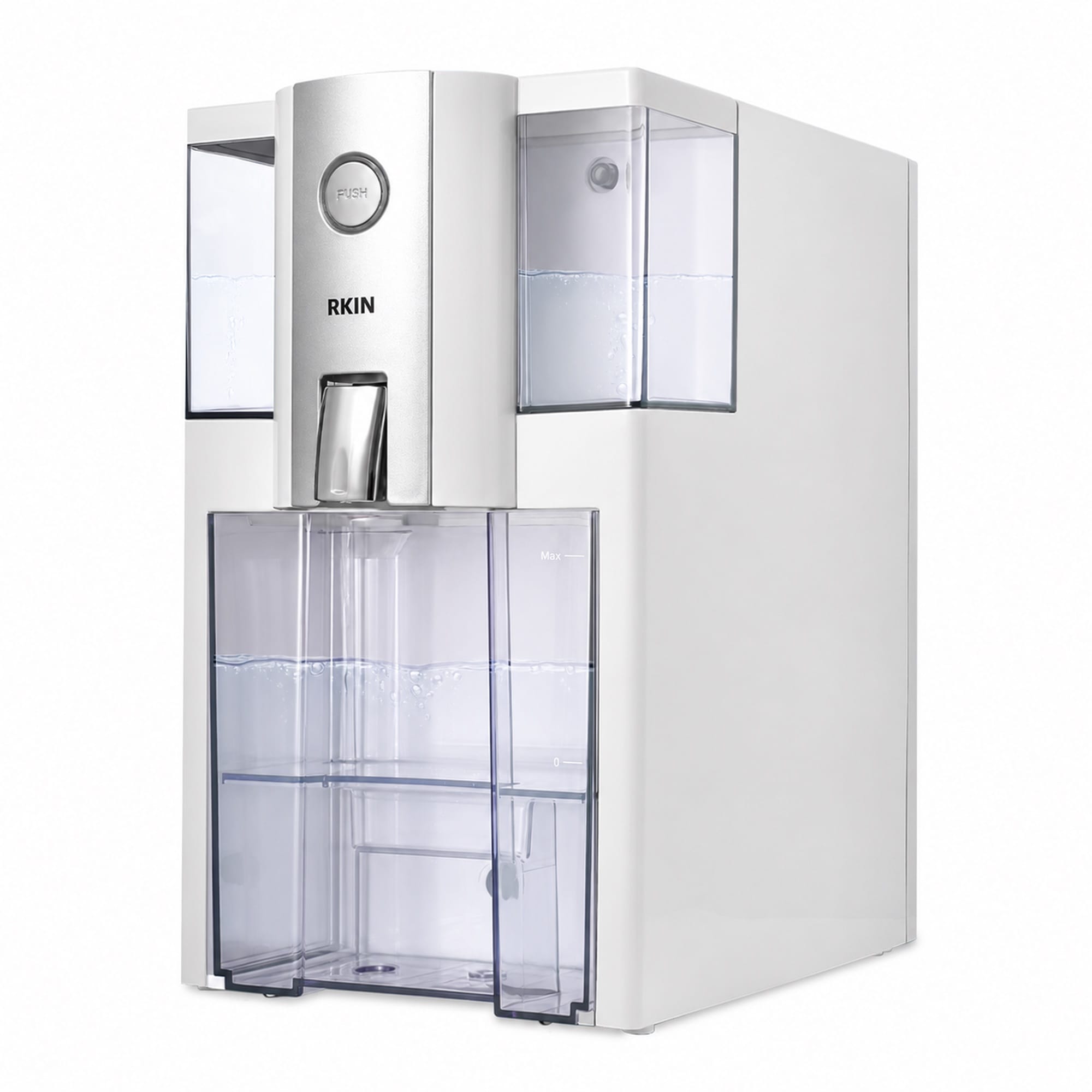
The Zero Installation Purifier combines four treatment stages.
The first is a 5-micron sediment filter designed to capture suspended particles such as dirt and rust.
Next, a coconut-based activated carbon block helps reduce certain impurities, including compounds responsible for unwanted tastes and odors.
The third stage uses a reverse osmosis membrane to separate water from many dissolved contaminants.
The final stage depends on the configuration selected.
AlcaPure uses a post-filter that adds small amounts of calcium and magnesium back into the treated water. RKIN says this produces water with a pH of approximately 7 to 8.
OnliPure uses an ion-exchange post-filter intended to reduce remaining dissolved solids to very low levels.
Neither configuration is automatically the better choice for every household. The distinction is primarily about water composition and personal preference, rather than an established health advantage from alkaline water or a near-zero total dissolved solids reading.
What Do the Filtration Tests Actually Show?
A significant consideration when buying a water purifier is whether the manufacturer's reduction claims are supported by testing.
RKIN states that its Zero Installation Purifier is certified by IAPMO R&T to NSF/ANSI 58 for the reduction of total dissolved solids, fluoride, lead, and hexavalent and trivalent chromium.
NSF/ANSI 58 is a standard addressing reverse osmosis drinking water treatment systems. Certification claims should always be checked against the particular contaminants covered rather than interpreted as universal purification guarantees.
RKIN also publishes laboratory reports for lead and two PFAS chemicals: PFOA and PFOS.
In the company's published testing, lead reductions exceeded 99% under the reported laboratory conditions. Testing for PFOA and PFOS also demonstrated substantial reductions, although results varied by compound and test conditions.
These findings provide useful evidence of performance, but they do not establish that the purifier removes 99% of every contaminant.
For example, reverse osmosis membranes can act as barriers to particles such as microplastics, but a specific microplastic reduction percentage for this RKIN model should not be assumed without corresponding product-specific testing.
Consumers can review the laboratory reports published by RKIN to examine the documented results.
How Does RKIN Compare With Other Water Filtration Options?
The most appropriate filtration system depends on the problem a household wants to solve.
A basic pitcher filter may be sufficient for someone primarily seeking to improve the taste of otherwise compliant municipal drinking water. Pitchers generally cost less upfront and require no electricity, although their contaminant-reduction capabilities differ by model.
An under-sink reverse osmosis system can make more sense for a household that consumes substantial amounts of filtered water and prefers a plumbed-in supply rather than manually refilling a reservoir.
RKIN's countertop purifier sits between these approaches.
It provides reverse osmosis filtration without installation, but requires more hands-on attention than a permanently connected system.
That makes it particularly relevant for consumers who prioritize portability and filtration capabilities over continuous water availability.
The same principle applies to other household purification appliances: verified performance should match the specific problem a consumer wants to address. Unhyd's guide to choosing an air purifier examines why independent testing, operating costs, and everyday usability matter more than broad marketing claims.
The Costs and Maintenance Requirements Buyers Should Consider
The initial purchase price is only one part of the ownership equation.
As of November 3, 2026, RKIN listed the Zero Installation Purifier at a promotional price of $369.95. Prices and promotions may change.
Replacement cartridges create recurring expenses.
According to RKIN's product listings reviewed for this article, the AlcaPure replacement-filter kit starts at $79.95, while the OnliPure kit starts at $99.95. A replacement reverse osmosis membrane is listed separately at $74.95.
The manufacturer generally recommends replacing the sediment and carbon filters every 12 months and the reverse osmosis membrane every 24 months or as needed. The AlcaPure post-filter also has a typical 12-month replacement interval, while OnliPure replacement needs may depend on water quality and usage.
Hard water can shorten membrane life, potentially increasing ownership costs. RKIN offers an optional anti-scale prefilter for certain water conditions.
Buyers should also account for the effort involved in cleaning the reservoirs and managing the water remaining after filtration.
These requirements are not unusual for a reverse osmosis system, but they are worth evaluating alongside the convenience of avoiding permanent plumbing modifications.
The Everyday Trade-Offs: Water Waste, Dispensing and Alerts
While the RKIN Zero Installation Purifier offers a convenient approach to advanced drinking water filtration, several practical characteristics deserve closer attention, particularly for households that expect to use the machine frequently.
Water Efficiency Can Be a Significant Concern for Larger Households
One of the most important considerations is the amount of incoming water required to produce a relatively small quantity of purified drinking water.
According to RKIN, a typical filtration cycle begins with approximately one gallon (4 liters) of tap water and produces about half a gallon (2 liters) of purified water.
The company's published recovery rating is approximately 55%, meaning a substantial portion of the incoming water remains as concentrate rather than becoming purified drinking water.
The remaining water collects in the lower supply pitcher and contains a higher concentration of dissolved substances rejected during reverse osmosis filtration.
Importantly, this water cannot simply be topped up with fresh tap water and filtered again. RKIN's operating manual instructs users to completely empty the supply pitcher after each filtration cycle. The manufacturer warns that adding fresh water to the remaining concentrate can reduce system performance and potentially damage the reverse osmosis membrane and filters.
For a family of four or more, especially an active household with substantial daily drinking water needs, the implications become more noticeable.
For example, producing approximately two gallons of purified water could require around four filtration cycles and roughly four gallons of incoming tap water. Under the manufacturer's approximate recovery figures, that process would leave close to two gallons of concentrated water that must be removed from the supply pitcher.
Some of that remaining water might be reusable for suitable non-drinking purposes, depending on its composition and the intended use. However, because the concentrate contains substances rejected by the filter, consumers should not automatically assume it is suitable for drinking, cooking, pets, or watering sensitive plants.
Where practical reuse is not possible, the water must be discarded.
For households that use substantial quantities of filtered water, this creates both an ongoing inconvenience and a water-conservation concern.
Water rejection is a normal part of reverse osmosis treatment, but recovery rates differ among systems. Consumers concerned about conservation should compare independently documented water efficiency alongside contaminant-reduction performance before purchasing.
The Dispenser Requires Manual Operation
Another practical consideration is how the purified water is dispensed.
Unlike appliances that use automatic or touchless dispensing, the RKIN purifier relies on a manually operated dispenser handle.
Users can push the handle inward to release water or pull it outward to keep the flow open. According to the manufacturer's instructions, pulling the handle outward allows it to remain in the open position without continuous pressure.
This mechanism is straightforward and does not require complex controls, but it may feel less convenient to consumers accustomed to automatic dispensing.
The distinction is worth understanding before purchase, especially for households that frequently fill water bottles, pitchers, or multiple drinking glasses throughout the day.
Flashing Lights and Audible Alerts May Be Distracting
The purifier also uses an illuminated status indicator to communicate different operating conditions.
During filtration, a blue LED flashes continuously until the cycle is completed. The manual confirms this flashing pattern as the normal indication that filtration is in progress.
Although useful for monitoring the machine's status, the bright, repeated flashing can be visually distracting depending on the appliance's location, particularly in open-plan kitchens, smaller apartments, or nearby workspaces.
Another noticeable characteristic is the audible beep at the end of a filtration cycle. Depending on the surrounding environment, the alert may seem loud or disruptive.
Perceptions of brightness and sound are subjective, and these observations should not be confused with measured light output or sound levels.
Neither issue changes the purifier's ability to filter water. Nevertheless, they are relevant to the overall ownership experience, especially for consumers who prefer unobtrusive appliances.
Together, the water-handling requirements, manual dispensing, and operating alerts illustrate an important distinction: a machine can perform its primary filtration function effectively while still introducing everyday inconveniences that influence whether it is the right choice for a particular household.
Who Is the RKIN Zero Installation Purifier Best Suited For?
The purifier is worth considering for apartment residents, renters, and households that want reverse osmosis filtration without modifying their plumbing.
It may also suit individuals or couples who prepare relatively modest amounts of drinking water throughout the day and are comfortable refilling a reservoir.
Its portability and relatively compact design are additional advantages for consumers who cannot accommodate a permanently installed filtration system.
However, there are situations where a different solution may be more practical.
Large or active households may find the repeated filtration cycles, reservoir refilling, and removal of concentrated water inconvenient, especially when multiple family members consume substantial quantities of drinking water daily.
Consumers who prefer automatic dispensing or are sensitive to prominent appliance lights and audible alerts should also consider these characteristics before purchasing.
Households whose principal concern is chlorine taste or odor may find that a certified carbon filter meets their needs at a lower cost.
And anyone purchasing a water filter to address a specific contaminant should verify that the product has been independently tested or certified for that particular reduction claim.
The first step should be understanding what is actually present in the water.
For customers of public water systems, an annual Consumer Confidence Report provides information about the local water supply. The EPA explains how to obtain and understand these reports.
The Bottom Line
The RKIN Zero Installation Purifier provides a convenient way to access reverse osmosis filtration without permanent plumbing modifications.
Its compact design, straightforward setup, four-stage treatment process, and documented contaminant-reduction testing make it an option worth considering, particularly for renters and smaller households.
However, convenience comes with trade-offs.
The amount of water remaining after each filtration cycle is arguably the most important practical consideration, particularly for larger households. Frequent refilling requirements, manual dispensing, recurring filter expenses, and noticeable operating alerts also deserve attention.
For individuals or smaller households that prioritize portability and installation-free water treatment, those compromises may be acceptable.
For larger or more active families, the relatively small output per cycle and associated water consumption may make a higher-capacity or more water-efficient filtration system a better long-term choice.
Ultimately, the right water purifier should be evaluated not only on the contaminants it can reduce, but also on its water efficiency, ongoing costs, daily convenience, and suitability for the people who will use it.
RKIN's Zero Installation Purifier offers a useful solution to the installation challenges associated with conventional reverse osmosis systems. Whether it represents the best purchase depends on how well those benefits align with a household's actual needs and priorities.
About Examined
Examined is Unhyd's in-depth editorial series exploring products, companies, people, and ideas through research, reporting, and independent analysis. Inclusion in Examined does not constitute an endorsement.