
Palantir earnings for the third quarter of 2026 offer two sharply different signals about the enterprise artificial intelligence boom. The software company reported 96% year-over-year revenue growth, and its U.S. commercial business outsold its U.S. government business for the first time. But the growth rate of new U.S. commercial contract value slowed substantially from the preceding quarter.
Those developments are not contradictory. Revenue measures sales recognized from work delivered; total contract value, or TCV, represents the potential lifetime value of contracts signed in a period. Understanding what each measures is more useful than treating one headline figure as definitive proof of either accelerating or fading AI demand.
What the Palantir earnings actually show
In its November 2 earnings release furnished to the SEC, Palantir reported $2.313 billion in total third-quarter revenue, up 96% from a year earlier. The results cover the three months ended September 30, 2026, and were announced after U.S. markets closed.
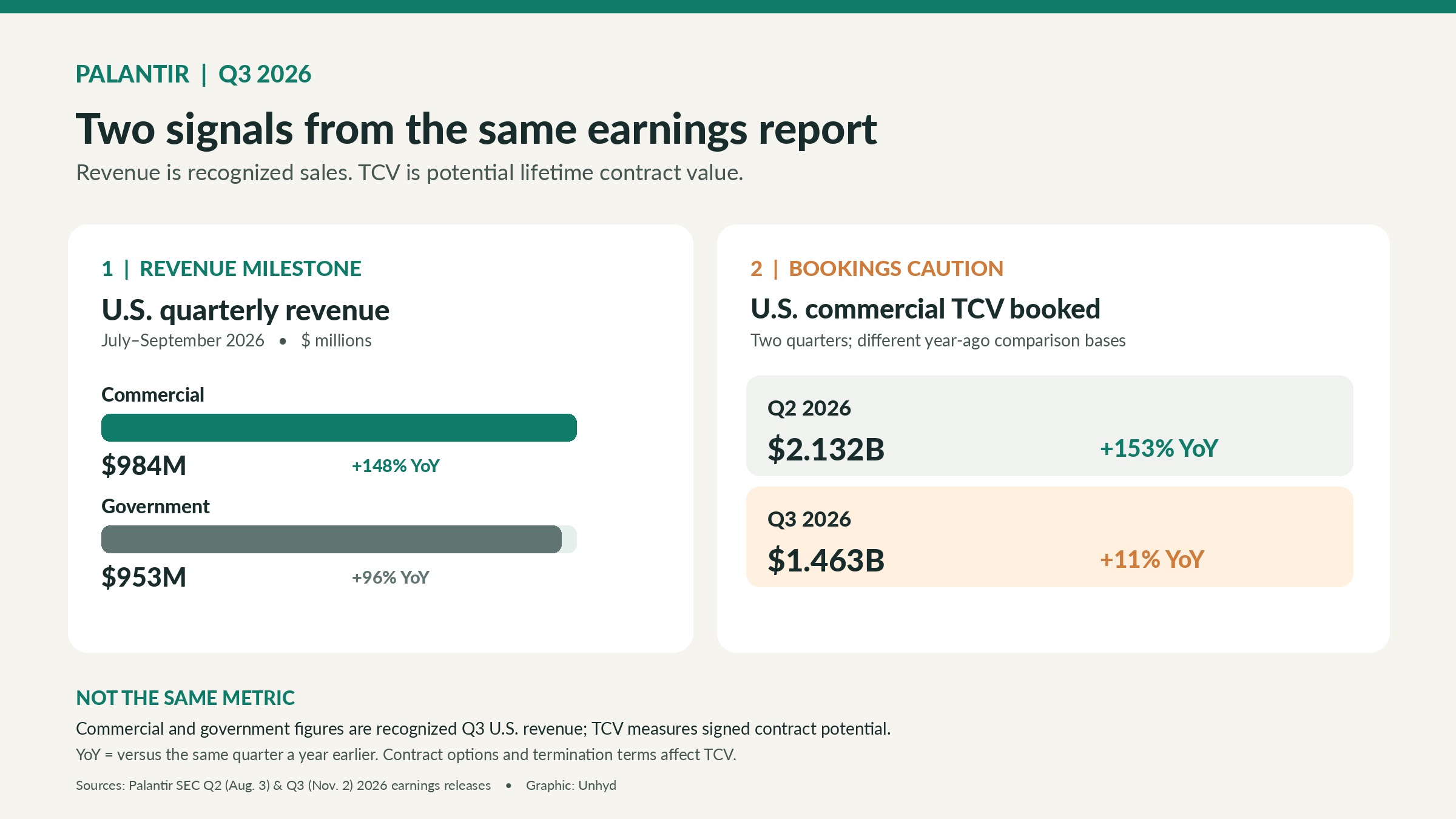
U.S. commercial revenue rose 148% year over year to $984 million. U.S. government revenue grew 96% to $953 million. The $31 million difference marked the first time the company's American commercial segment exceeded its American government segment in quarterly sales. That is a meaningful shift for a business closely associated with defense and intelligence customers.
The crossover does not mean government demand is declining: U.S. government revenue also nearly doubled. Nor does it show that every commercial AI deployment has achieved measurable productivity gains. Palantir attributes strong demand to its software platforms and newer sovereign-AI offerings; the earnings release measures the company's commercial performance, not independently audited customer outcomes.
The slower bookings number behind the growth
Palantir reported $1.463 billion in U.S. commercial TCV booked during the third quarter, up 11% from the same quarter a year earlier. Its second-quarter release reported $2.132 billion in U.S. commercial TCV, up 153% year over year. Those are the same company-defined measure across two consecutive quarters, making the slowdown worth examining.
Crucially, the 153% and 11% figures compare each quarter with its own year-earlier counterpart; they are not a direct calculation of the change from the second quarter to the third. The reported dollar value of U.S. commercial bookings was also lower sequentially, but a shorter contract can have a smaller lifetime value even when its customer expects to use the software intensively.
On the company's earnings call, Chief Financial Officer Dave Glazer said Palantir had signed multiple eight-figure sovereign-AI deals that were shorter in duration than usual. Management expects customers to expand those arrangements over time. That explanation is plausible, but extensions and renewals are future events, not revenue or bookings already secured.
Independent Reuters reporting identified the slowdown in commercial bookings as a key concern for investors despite the earnings beat. The useful conclusion is narrower than either extreme: slower bookings growth is a real caution signal, while short initial contracts are one potential reason that TCV alone may not capture the entire adoption picture.
Why contract value is not the same as guaranteed revenue
Palantir's financial definitions make the distinction especially important. The company defines TCV as the total potential lifetime value of agreements entered into or awarded at signing. It generally assumes that customers exercise available options and do not terminate contracts. Yet the company acknowledges that most contracts contain termination provisions, including termination for convenience.
In other words, a dollar booked as TCV is not necessarily a dollar that will be collected, recognized as revenue or received next quarter. The figure can also move when the expected duration or size of a signed contract changes. It is an indicator of commercial activity, not a guaranteed future-income account.
The company's U.S. commercial remaining deal value reached $6.517 billion at September 30, up 79% year over year but only 4% from the preceding quarter. This provides another window into the pipeline, though Palantir says that measure too can include options and terminable agreements. Investors should not conflate it with remaining performance obligations, a more restrictive accounting category for unrecognized noncancelable contracted revenue.
How this fits the wider AI business cycle
The distinction between present performance and anticipated future returns appears elsewhere in the AI sector. Unhyd's examination of Microsoft and Alphabet separated cloud growth from the cash cost of AI infrastructure. A separate look at Amazon's AWS earnings showed why a profitable cloud division and heavy company-wide spending can coexist.
Palantir occupies a different position in that economy: it sells software designed to make data and AI models useful within customer operations. The newly reported revenue is evidence of sales momentum for Palantir. It is not, on its own, evidence that the companies buying its products will recover every implementation cost or improve profits by a specified amount.
What should readers watch next?
Three indicators can help test whether the commercial acceleration is durable. First, compare future U.S. commercial revenue with TCV bookings over several quarters rather than extrapolating a single report. Second, watch whether shorter sovereign-AI deals renew or expand, as management predicts. Third, follow remaining deal value and customer growth alongside revenue to see whether the pipeline broadens or depends on a small number of large agreements.
Palantir lifted its full-year 2026 revenue outlook to $8.530 billion–$8.534 billion and forecast fourth-quarter revenue of $2.649 billion–$2.653 billion. Those estimates are management guidance, not realized sales. They reinforce confidence in the near-term revenue trajectory but do not settle the longer-term bookings question.
The essential reading of Palantir's November 2 results is therefore two-sided. Its U.S. commercial business has reached a genuine milestone and is delivering rapid recognized revenue growth. Its slower new-contract-value growth, together with the assumptions embedded in TCV, makes the sustainability of that momentum a question worth revisiting after the next earnings release—not a question this quarter can answer definitively.