
The Marvell Lumentum deal is a $115 billion wager on a less visible constraint in artificial intelligence: moving information between chips, servers and data centers quickly enough for expanding AI systems. On November 2, Marvell and Lumentum announced an agreement for Marvell to acquire the optical-components company in an all-stock transaction. The headline valuation is an enterprise value, not a cash payment or a declaration that the merger has closed.
The proposed combination brings together Marvell's networking chips, custom processors and digital signal processing with Lumentum's lasers, optical transceivers, switching technology and specialist manufacturing. It also raises a question that goes beyond the deal price: can tighter coordination between electronic and optical components actually deliver faster, more efficient AI infrastructure at scale?
What the Marvell Lumentum deal actually buys
Under the agreement, Lumentum shareholders would receive 4.5 Marvell shares for each Lumentum share. The companies estimate an implied enterprise value of approximately $115 billion, using unaffected share prices from October 28, and say the consideration represented a roughly 23.9% premium on that basis. After completion, existing Marvell shareholders are expected to hold about 67% of the combined company, with Lumentum shareholders owning about 33%.
Those figures describe a proposed stock exchange and ownership split. The value ultimately received can change with Marvell's share price; the announcement is not evidence that $115 billion in cash is being transferred. The companies expect a closing in the first half of 2028, subject to shareholder votes, regulatory clearance and other conditions. Until then, they remain separate businesses.
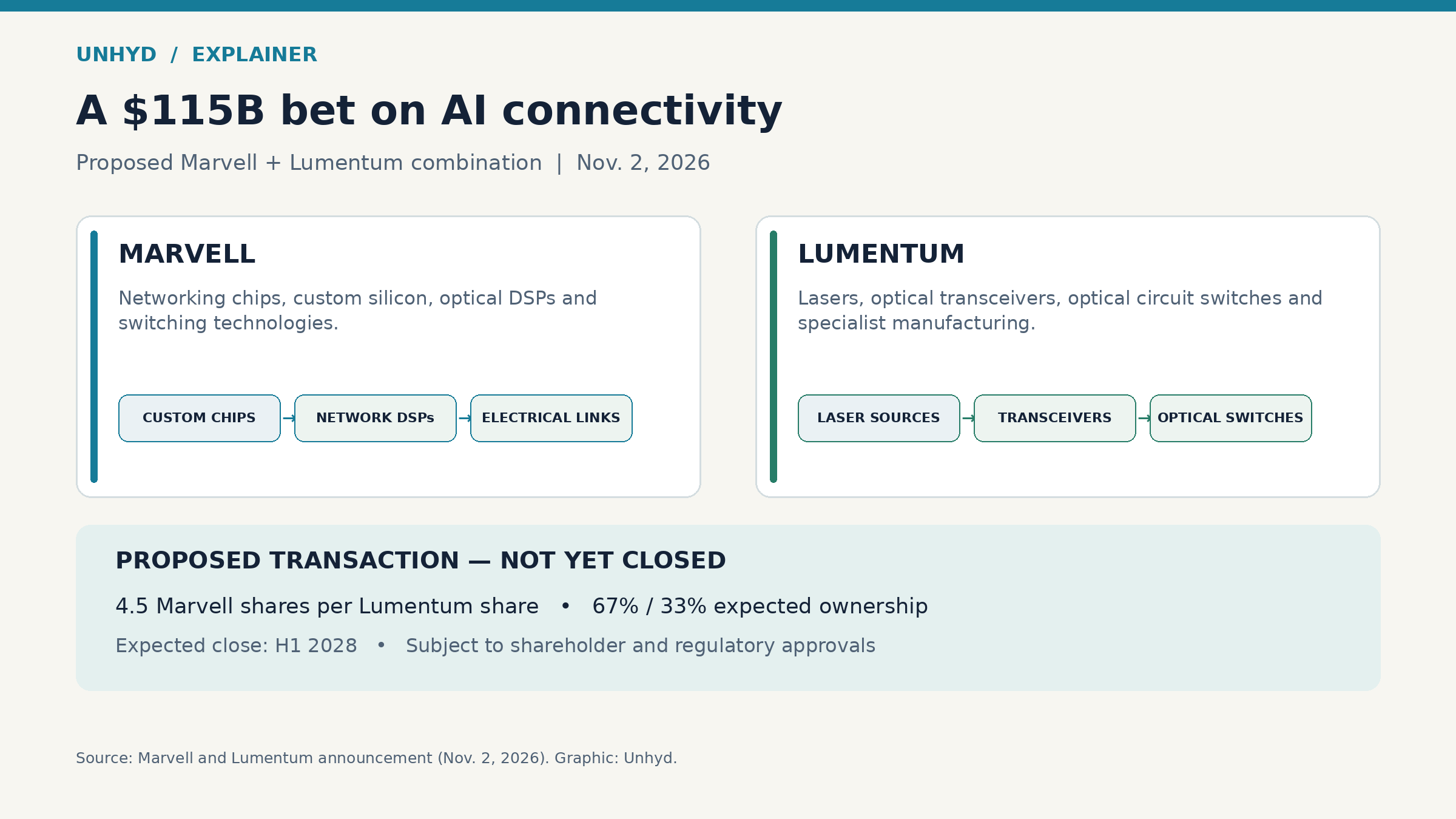
For customers building AI clusters, the strategic rationale is more technical than financial. Marvell designs circuitry that helps transmit and manage data, while Lumentum makes optical components that convert electrical signals into light, route those signals and convert them back when necessary. The companies argue that designing these elements together can reduce integration friction across the network.
Why optical links matter to AI infrastructure
A large AI system does not consist of one isolated processor. Accelerators exchange model parameters, intermediate results and other data with many neighboring devices. As clusters grow, communication delays, power consumption and cabling density can constrain how much useful work the processors accomplish.
Optical transmission can carry high-bandwidth signals over distances that make electrical copper links increasingly difficult to scale. That does not mean every copper connection will disappear. Different lengths, power budgets and architectures call for different technologies. The important design decision is where optical links offer a net improvement after accounting for transceivers, lasers, packaging and the energy needed to convert signals.
The two companies were not strangers before the proposed merger. In March 2026 they announced a joint demonstration pairing Marvell optical connectivity equipment with Lumentum's optical circuit switching platform. That earlier work is evidence of an existing technical relationship, not proof that a merged company will achieve every projected performance benefit.
Three numbers that should not be confused
The $115 billion figure describes the transaction's implied enterprise value. The companies' $550 billion figure is an estimated addressable market for their combined opportunities, not revenue already earned or a purchase commitment. Their expectation of more than $1 billion in annual run-rate cost synergies is a management projection that depends on integration and execution.
Even if the merger closes, market size is not market share. A broad market estimate does not tell investors how much equipment customers will buy, what price they will pay or what portion of demand the combined company can profitably serve. Similarly, projected cost savings can be delayed or offset by manufacturing investment, overlapping product lines and organizational complexity.
Independent Reuters reporting on November 2 framed the agreement as a major bet on data-center demand. That demand is real enough to motivate investment, but future spending is not guaranteed. Unhyd has previously examined why a proposed AI campus can encounter grid-connection obstacles even after customer plans are announced. Networking equipment demand ultimately depends on facilities actually being built and commissioned.
The manufacturing question behind the merger
Lumentum brings laser and compound-semiconductor expertise, including indium phosphide manufacturing. Those capabilities matter because optical networking is not simply software that can be deployed on existing chips. High-performance lasers, packaging, thermal management and production yields can determine whether a promising design becomes a reliable, economical component shipped in volume.
The companies say a combined portfolio would span electrical interconnects, silicon photonics, optical switching and advanced packaging. That breadth could allow customers to buy more tightly matched components. It could also make the integration process more complicated, particularly while regulators and customers assess the effects of consolidation in a strategically important supply chain.
Claims of improved energy efficiency also require careful boundaries. A link that uses less energy per transmitted bit does not necessarily reduce the total electricity use of a growing AI campus. More bandwidth can support larger clusters and greater total utilization. As Unhyd's analysis of data-center electricity forecasts explains, projected power demand depends on equipment, operating assumptions and the scale of deployment.
What would demonstrate success?
Several milestones will matter more than the merger announcement alone: completion of regulatory reviews, a clear integration plan, products that customers can qualify and purchase, and measured improvements in bandwidth, latency, reliability or power consumption under comparable conditions. Public performance benchmarks should state the hardware configuration and test boundaries rather than relying on broad efficiency claims.
The November 2 agreement is consequential because it places optical connectivity closer to the center of AI infrastructure strategy. It does not settle which architectures will win, how much of the proposed market can be captured or whether the transaction's projected savings will materialize. For readers, the distinction is between a very large commitment to a technology direction and evidence that the promised results have been delivered.