
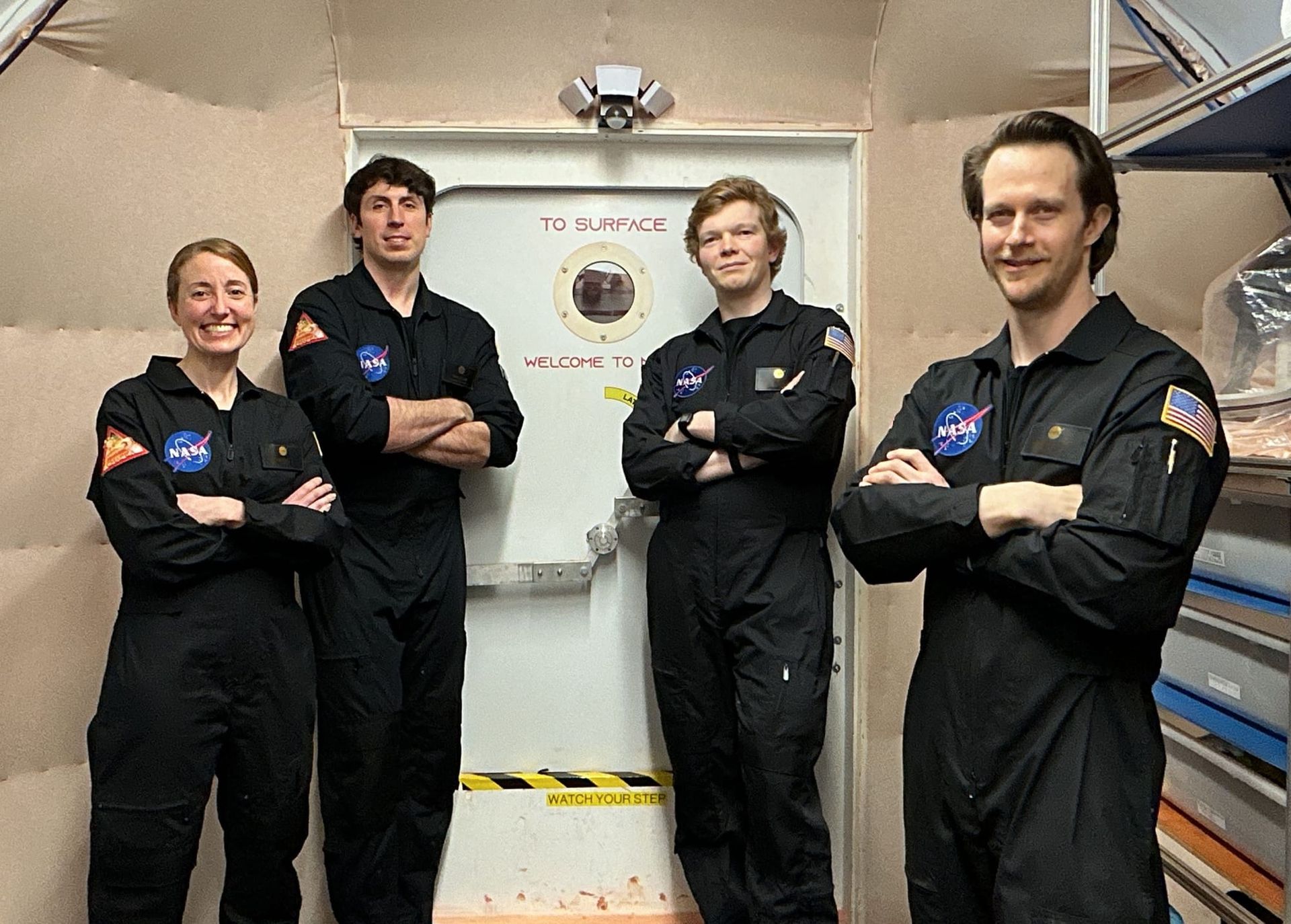
The second NASA Mars simulation has reached its visible finish: four volunteers emerged from a 3D-printed habitat in Houston on October 31 after 378 days of simulated life on the Red Planet. The mission, known as CHAPEA Mission 2, was a human-research experiment on Earth, not a journey into space. Its ending makes a compelling scene, but the most useful findings will come from examining what the crew's daily routines reveal about long-duration missions.
NASA scheduled the exit for 3 p.m. Eastern on October 31, and post-event reporting confirmed that the crew completed the stay. The agency's October 27 advisory and October 19 mission update document the setup. They do not yet provide a completed analysis of the health and performance data, and Unhyd has not independently reviewed that dataset.
What the NASA Mars simulation actually tested
Mission commander Ross Elder, medical officer Ellen Ellis, science officer Matthew Montgomery and flight engineer James Spicer entered the roughly 1,700-square-foot habitat on October 19, 2025. For more than a year, they worked within a constrained environment, carrying out simulated surface excursions, maintaining equipment, growing plants, exercising and managing limited resources. Communication with people outside the habitat was deliberately delayed to resemble the difficulty of contacting Earth from Mars.
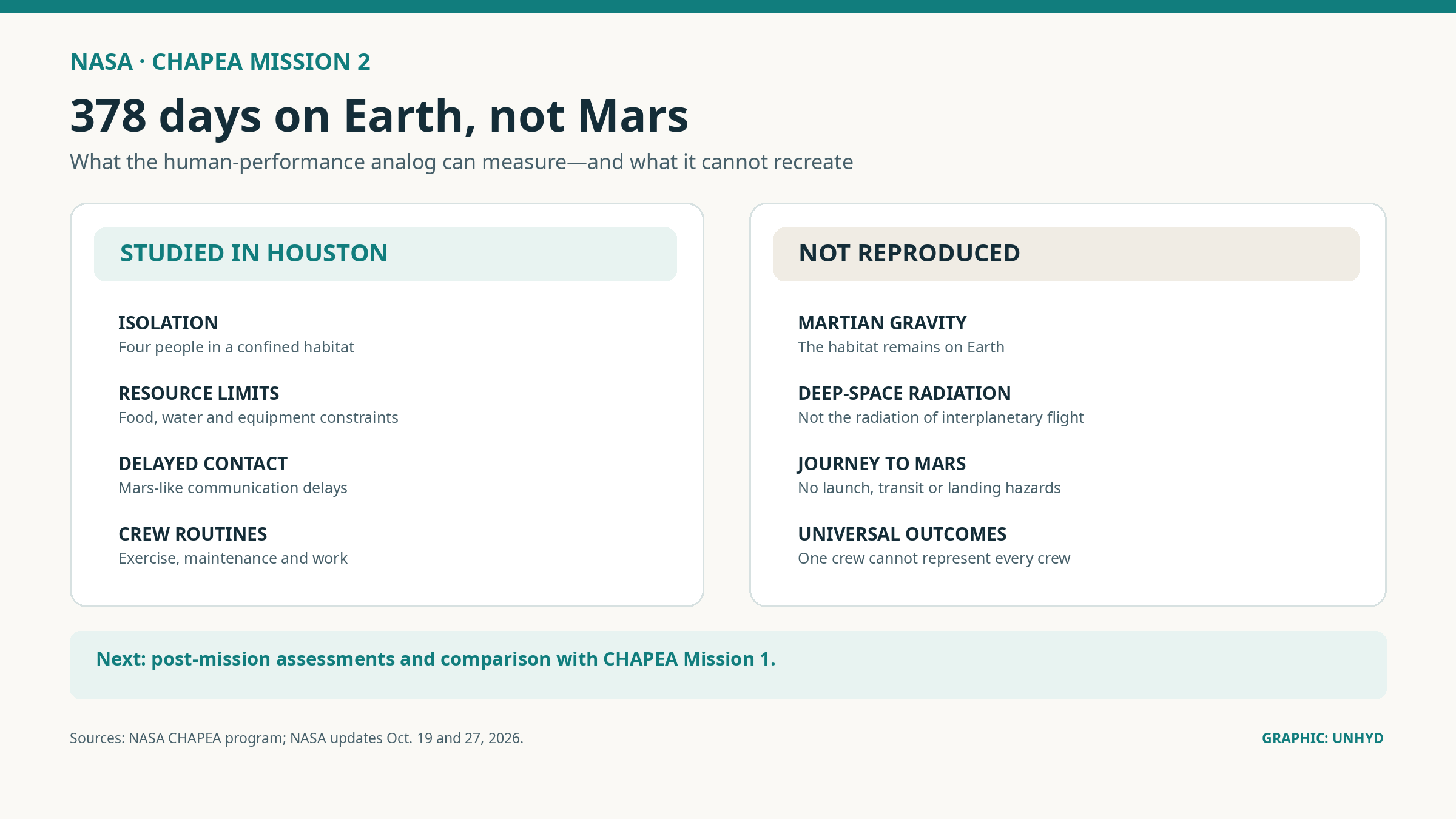
Those conditions allow NASA to study how work, food, exercise, privacy and decision-making interact over time. A habitat can contain enough supplies for a day while still creating problems when a crew must schedule meals around physically demanding tasks. A communications system can technically transmit a message while still making real-time help impractical. The research question is not simply whether four people can endure isolation; it is which operational arrangements help them remain healthy and productive.
A physical analog is not a virtual world
The word simulation can be misleading. Unhyd recently examined AI-generated interactive worlds, where the central uncertainty is whether a generated environment behaves consistently. CHAPEA is different: real people eat, sleep, work and interact inside a physical facility while researchers measure selected stressors. It is not an attempt to reproduce every aspect of Mars through visual realism.
The Houston habitat does not reproduce Martian gravity, the radiation environment of deep space or the dangers of an interplanetary launch and transit. Nor can a single small crew stand in for every possible combination of astronauts, medical needs and personalities. Those boundaries do not make the experiment meaningless; they define which conclusions researchers can reasonably draw from it.
Why the crew’s ordinary routines are the science
In an official NASA podcast released October 23, recorded before the mission ended, crew members discussed how much effort it took to meet caloric goals while conducting frequent simulated spacewalks and maintenance work. They also described the quiet of a habitat without ordinary street or weather sounds, the need to log small quantities of food and water, and the way off-duty time could be consumed by preparation for the next task.
These accounts are first-person reflections published by NASA, not interviews conducted by Unhyd. They illustrate plausible research questions but should not be treated as measured results. For example, a crew member reporting that meals were difficult to fit into the schedule is a useful observation. Establishing whether a particular food system improves performance would require the study's collected measurements, methodology and comparison across conditions.
The two-week follow-up is part of the experiment
NASA said the volunteers would undergo roughly two weeks of post-mission assessments and debriefs after leaving the habitat. The agency plans to examine end-of-mission baselines and ask about experiences that were difficult to explore during delayed communications. In the same podcast, CHAPEA principal investigator Grace Douglas explained that researchers want to compare information across multiple crews, rather than mistake one team's experience for a universal pattern.
That follow-up matters because the public ceremony is not the final scientific endpoint. Health measurements, psychological assessments and operational records need interpretation, and the process may identify questions that cannot be answered from this mission alone. The timing and publication format of any peer-reviewed results have not been established in the official material reviewed here.
Two completed crews improve comparison, not certainty
NASA's first CHAPEA mission ended in July 2024. The second mission provides another long-duration set of observations using a broadly repeatable experimental setup. Repetition can help researchers distinguish recurring operational difficulties from unusual experiences of a particular group. But a total of two four-person missions remains a limited sample, especially for rare medical events or questions that depend on crew composition.
NASA has said the information could inform future lunar and Mars exploration, including choices about food systems, crew-time allocation, delayed communications and behavioral support. Those are applications under investigation, not proof that a particular habitat design, nutrition plan or psychological intervention has been validated for a real Mars expedition.
What would count as a meaningful result
A strong next report would identify the questions NASA tested, the measures collected, how the two missions compare and which changes are being recommended for future crews. It would also distinguish findings based on quantitative measurements from experiences reported in interviews. Readers should look for transparent caveats about the small sample, Earth-based conditions and which recommendations have yet to be tested in space.
The lasting significance of CHAPEA Mission 2 is not that four people proved humanity can live on Mars. It is that NASA now has another long record of how a small team managed work and daily life under selected constraints. The door opening was the public milestone; evaluating those records is the work that could make the mission useful.