

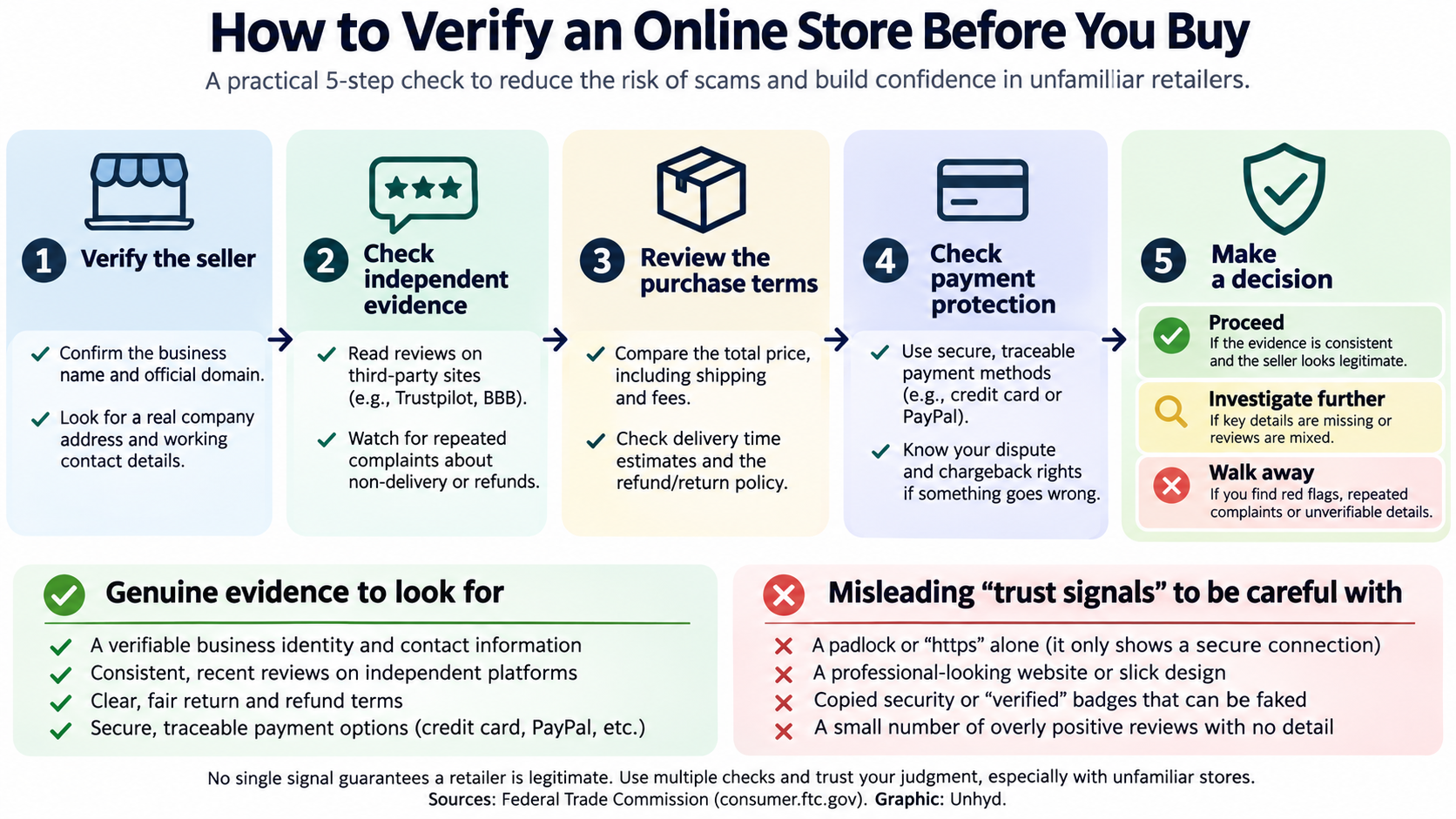
Knowing how to tell if an online store is legitimate requires more than spotting a padlock or reading a five-star review. A fraudulent storefront can have professional photography, an encrypted checkout, a convincing return policy and a familiar payment logo. Before you pay, the useful question is whether independent evidence supports the seller's identity, the transaction terms and your ability to recover money if the order goes wrong.
This guide uses a three-way decision: stop when there is a serious contradiction or unsafe payment demand; investigate when meaningful evidence is missing; and proceed cautiously when independent checks agree. It is an editorial decision aid, not a fraud-detection certification. The Federal Trade Commission's online shopping guidance supports researching sellers, checking terms, paying by credit card when possible and keeping records.
How to tell if an online store is legitimate: Verify the seller first
Find the name of the company actually taking payment, not just the storefront's marketing name. Check the contact page, checkout seller identification, shipping origin and return address. Search the business name and exact domain separately with words such as “complaint,” “refund” and “scam.” Then compare the results with the store's claims. A working phone number or attractive office address alone is not proof: a scammer can copy those details from another business.
If the store claims to be an authorized reseller, look for that relationship on the manufacturer's official website or ask the manufacturer using contact information you found independently. If it claims accreditation, follow the credential to the issuing organization's own directory. The Better Business Bureau's fake-website guidance explains how impostors copy brand names, addresses and site design.
A young business may genuinely lack extensive independent reviews. That does not prove fraud. It does mean you have less evidence, and the amount you are considering spending should influence how much uncertainty you accept.
Check the domain instead of trusting the logo
Read the actual web address. A familiar brand name in a long URL may be part of a subdomain or path controlled by someone else. Compare the registered domain with the address linked from the company's established website. Look for substituted letters, extra words and unexpected redirects. A different domain is not automatically fraudulent—some businesses use legitimate checkout providers—but its relationship to the seller should be verifiable.
Do not treat the padlock as an authenticity certificate. HTTPS encrypts data in transit; it does not verify the seller's honesty. The FTC explicitly distinguishes an encrypted connection from a legitimate seller. Conversely, a checkout that lacks secure transport is a reason not to enter payment information.
Read reviews as evidence, not a vote
Compare several independent review sources. Look for specific descriptions of products arriving, return requests being resolved and customer service responding to problems. Dates matter: a cluster of near-identical reviews can be a reason to investigate, but it is not proof that they are fake. Negative reviews can also be misleading or manipulated. The FTC advises evaluating the reviewer's history and context rather than trusting star ratings alone.
Search for the exact domain, not merely the brand name. If the store changed domains or uses a marketplace profile, check whether the reviews actually concern the same legal seller. A complaint about a different company with a similar name is not evidence against this one.
Check the item, the final price and the return policy
Match the product model, size, condition, included accessories and warranty terms to established listings. An unusually low price may reflect clearance, refurbishment, a missing accessory or a counterfeit offer. Compare the complete checkout total, including required shipping and handling charges, taxes and recurring commitments, rather than only the advertised headline price.
Read the promised dispatch and delivery dates, return window, refund method, restocking charges and who pays for return shipping. Imagine the item never arrives: can you identify the person or business to contact, and what records would you need? Under the FTC's online-shopping guidance, covered sellers generally must ship when promised or within 30 days if no time was promised, subject to the rule's details and exceptions. A missed shipping promise does not automatically establish criminal fraud, but it can trigger consumer remedies.
For electronics, compare the retailer's promises with the manufacturer's warranty and your existing protections. Unhyd's extended-warranty analysis addresses the separate question of whether extra coverage adds value. A generous warranty claim does not itself verify the seller's identity.
Use a payment method with meaningful recourse
The FTC recommends paying by credit card when possible because qualifying billing problems can be disputed under federal law. Contact your issuer promptly about an unauthorized or disputed charge; applicable procedures and deadlines matter. A payment logo on a website is not evidence that the payment service endorses the seller.
Walk away when an unfamiliar retailer insists on payment only by gift card, cryptocurrency or wire transfer. These methods can make recovery difficult. Be wary when a marketplace seller directs you to pay outside the marketplace's checkout, potentially forfeiting platform protections. The California Attorney General's consumer guidance likewise emphasizes researching sellers, checking purchase terms and using credit cards where appropriate.
Apply the stop, investigate or proceed framework
Stop when a major warning cannot be explained
Examples include a site impersonating another business, a checkout domain that contradicts the seller's identity, a demand for irreversible payment, or requests for information irrelevant to the transaction. Several attractive design features do not cancel out one serious contradiction. Do not submit card information while you are uncertain who receives it.
Investigate when the evidence is incomplete
Examples include a recently launched shop with few independent records, unclear shipping terms, an unfamiliar checkout provider or a dramatic discount without an explanation. Ask a specific question in writing, independently verify the reply and consider buying from a more established seller if the purchase is expensive or urgent. A lack of reviews alone should not be described as proof of fraud.
Proceed cautiously when independent checks align
Reasonable confidence comes from consistent identity information, credible external history, clear product and return terms, and an appropriate payment method. Even then, retain the order confirmation and screenshots of the promised delivery date. This is a risk-reduction process, not a guarantee that an order will arrive.
Different selling channels create different risks
On a major marketplace, the platform's reputation is not the same as the individual seller's reliability. Confirm who sells and ships the item, whether the marketplace handles returns and whether checkout stays on the platform. On social media, a sponsored advertisement or popular account does not independently verify a store. Navigate to the brand's official website and confirm the linked seller there.
For used electronics, the risks extend beyond payment. Device condition, ownership restrictions and activation locks may be invisible in polished photos. Unhyd's used-laptop buying guide explains those product-specific checks; they complement rather than replace seller verification.
What to do if you have already paid
Save the product page, seller identity, checkout total, promised delivery date, confirmation email, refund terms and correspondence. Contact the seller through a documented channel when appropriate. If the seller does not resolve the problem, contact your card issuer or payment provider promptly and ask about dispute procedures. Do not assume that reporting to a government agency automatically refunds your payment.
If you entered a password on a suspected impersonation site, change it on the legitimate account and anywhere you reused it. Enable stronger authentication where supported; Unhyd's passkey setup guide explains the benefits and recovery considerations. If you entered payment-card information, ask the issuer whether monitoring or replacement is appropriate.
Report suspected shopping fraud to the FTC through ReportFraud.ftc.gov. The FTC uses reports to identify patterns, but a report is not a guarantee of recovery. If the seller appears to have stolen your identity, seek guidance tailored to the information disclosed.
Five questions to answer before buying
- Who takes the payment? Can you independently identify the seller?
- Is this the real site? Does the exact domain match an independently confirmed business or partner?
- What corroborates the offer? Are product details and customer experiences consistent across credible sources?
- What happens if something goes wrong? Are delivery, returns and refunds understandable and documented?
- How can you dispute a problem? Does the payment method offer meaningful recourse?
A legitimate online store cannot prove its trustworthiness simply by looking professional. When independent evidence is missing, waiting or choosing another retailer may be the better decision. When the evidence aligns, clear transaction terms and safer payment methods help make an ordinary purchase less risky.