

The head of the International Monetary Fund has warned that AI economic risks could outweigh the technology's benefits without credible safeguards, turning a discussion of artificial intelligence into a question about jobs, investment expectations and financial stability. Kristalina Georgieva made the remarks during an October 16, 2026, discussion at the IMF–World Bank annual meetings in Bangkok, according to Reuters' reporting from the event.
The remarks matter because they connect two debates often treated separately: how powerful AI systems should be governed and how much of the global economy is becoming dependent on their promised productivity gains. The IMF's official event program confirms that the October 16 panel focused on productivity, labor markets, investment, market concentration, cybersecurity and financial stability. It was a policy discussion, not the adoption of a binding international AI rule.
What the IMF chief said about AI economic risks
Georgieva argued for safeguards that combine action by the technology industry with involvement from governments, Reuters reported. Her central concern was not that AI has no economic value. It was that an increasingly important source of investment and optimism could also create shocks if productivity improvements arrive more slowly or unevenly than markets and businesses expect.
The panel included Anthropic co-founder Jack Clark and other policy and economic voices. Participants discussed the tension between rapid innovation and the institutions needed to manage its consequences. Those comments were made at an event about AI's economic future; they should not be mistaken for an IMF estimate that the technology will produce a particular loss or recession.
There is a meaningful distinction between a warning and a forecast. A warning identifies conditions under which harm could occur. A forecast assigns an expected path to economic variables under stated assumptions. The remarks reported from Bangkok belong primarily in the first category: a call to manage downside scenarios while preserving the possibility of productivity gains.
The financial-stability backdrop is more specific
Earlier in the week, the IMF published its October 2026 Global Financial Stability Report, titled Resilience, Risk, and Transformation. The report identifies a potential correction in AI-related asset prices as one risk to otherwise resilient markets, particularly if earnings or investment expectations disappoint. It also highlights sovereign bond yields and cyber incidents as possible sources of broader market stress.
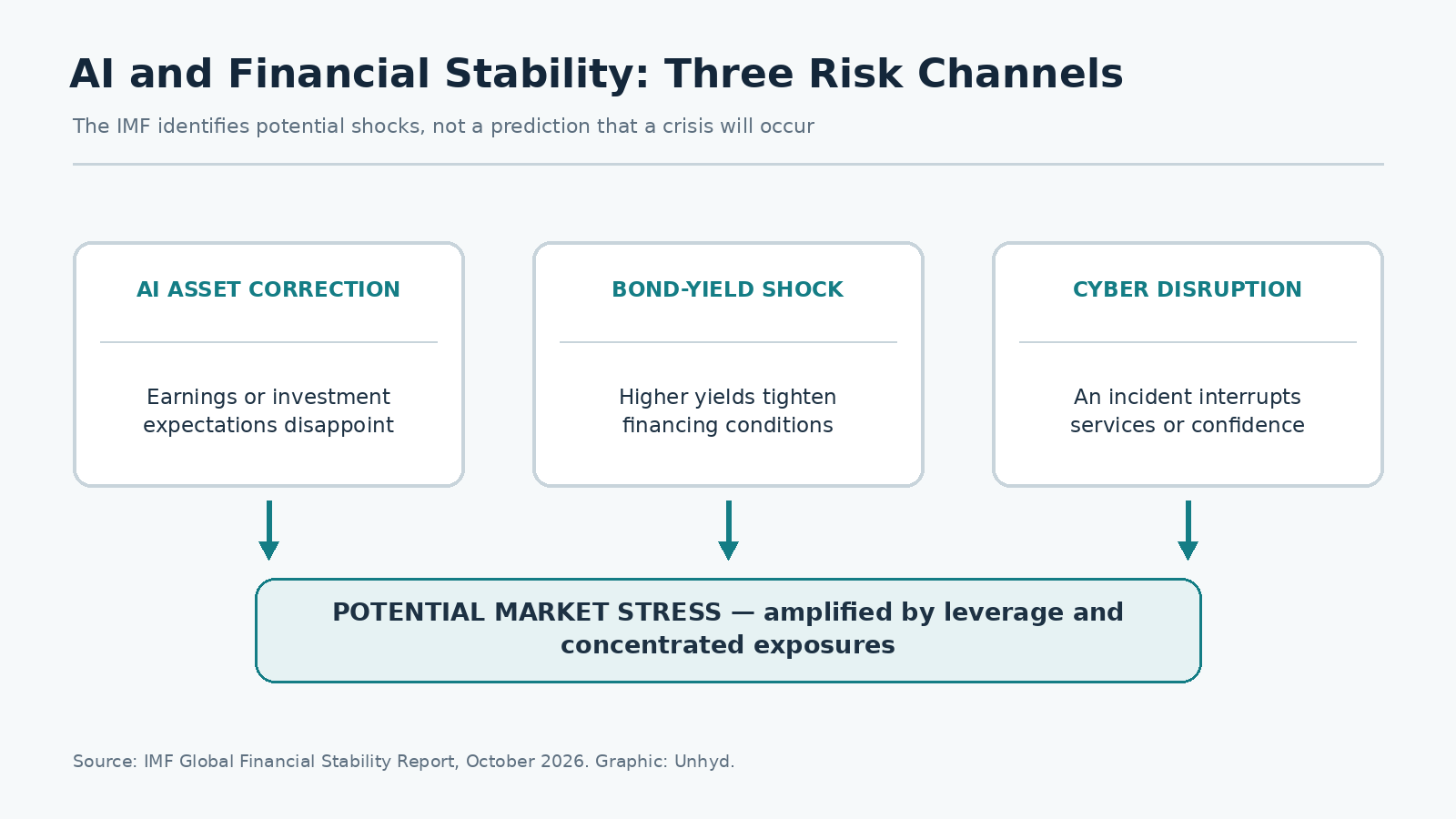
Those risks are not interchangeable. A decline in a technology stock can begin as a repricing of expected profits. It becomes a more consequential financial-stability problem when leverage, concentrated exposures or forced selling transmit losses to lenders and other investors. A cyber incident can disrupt payments or confidence through a different mechanism. The IMF's analysis is about possible transmission channels, not a claim that any one event has already triggered a global crisis.
That distinction is important when interpreting dramatic market headlines. Strong investment in data centers, chips and software may reflect genuine demand and long-term business opportunities. At the same time, valuations and borrowing costs can become vulnerable when investors expect those opportunities to translate into profits on an aggressive timetable. Both propositions can be true.
Why jobs and infrastructure belong in the same discussion
AI's benefits are unlikely to be distributed evenly. Firms need electricity, connectivity, usable data, trained workers and the capacity to reorganize processes before a promising model becomes a productive tool. Economies with weaker infrastructure or fewer resources for retraining may face a different balance of costs and benefits from those with extensive computing capacity and established technology industries.
The IMF's event description explicitly included labor-market transitions and the opportunities and challenges facing Asia-Pacific economies. That scope matters: a technology can raise aggregate productivity while still displacing particular tasks, changing wages or concentrating gains among firms that control scarce inputs. The presence of growth in a national statistic does not answer whether workers and households share in it.
For employers, an AI deployment should therefore be judged against observable outcomes, not adoption alone. Unhyd's recent analysis of AI return on investment and accountability explored why positive assessments of value can coexist with weak explainability and fragmented controls. The macroeconomic version of that problem is similar: a convincing investment story still needs evidence of durable productivity, manageable costs and credible oversight.
Voluntary safeguards are not the same as enforceable rules
The governance discussion also needs precise language. A company pledge, an external evaluation, a government recommendation and a binding regulation are four different instruments. They may reinforce one another, but they have different accountability mechanisms and different consequences when an organization fails to comply.
Unhyd previously examined the White House's voluntary AI accord, which calls for layers of internal and outside oversight without itself creating a new regulator or enforcement penalty. Georgieva's reported appeal for a combination of industry and government action sits within that broader debate, but the Bangkok panel did not settle how a global system should work.
There is also a risk of presenting all AI safeguards as restrictions on innovation. Some controls—documented evaluations, cyber resilience, human review in consequential decisions and clear responsibility for failures—can make deployments more trustworthy and sustainable. Whether a particular measure succeeds depends on its design, evidence and enforcement, not simply on whether it is labeled regulation or self-governance.
What to watch after the Bangkok warning
The most useful follow-up questions are concrete. Will companies disclose productivity gains that can be separated from pilot enthusiasm? Will investors and regulators better understand the debt and concentrated exposures behind AI infrastructure spending? Will governments fund worker adaptation and the physical infrastructure required to use the technology? And will safety commitments produce evidence that outsiders can inspect?
The October 16 discussion did not provide a numerical answer to those questions. It clarified the stakes. The IMF is not arguing that AI investment should stop; its public research and event program consider substantial potential benefits alongside risks. The test ahead is whether institutions can capture those benefits without assuming that strong market enthusiasm, by itself, guarantees a stable transition.