
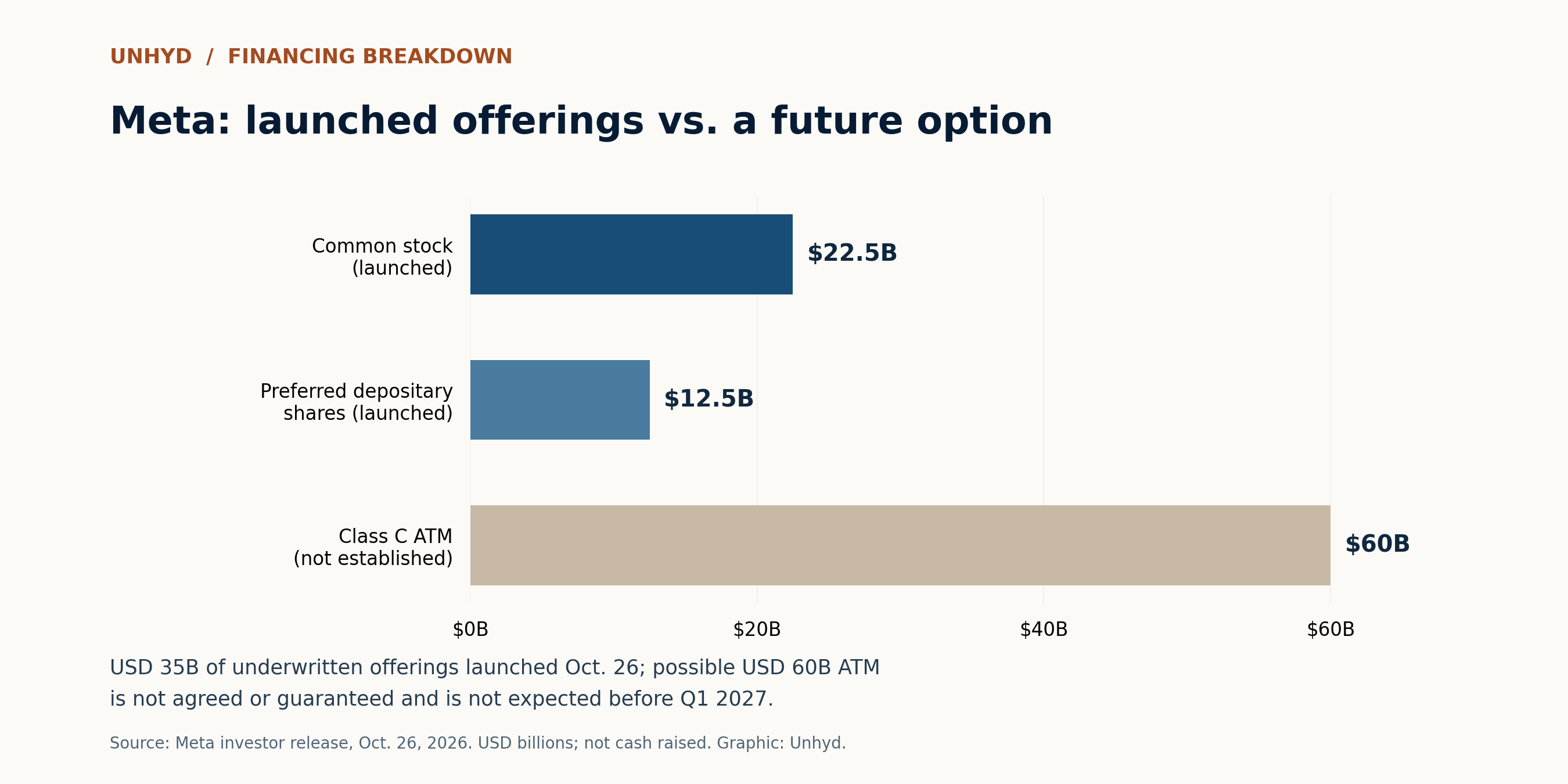
Meta $95 billion financing plan, announced October 26, lays out a potential $95 billion equity program to support artificial-intelligence infrastructure. That figure is a ceiling for a plan with different stages, not $95 billion already raised. Approximately $35 billion of underwritten offerings have been launched; another roughly $60 billion is a possible future at-the-market program that has not been established.
The distinction is central to understanding what Meta is asking investors to finance. The immediate offerings comprise approximately $22.5 billion of Class A common stock and $12.5 billion of depositary shares representing mandatory convertible preferred stock. The proposed later program would sell nonvoting Class C shares over time, subject to conditions and future decisions.
Meta $95 billion financing plan: $35 billion now, $60 billion only if launched
Meta says the concurrent underwritten offerings total about $35 billion, excluding possible underwriter over-allotment options. These are offerings launched on October 26, not completed cash receipts. The company specifically notes that it does not initially expect to receive proceeds from the common shares sold by forward purchasers; it expects proceeds when the forward-sale agreements are settled in the future.
The remaining approximately $60 billion is a proposed at-the-market, or ATM, program. Unlike a single block sale, an ATM arrangement typically allows a company to sell shares into the market over a period of time. Meta says it has not entered into an agreement for this program and cannot assure investors that it will establish the program or sell any particular amount. It does not expect the program to begin until the first quarter of 2027, after the new Class C shares start trading.
Consequently, treating $95 billion as cash in Meta's bank account today would be wrong. Treating the future $60 billion as a firm commitment would also be wrong. The company has announced a financing architecture with a near-term transaction and a contingent later option.
Why the share classes matter as much as the dollar amount
The $12.5 billion preferred-stock component is not simply another sale of ordinary common shares. Meta describes depositary shares representing interests in mandatory convertible preferred stock, with conversion, dividend and other terms that will be determined at pricing. The preferred security is designed to convert into common equity on a future settlement date, subject to the detailed terms and conditions.
Meta's October 21 earnings release had already announced plans for a new publicly listed, nonvoting Class C share class effective in January 2027. The later ATM program would use that class. For investors, the distinction matters because a new share can dilute economic ownership without necessarily distributing equivalent voting influence. The exact effect depends on final pricing, conversion terms, issuance and the number of shares actually sold.
The company also disclosed that Nvidia, AMD and Broadcom expressed interest in buying up to $5 billion of the Class A offering in aggregate. Meta explicitly says these indications are nonbinding. They are neither completed investments nor proof that the chip suppliers will purchase the full amount. The relationship is noteworthy because potential suppliers could also become investors in a major customer, but the eventual allocations remain unknown.
How large is the spending commitment behind the raise?
Meta expects capital expenditures of $135 billion to $145 billion in 2026, according to its announcement. It also reports approximately $97 billion in operating cash flow during the first three quarters and around $82 billion in cash, cash equivalents and marketable securities at September 30. These are company-reported measures for different periods; they should not be added together as if they were interchangeable funding pools.
The company argues that AI investment is already improving engagement and advertising performance while creating opportunities in agents, business tools and AI glasses. Those are management's stated business expectations. The announced financing does not establish that every planned data center will be delivered on schedule or that future AI revenue will cover the full cost of infrastructure.
Unhyd previously examined Meta's Muse Wonder models and the challenges of reliable AI agents. The financing plan supplies the capital-market side of that same strategy: developing capable models is only one step; supplying them to millions of users and businesses requires compute capacity, energy, networking and ongoing operating expenditure.
What the announcement means for shareholders and the AI buildout
For existing shareholders, the immediate questions are how much equity will ultimately be issued, when proceeds reach Meta, what preferred dividends and conversion terms are finalized, and whether the planned nonvoting share structure changes the balance of economic and voting interests. A large announced maximum is not enough to calculate dilution: that requires the offering price, share counts and actual settlement details.
For the wider economy, the financing underscores how AI expansion is moving beyond software launches into power, land, equipment and construction. Unhyd's reporting on Google's nuclear-uprate agreement with Constellation illustrates a different response to the same infrastructure constraint: contracting for additional electricity capacity. Meta's financing does not itself provide power, but it shows how aggressively companies are arranging capital for infrastructure ambitions.
Reuters independently reported the financing announcement on October 26 and described investor concerns about the scale of technology companies' AI spending. Such concerns are reasonable subjects for scrutiny, not evidence that Meta's announced offerings will fail. Meta's recent results show a substantial operating business alongside rapidly increasing investment demands.
Three milestones that will test the plan
First, the final pricing and allocation of the launched offerings will reveal their immediate terms. Second, settlement of the forward-sale agreements will show when Meta actually receives proceeds from that portion. Third, a signed ATM agreement and actual Class C sales—if they occur—will show whether the proposed $60 billion program becomes real financing rather than an unused authorization.
The clearest reading of the news is therefore neither that Meta has already raised $95 billion nor that the plan is merely a vague aspiration. It has launched substantial underwritten offerings while retaining a conditional option to raise considerably more. That distinction gives readers a concrete way to judge future announcements against the commitments made today.