Microsoft has reportedly withdrawn from an agreement to use the planned Nscale Loughton data center in Essex, dealing a setback to a project that the two companies promoted last year as a flagship of Britain’s artificial-intelligence infrastructure ambitions. Reuters reported the Microsoft–Nscale development on October 18, citing an earlier report in The Telegraph. Nscale says it remains committed to the site and that its other contracts with Microsoft are unaffected.
The immediate significance is not that Microsoft has abandoned AI investment in Britain. The reported exit concerns one proposed campus, whose power-connection timetable had already become a major question. Neither Microsoft nor Nscale has publicly disclosed the termination terms, and the companies have not established in a new joint announcement precisely why the agreement ended. The reported grid delays are crucial context, but they should not be presented as a confirmed contractual explanation.
What the Nscale Loughton data center originally promised
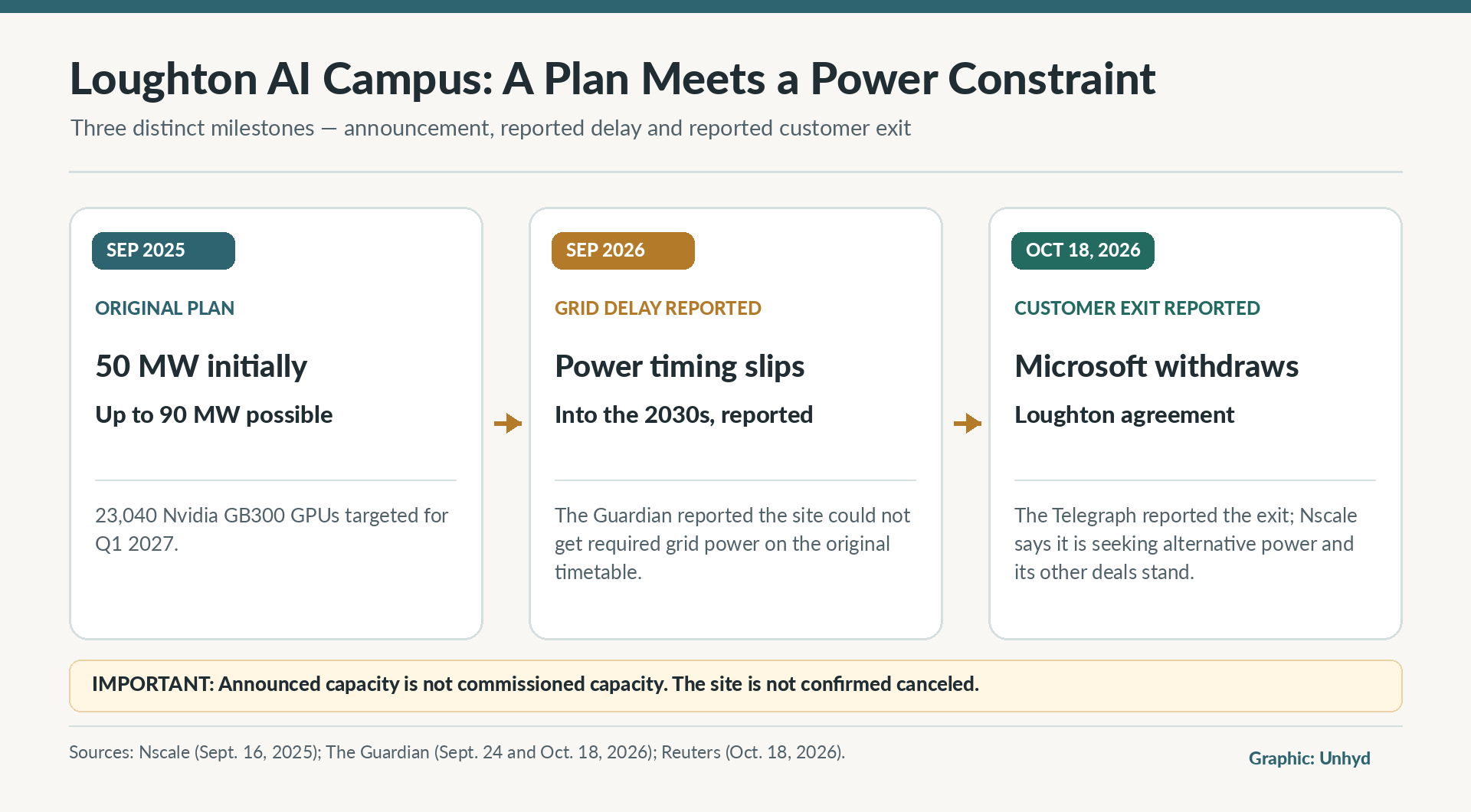
In a September 16, 2025 announcement, Nscale described the Loughton site as a 50-megawatt AI campus, potentially expandable to 90 megawatts. Its plan called for 23,040 Nvidia GB300 graphics processors to be delivered in the first quarter of 2027, with the facility supporting Microsoft Azure services in the United Kingdom.
Those were planned specifications and delivery targets, not evidence that the capacity was operating. The distinction matters now: a project can have a customer agreement, equipment plan and proposed opening date while still lacking the electricity connection needed to operate the hardware.
The relationship expanded on paper the following month. In an October 15, 2025 release, Nscale outlined agreements involving approximately 200,000 Nvidia GB300 processors across several locations in Europe and the United States. Loughton was one element of that broader package, not its entirety.
What changed on October 18
The Telegraph first reported that Microsoft had pulled out of the Loughton agreement. Reuters carried that account on Sunday, while The Guardian separately reported the withdrawal and quoted Nscale’s response. The company said it was exploring alternative power sources for Loughton as well as other expansion locations in Britain.
Nscale also said its relationship with Microsoft remained strong and long-term and that the London-area grid issue had no impact on its other contracts. That is the company’s position, not an independently audited assessment of every agreement. Reuters said Microsoft and Nscale had not immediately answered its requests for comment outside business hours. Microsoft had not issued a public statement confirming the precise exit terms in the material reviewed for this article.
As a result, the defensible headline is a reported withdrawal from a specific AI campus, not a cancellation of every Nscale–Microsoft partnership or a shutdown of an operational supercomputer. Nscale has not publicly identified a replacement anchor customer for Loughton in the reporting reviewed.
Why the electricity connection matters
Large AI campuses need a reliable supply of electricity before racks of processors can be put into service. A data center’s power budget is not merely an operating expense: it shapes where the facility can be built, when customers can use it and whether the economics of an equipment order still make sense when the site opens.
In September, The Guardian reported that grid-connection difficulties could push the Loughton project’s access to the required power into the 2030s, well beyond the original 2027 equipment-delivery target. That timetable is reporting about a project constraint, not a verified announcement that the entire site has been canceled.
A proposed 50 MW campus scalable to 90 MW also should not be confused with an already energized 90 MW facility. The first number described the planned initial capacity; the second was an expansion ceiling. Neither established that electricity, cooling, networking and commissioned compute were available for customers on the original schedule.
This is the practical lesson of the latest news: a customer commitment and a grid connection are different milestones. Unhyd recently examined the same distinction in Applied Digital’s proposed Finland AI campus, where access to potential power is a step toward development rather than proof of a finished facility.
What the withdrawal does not mean
The reported Loughton change should not be generalized to every Microsoft infrastructure project. Nscale’s October 2025 release also described planned deployments in Texas, Portugal and Norway. For example, it outlined a roughly 240 MW Texas campus involving approximately 104,000 processors and a separate Norwegian agreement covering about 52,000 processors. Those are company-announced plans and contracts; the release does not, by itself, establish their present operating status.
Microsoft is also developing its own accelerator systems. Unhyd’s coverage of the Azure Maia 300 roadmap describes the company’s planned push to increase AI inference output per unit of electricity. That hardware strategy and the Loughton tenant decision are distinct developments, but both underline the importance of converting ambitious compute plans into functioning, power-backed infrastructure.
Nor does the report establish that Britain’s entire AI data-center strategy has failed. It is one consequential setback at a highly publicized site. Other projects may have different grid connections, customers, permitting positions and delivery schedules. Comparisons require project-by-project evidence.
What investors, customers and policymakers should watch next
The most useful next milestone is an explicit statement from Microsoft or Nscale clarifying the Loughton agreement’s status and any remaining commercial obligations. A second is a documented, achievable power-supply plan: an accelerated grid connection, approved on-site generation or another solution capable of supporting the proposed computing load.
Other signals include a named replacement customer, a revised delivery date, construction progress and disclosures in any subsequent Nscale securities filing. Until those appear, the site’s prospects remain uncertain. It would be premature to infer a financial loss amount, contract penalty or new operational deadline from the reporting available on October 18.
The broader question is whether AI infrastructure announcements will increasingly be judged by energization and customer service dates rather than planned processor counts. Loughton offers a concrete test: a once-prominent 2027 timetable now faces a reported customer exit and an unresolved power pathway. That is material news even without a definitive answer about the project’s future.