Amazon AWS earnings for the September 2026 quarter reveal two facts that can both be true: Amazon's cloud business is growing quickly and earning more operating profit, while the company as a whole is spending more cash on infrastructure than its operations generated over the latest 12 months. Treating either number as the complete AI investment story would miss the timing and accounting differences.
Amazon released third-quarter results on October 29. The following day, U.S. technology stocks fell sharply amid concern about the cost of artificial intelligence investment. Reuters reported that the Nasdaq Composite declined 2.86% on October 30, with Amazon and Intel results contributing to the market's anxiety. That market reaction is context, not proof that investors have correctly priced Amazon's future returns.
What Amazon AWS earnings actually show
In its official earnings release, Amazon reported third-quarter AWS sales of $46.0 billion, up approximately 39% from $33.0 billion a year earlier. AWS operating income increased to $17.8 billion from $11.4 billion. Using the rounded figures disclosed in the release, that implies an operating margin of roughly 38.7% in the latest quarter, versus 34.5% a year earlier.
That is evidence of stronger reported cloud profitability, not just faster cloud revenue. AWS operating income increased by about $6.4 billion year over year on the disclosed rounded figures. It does not, however, establish the profit from generative AI alone: AWS includes a broad portfolio of cloud infrastructure, databases and other services, and Amazon does not provide a standalone AI operating-income line in the figures cited here.
Across the entire company, third-quarter sales rose 12% to $201.9 billion and operating income reached $28.1 billion, compared with $17.4 billion a year earlier. Amazon described its 13.9% operating margin as a company record. These numbers show that the company is not simply losing money across its operations because of AI investment.
Two periods, two different pictures
The headline cash-flow number covers the trailing 12 months ended September 30, 2026—not just the three-month earnings quarter. Amazon reported $168.3 billion of operating cash flow over that year, up from $130.7 billion in the prior comparable period. But purchases of property and equipment, net of specified proceeds and incentives, rose sharply enough to push its free cash flow to a $42.4 billion outflow from a $14.8 billion inflow one year earlier.
The figures should not be treated as a single quarterly profit-and-loss calculation. AWS revenue and operating income describe one business segment over three months; free cash flow describes the entire company over 12 months. Amazon's definition subtracts cash equipment purchases, net of certain proceeds and incentives, from operating cash flow. It is not a measurement of whether each new AI data center will eventually earn an adequate return.
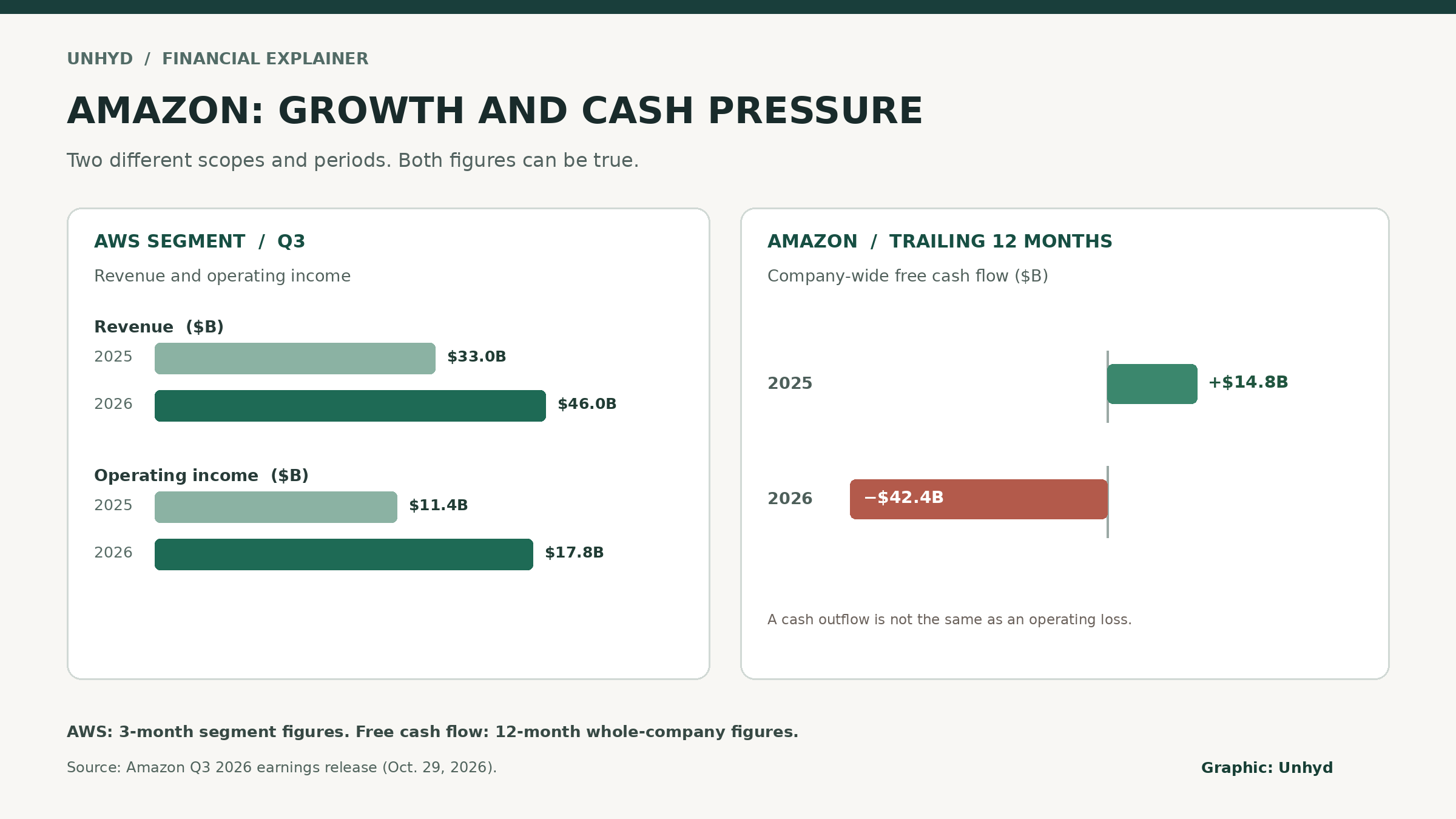
Using the company's more precise supplemental figures, trailing free cash flow changed from approximately positive $14.788 billion to negative $42.357 billion: a deterioration of about $57.145 billion. Amazon attributed the decline primarily to a $94.8 billion year-over-year increase in property-and-equipment purchases, net of proceeds and incentives, reflecting AI-related investment. The cash-flow movement cannot be assigned entirely to AWS without a business-specific cash-flow reconciliation.
Why faster cloud growth does not immediately fund the buildout
Data centers require servers, chips, electrical infrastructure, networking and construction before customers use all the resulting capacity. Cash may leave during installation while revenue and profit emerge over subsequent years. A cloud operator can therefore improve current operating profit while company-wide free cash flow falls during a major construction cycle.
Amazon's management expects approximately $220 billion of cash capital expenditures in 2026. That is guidance for a calendar year, not the same metric as trailing-12-month property-and-equipment purchases or third-quarter AWS expenses. Comparing those numbers as if they shared one period would be misleading.
Chief executive Andy Jassy also projected AWS revenue growth above 40% in 2027 and 2028. Those are management expectations, not realized results. The key unknown is how much of the infrastructure now being installed will be used at prices and utilization rates sufficient to earn attractive returns after power, hardware, depreciation, maintenance and financing costs.
What the market reaction does—and does not—prove
Friday's market selloff reflected wider concerns about AI investment, not a new finding that AWS demand has disappeared. Reuters reported significant declines across semiconductor and technology shares after results from Amazon and Intel. Prices reflect changing investor expectations, risk tolerance and interest rates as well as operating data; a one-day move is not an audited verdict on a company's infrastructure strategy.
Unhyd recently examined Microsoft and Alphabet's contrasting quarterly cash flows. Amazon adds a different, separately announced event: a growing and profitable cloud segment paired with negative trailing-year company-wide free cash flow. Those measurements should not be placed on one comparative chart without aligning their periods, definitions and business scope.
The longer investment cycle also connects to Unhyd's reporting on Microsoft's custom AI chips, which described why power efficiency and workload utilization can matter as much as headline processor speed. Amazon's latest release does not provide a standardized return-on-invested-capital figure for its newly deployed AI infrastructure that would resolve the question.
Three measures worth watching next
First, monitor AWS operating income alongside revenue rather than assuming growth alone means better margins. Second, follow Amazon's actual equipment spending and operating cash generation across several quarters; a single trailing-year figure captures a large investment cycle but does not predict its endpoint. Third, look for evidence of utilization, pricing and cash returns from installed AI capacity rather than treating management forecasts as guaranteed demand.
Amazon's results make the investment dilemma concrete. Its cloud division is reporting strong operating performance, yet the company's infrastructure spending is absorbing more cash than its operations generated over the latest year. The question is not whether both statements can coexist—they already do. It is how quickly new capacity turns into durable cash generation, and whether the eventual return justifies the spending.