

Google Genie 4 is designed to do something that a conventional AI video generator cannot: keep creating an environment as someone moves through it, changes the weather, introduces a character or asks the scene to behave differently. Google DeepMind announced the model on October 27, 2026, with native sound and interactive dialogue alongside its generated imagery. But the most important distinction is between an impressive research demonstration and a dependable simulation of reality.
Google has begun a limited research preview for trusted testers. Wider access is planned for Google AI Ultra subscribers through Project Genie and for selected developers through Gemini API and AI Studio. It is not a general public release, and Google has not provided a firm launch date for those wider groups. Independent TechCrunch coverage on October 27 also describes the system as experimental rather than a finished consumer product.
What Google Genie 4 actually changes
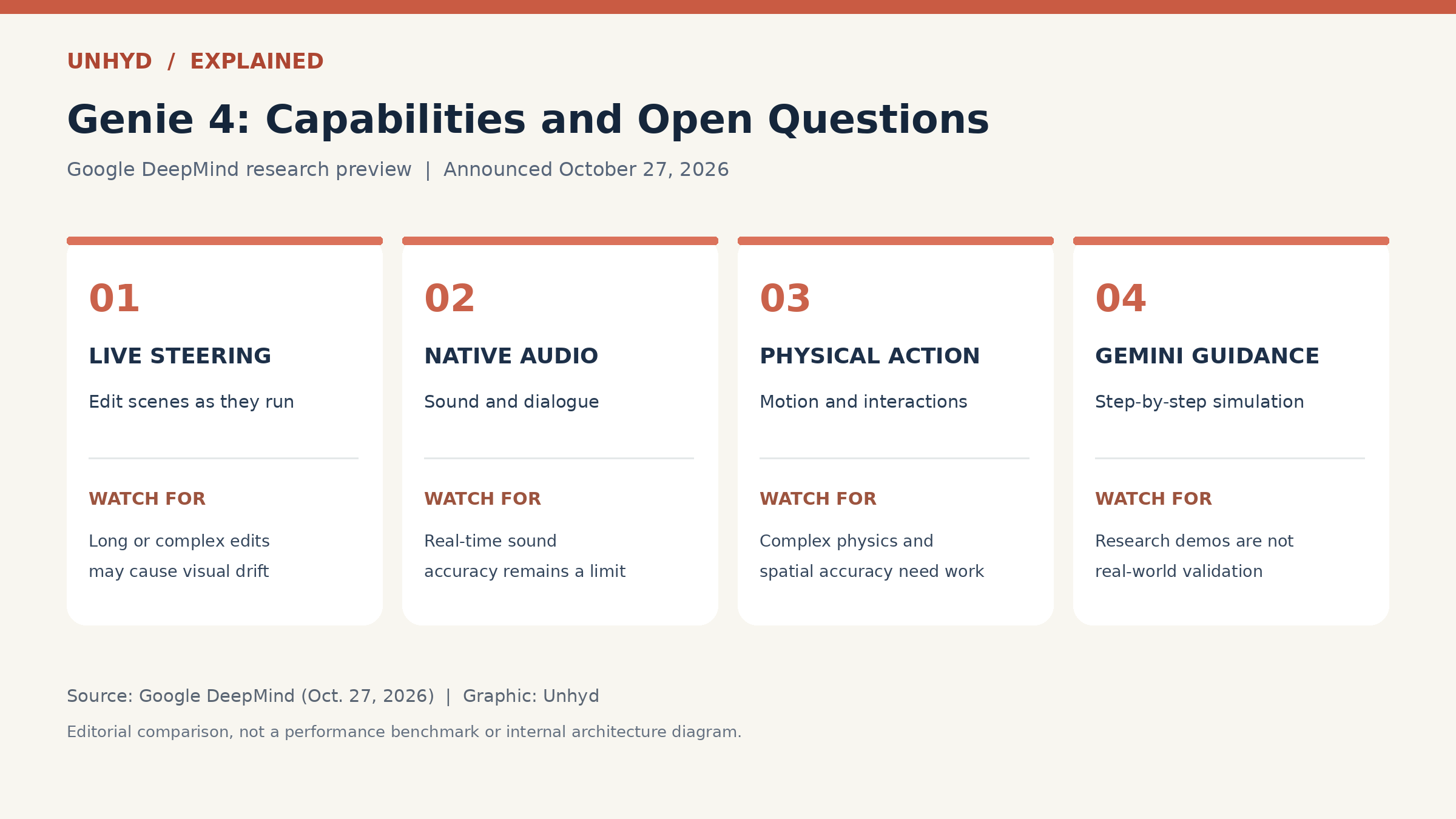
A normal generated video is mostly a fixed sequence: once the frames are created, the viewer watches what the model produced. A world model attempts to respond as a participant changes direction or takes an action. Genie 4 goes further by accepting text instructions during the session. Google demonstrates changes to a camera's position, the weather and the people or objects in a scene without requiring a new clip to be produced from scratch.
Audio is another material change. DeepMind says Genie 4 produces environmental sounds, music and character dialogue as the world evolves, rather than merely attaching an unrelated soundtrack afterward. That could make a prototype more informative for a game designer or a filmmaker testing whether a scene works with sound. It does not mean the audio is always accurate: Google explicitly identifies real-time sound accuracy as unfinished work.
Google DeepMind's official Genie 4 demonstration shows interactive AI-generated environments with accompanying sound. Video: Google DeepMind.
The company also describes improvements in physical interactions and human movement, including examples involving collisions and aerodynamics. These are demonstrations of the model's claimed abilities, not independent evidence that its simulated physics reliably predicts what would happen outside a computer. A convincing animation can still make an incorrect prediction.
Why Gemini matters behind the simulation
DeepMind says Genie 4 works with other Gemini models. In one described arrangement, Gemini 3.8 Flash observes frames, divides a goal into steps and adjusts its guidance as the scene changes. Genie generates the immediate sights and sounds while Gemini helps keep the sequence oriented toward a task. The company also showed a research experiment combining Genie 4, Gemini 4 Argon and robotics-related scenarios.
That pairing is more consequential than simply producing prettier imagery. A robot-training system, for example, needs an environment that responds to actions and retains important facts about where objects are. A model that invents a plausible scene but forgets an object after the camera turns cannot automatically be trusted to test a physical robot's safety. The same issue matters when a game designer expects an interactive prototype to preserve rules across a longer session.
Unhyd's earlier guide to AI-agent evaluation offers a useful parallel: the right question is not whether a demo looks convincing, but whether the system repeatedly completes a defined task and stays within its limits. A simulated environment should be tested against known scenarios before its results are used to justify real-world decisions.
The limits Google says remain
Google's technical announcement acknowledges that details and object permanence can drift during longer sessions or after complex changes. Spatial accuracy, intricate physical interactions, legible text and consistent audio remain research challenges. Those caveats are central to interpreting the demonstrations: a world that looks photorealistic is not necessarily a faithful model of the real world.
TechCrunch reports that Genie 4 can maintain a scene for up to two minutes, compared with a shorter window for Genie 3. That duration comes from the outlet's reporting, not a separately reproduced Unhyd test. It illustrates how far current interactive experiences remain from persistent virtual environments that operate without interruption for hours.
Google also says its generated audio and video will carry SynthID, the company's imperceptible AI-content watermark. That is a provenance measure, not proof that a particular simulated historical scene is accurate. A recreation built from an archival photograph, for example, may add plausible but unverified people, dialogue or events. Journalists and educators should distinguish such reconstructions from documentary footage or evidence of what actually occurred.
Where the model could be useful first
Early testers described applications in filmmaking, journalism, education, gaming and engineering. For a director, an explorable draft could help compare camera movement, lighting and pacing before a shoot. For a game team, it could test a mechanic or a visual mood before building the scene in a conventional engine. For engineers, it might eventually help generate varied training scenarios. Each use has a different standard of acceptable error.
Creative ideation can tolerate invented details if they are clearly understood as invented. Safety-critical robotics, historical reconstruction and physical engineering require a higher standard: repeatable behavior, known reference conditions and evidence that simulated outcomes correspond to reality. The closer a generated world gets to consequential decision-making, the less persuasive visual realism alone becomes.
There is a related governance question. If an AI system can choose actions inside a simulated environment, organizations still need to define what it is permitted to do when the same agent is connected to real tools. Unhyd's permission-first AI-agent security guide explains why tool access, approval boundaries and audit trails remain separate from model intelligence.
What to watch before wider availability
For now, the practical questions are whether Google publishes reproducible evaluations, how consistently the model handles longer and more complex sessions, which features reach paying subscribers, and what usage limits or developer terms accompany the rollout. Google has announced intended access channels, not a universal release or a guarantee of scientific fidelity.
Genie 4's genuine development is the combination of live visual steering, generated sound and Gemini-guided behavior in one experimental system. Its unresolved challenge is whether that apparent continuity holds when a scene becomes complicated, unfamiliar or consequential. That difference—between an interactive demonstration and a reliable world model—is the question that will determine where the technology can responsibly be used.