
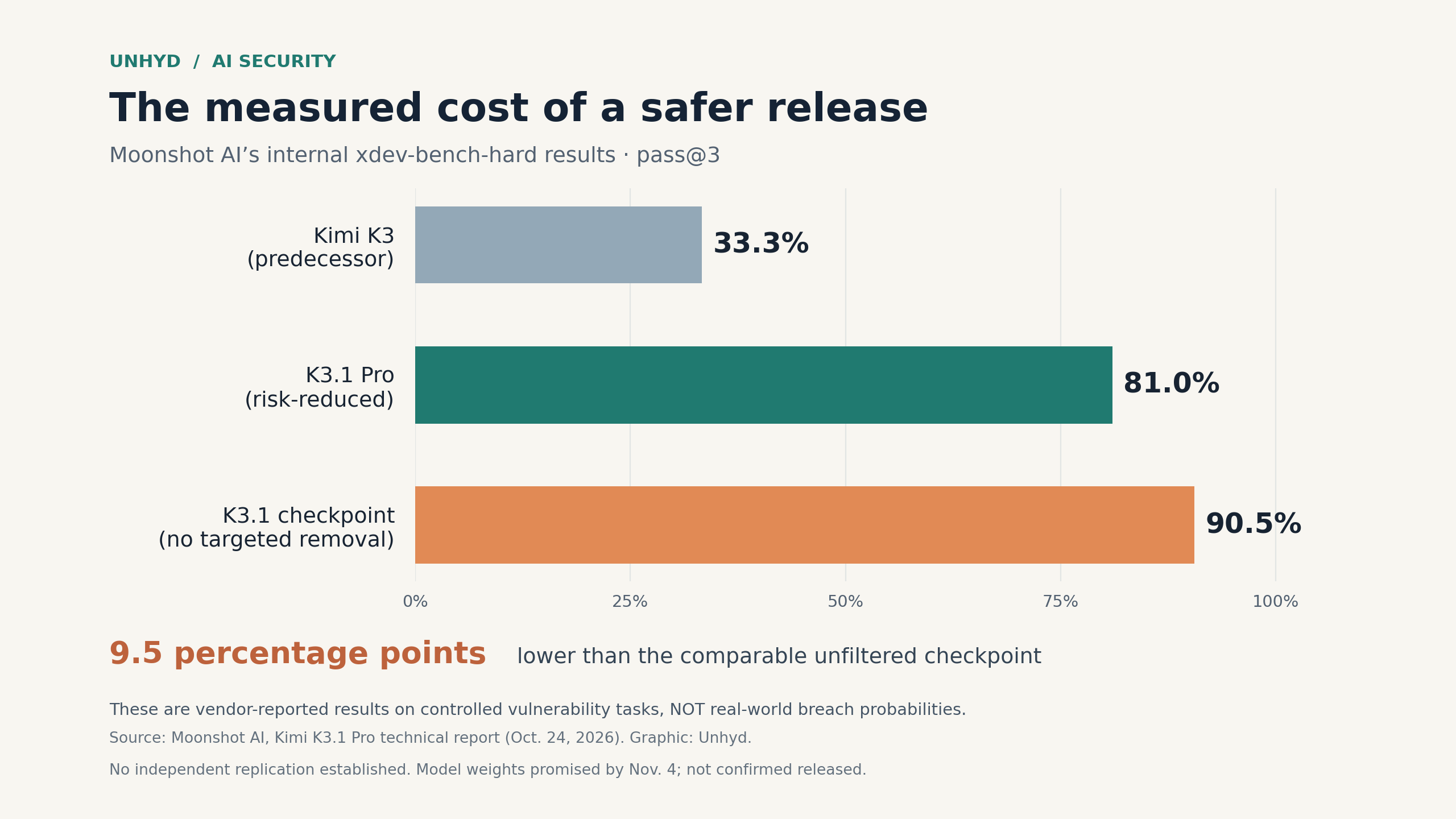
Kimi K3.1 Pro arrived with an unusual admission from its developer: Moonshot AI says it intentionally made the model less capable at finding and exploiting software vulnerabilities than another version it could have released. In a technical account dated October 24, the company reported an 81.0% score for the final model on its internal cyber test, compared with 90.5% for a checkpoint trained without the cyber-specific restrictions. That is a 9.5-percentage-point difference—not proof that the released model is harmless.
The timing deserves precision. Moonshot’s Kimi Code release notes date the product rollout to October 23; its research index dates the detailed technical account to October 24. Reuters reported the cybersecurity decision on October 24. The new story is not simply another large AI model becoming available. It is the company’s documented decision to trade some offensive capability for a more controlled open-weight release.
What Moonshot changed in Kimi K3.1 Pro
According to the company’s technical report, Moonshot identified cyber-related material in both its mid-training data and its reinforcement-learning task environments. It removed relevant data from both stages while keeping general-purpose coding tasks. The intended distinction is between building useful software and training an agent to perform specialized vulnerability exploitation.
That distinction is difficult to enforce perfectly. Strong programming skills also help an AI system understand unfamiliar code, follow a bug through several components and test whether a fix works. The same abilities can assist a legitimate security team or someone attempting to misuse a vulnerability. Moonshot acknowledges that the final model remains substantially more capable on its internal cyber test than its predecessor, even after the restrictions.
The company describes K3.1 Pro as a roughly three-trillion-parameter-class open-weight model with a one-million-token context window. It is available through Kimi’s hosted products and API, alongside a faster Highspeed version. Moonshot says it plans to publish the full model weights by November 4, 2026; that is a future commitment, not evidence that the weights have already been released.
What the 81.0% and 90.5% scores actually measure
The figures come from xdev-bench-hard, a benchmark Moonshot developed internally. Its tasks use source code, a brief hint and a compiled program associated with reproduced software vulnerabilities. An AI agent must solve a controlled challenge inside a sandbox, and Moonshot reports results using a pass@3 evaluation. The benchmark includes recreated vulnerabilities in several widely used software projects, according to the company.
Three numbers are informative when kept on the same scale: the earlier Kimi K3 scored 33.3%, the risk-reduced K3.1 Pro scored 81.0%, and a comparable K3.1 checkpoint without the targeted removals scored 90.5%. The gap between the final model and the unfiltered checkpoint is 9.5 percentage points. The final model’s advantage over K3 is 47.7 percentage points on this same company-run test.
Those differences do not mean the model has an 81% chance of compromising a real organization, that 19% of attacks will fail, or that the training changes eliminate cyber misuse. The task selection, sandbox, hints, allowed attempts and scoring method shape the results. Nor has Unhyd independently reproduced the benchmark or inspected the training data. The figures establish what Moonshot reports under its stated evaluation conditions; independent validation remains an open question.
Why an open-weight release makes the decision consequential
With a hosted model, the provider can apply access restrictions, monitor abuse patterns, change usage policies and update its serving system. Open weights give outside developers much more control over where and how a model runs. That can help organizations keep sensitive code on their own infrastructure and evaluate models directly. It also limits what the original developer can control after copies circulate.
Removing training material is therefore a different intervention from refusing a dangerous request at an API endpoint. Moonshot is attempting to influence the model’s underlying capability before broad distribution, rather than relying solely on rules enforced by a hosted service. The technical report does not establish that every future fine-tune, tool configuration or deployment will retain the same risk profile.
The trade-off is also not simply “security versus progress.” Defensive researchers need capable systems to inspect aging code, identify weaknesses and help verify patches. In Unhyd’s coverage of a collective AI cyber-defense proposal, the central issue was whether stronger tools could be made genuinely useful to organizations that lack large security teams. Moonshot’s release adds a sharper question: how much cyber capability should be available in downloadable weights before safeguards and independent evaluations can keep pace?
What users should verify before treating Kimi K3.1 Pro as a security tool
For software teams, the practical next step is to distinguish the announcement from a deployment decision. First, check whether the promised weights, model documentation and license actually appear by November 4. A model described as open-weight is not the same as a package whose complete files and usage terms have been independently examined.
Second, look for evaluations conducted outside Moonshot’s own infrastructure. Useful testing should state the tasks, permitted tools, time limits, whether hints were provided and how many attempts were counted. A favorable result on one benchmark cannot establish reliability on a company’s actual codebase or prove that a model will avoid unsafe actions in an unfamiliar environment.
Third, keep model authority separate from model skill. A coding assistant that can suggest a patch does not automatically need credentials to change production systems, retrieve confidential repositories or execute arbitrary commands. Unhyd’s permission-first guide to AI agents explains why narrowly scoped tools, audit trails and human approvals matter even when the model itself has undergone safety training. These controls remain relevant whether an organization hosts the weights or uses a provider’s API.
The question is whether restraint can survive distribution
Moonshot’s approach is noteworthy because it publishes a measurable cost of a deliberate safety intervention rather than presenting greater capability as an unqualified good. Yet the same benchmark shows how much stronger the final model remains than its predecessor. The results are best read as evidence of a reported reduction relative to one development alternative, not a certification of safe deployment.
Recent Unhyd reporting on OpenAI’s frontier-training containment measures examined a different part of the problem: whether highly capable agents can be kept within technical boundaries during research. Moonshot’s case concerns what capabilities developers choose to distribute in the first place. Together, the cases illustrate why model training, release decisions and deployment permissions are separate layers of AI security.
The next meaningful evidence will be the actual weight release, its accompanying documentation and independent testing that can confirm—or challenge—the claimed reduction. Until then, the defensible conclusion is narrow: Moonshot says it intentionally reduced one measured form of cyber capability, while still shipping a substantially more capable model overall.