A new analysis of nearly 443,000 U.S. adults has brought renewed attention to cannabis stroke risk: can occasional use affect the likelihood of having a stroke? In the preliminary findings, people who reported using cannabis on just one to five days in the previous month had 40% higher adjusted odds of reporting a past stroke than people who reported no recent use.
That number is significant enough to examine, but it is easy to misunderstand. The research did not establish that cannabis caused any of the strokes, and it did not measure a 40% increase in anyone's future probability of experiencing one. The crucial task is separating what researchers observed from what the study was capable of proving.
What the new cannabis stroke risk study measured
The findings were announced by the American Heart Association on November 2, 2026, ahead of its Scientific Sessions meeting in Chicago. The research, led by Aabha Divya of Tulane University School of Medicine, was presented as conference abstract Mo3041. No full peer-reviewed paper is available.
The team examined 442,906 adults (average age 49) in the CDC's Behavioral Risk Factor Surveillance System. The 2020–2024 data came from states that included an optional cannabis questionnaire; participation varied by year.
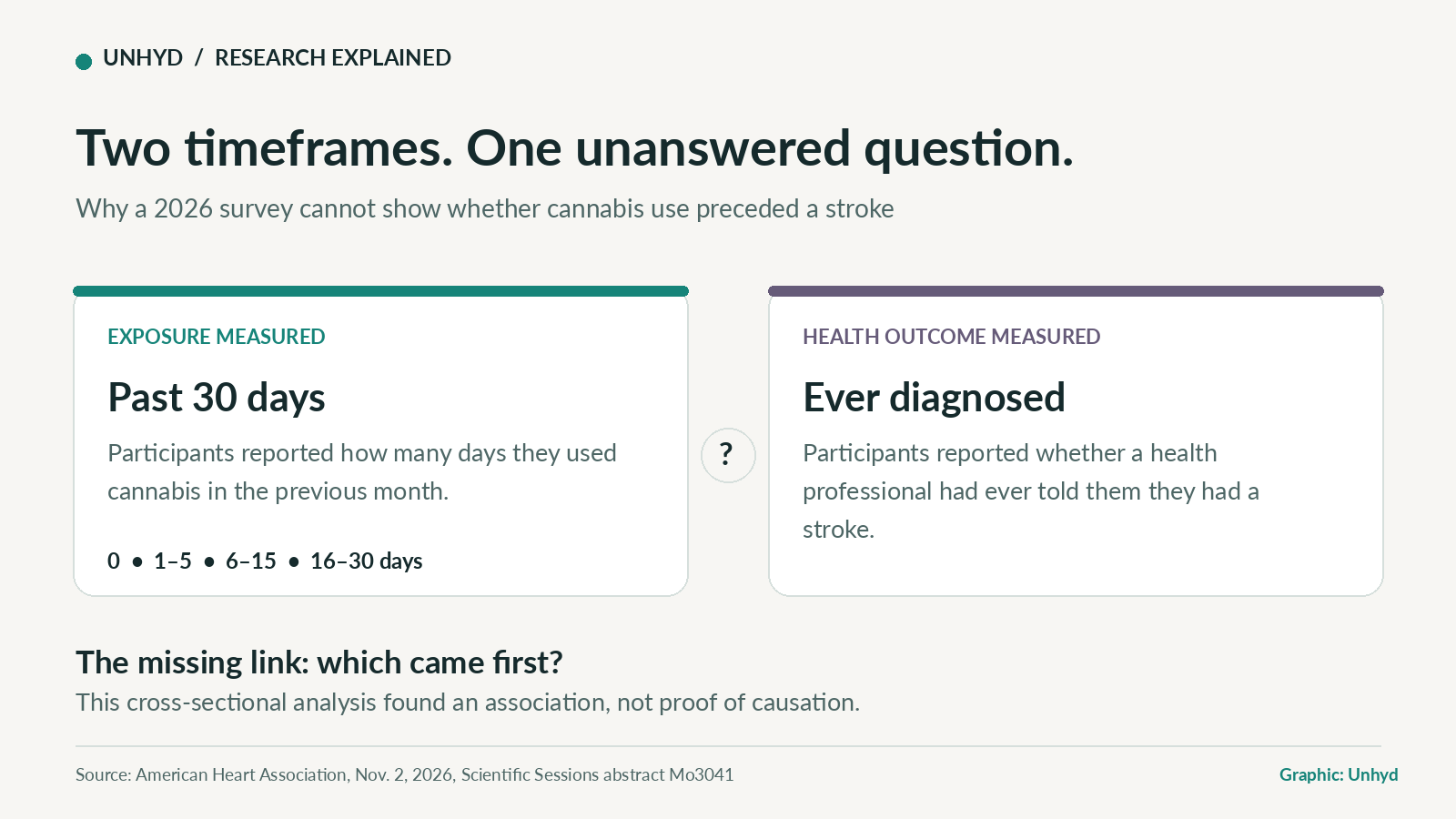
Participants reported how many days they had used cannabis during the preceding month. They also reported whether a healthcare professional had ever told them they had experienced a stroke, heart attack or other cardiovascular condition.
Compared with respondents reporting no cannabis use in the previous month, those reporting use on one to five days had 40% higher adjusted odds of reporting a stroke history. Those reporting use on 16 to 30 days had 25% higher odds. For the broader category of cardiovascular disease, the corresponding figures were 23% and 21% higher odds. The researchers did not find a statistically significant association between use frequency and heart attack in this analysis.
The models adjusted for factors including tobacco and alcohol use, obesity, diabetes, kidney disease, inactivity, income and education; they could not eliminate every possible source of bias.
What does 40% higher odds actually mean?
It does not mean that 40% of occasional cannabis users had a stroke. It also does not mean that a person's chance of experiencing a stroke in the next year rises by 40% after occasional use.
The study compared the odds that survey respondents reported a previous stroke diagnosis. Odds and probabilities are not interchangeable, and the absolute difference depends on how common strokes were in each group.
The American Heart Association's public summary did not provide the group-specific baseline stroke probabilities needed to calculate an absolute difference for occasional users. Translating its headline statistic into a personalized forecast would therefore go beyond the available evidence.
Why did occasional users show higher odds than heavier users?
The frequency pattern is one of the study's most interesting—and most easily misread—results. Respondents reporting one to five days of use had a larger estimated association with past stroke than respondents reporting 16 to 30 days.
That is not evidence that heavier use is protective. Both figures compare their respective groups with people reporting no recent use. The publicly released summary does not establish that the occasional-use and heavy-use estimates were statistically different from one another. It also does not publish enough detail about the six-to-15-day group to draw a complete dose-response curve.
One possible complication is that some people may have cut back or stopped using cannabis after a cardiovascular diagnosis. Other differences may remain unmeasured. These possibilities were not demonstrated by the study.
The timing problem: Researchers could not establish which came first
The cannabis question looked back just 30 days. The stroke question asked whether a participant had ever received that diagnosis. Someone who had a stroke years earlier but only recently started using cannabis could appear in the same analysis as someone who used cannabis before their stroke.
That difference in timeframes is central to interpreting the findings. This was a cross-sectional survey analysis, not an experiment assigning cannabis use, and not a study tracking cannabis exposure before new strokes occurred.
The research also depended on participants' recollections. It lacked detailed information about the amount consumed and product potency, including THC concentration. The optional module also excluded some states, limiting national coverage.
What does earlier cardiovascular research show?
A 2024 study in the Journal of the American Heart Association analyzed survey responses from 434,104 adults collected between 2016 and 2020. It found that daily cannabis use was associated with 42% higher adjusted odds of stroke and 25% higher odds of heart attack compared with nonuse. Unlike the new abstract, that analysis reported a pattern of higher odds with more days of cannabis use.
There is also broader evidence. A 2025 systematic review and meta-analysis published in Heart included 24 observational studies. Its pooled estimate associated cannabis exposure with a 20% higher relative risk of stroke. The studies differed in design and exposure measurement, so the pooled figure should not be treated as a precise prediction for an individual.
Together, these findings strengthen the case for studying cannabis and cardiovascular health. They do not settle whether cannabis itself caused the observed outcomes, or what risk might be attributable to a particular product, dosage, age group or pattern of use.
Different outcomes require different evidence. As Unhyd explored in its report on cannabis and the aging brain, results concerning memory, cognition and aging cannot simply be substituted for evidence about stroke.
Do smoking, vaping and edibles carry the same risk?
The newer survey included cannabis consumed through smoking, vaping and edible products, and the American Heart Association said the reported association was not limited to one consumption method. But the public summary does not establish that these methods produce identical cardiovascular risks.
Without product-level exposure and dose comparisons, this does not establish that edibles are safe or that all forms have equal effects.
What should people who use cannabis take away?
The findings are a reason for informed discussion, not an individualized diagnosis. People who use cannabis—particularly those with cardiovascular disease, high blood pressure or other stroke risk factors—can discuss the frequency, form and reasons for their use with a qualified healthcare professional. Anyone using cannabis for a medical purpose should review potential risks and treatment decisions with their clinician rather than abruptly changing a care plan based on a news report.
Recognizing an actual stroke is more urgent than interpreting a statistical association. The CDC advises calling 911 immediately for possible stroke symptoms, including sudden facial or limb weakness, difficulty speaking, vision changes, loss of balance or an unexplained severe headache. Do not wait to see whether symptoms disappear.
What evidence is still missing?
Researchers need studies that measure cannabis exposure before new cardiovascular events, account more precisely for dose and potency, distinguish consumption methods, and report absolute outcomes alongside relative estimates. Confidence intervals and results for intermediate-use groups would clarify the precision of the new estimates.
For now, the responsible conclusion is neither that occasional cannabis use has been proved to cause stroke nor that the association can be ignored. The signal deserves attention. The unanswered questions deserve just as much.