

Microsoft unveiled Azure Maia 300 on Monday, October 12, setting out plans to make its own chips the primary hardware for running AI models across Microsoft products and services. The company says it will begin production deployments in 2027 and scale its Maia infrastructure to multiple gigawatts, a significant escalation in the effort by major cloud providers to control the cost and power demands of artificial intelligence. Reuters also reported the rollout plans on Monday, citing Microsoft executives.
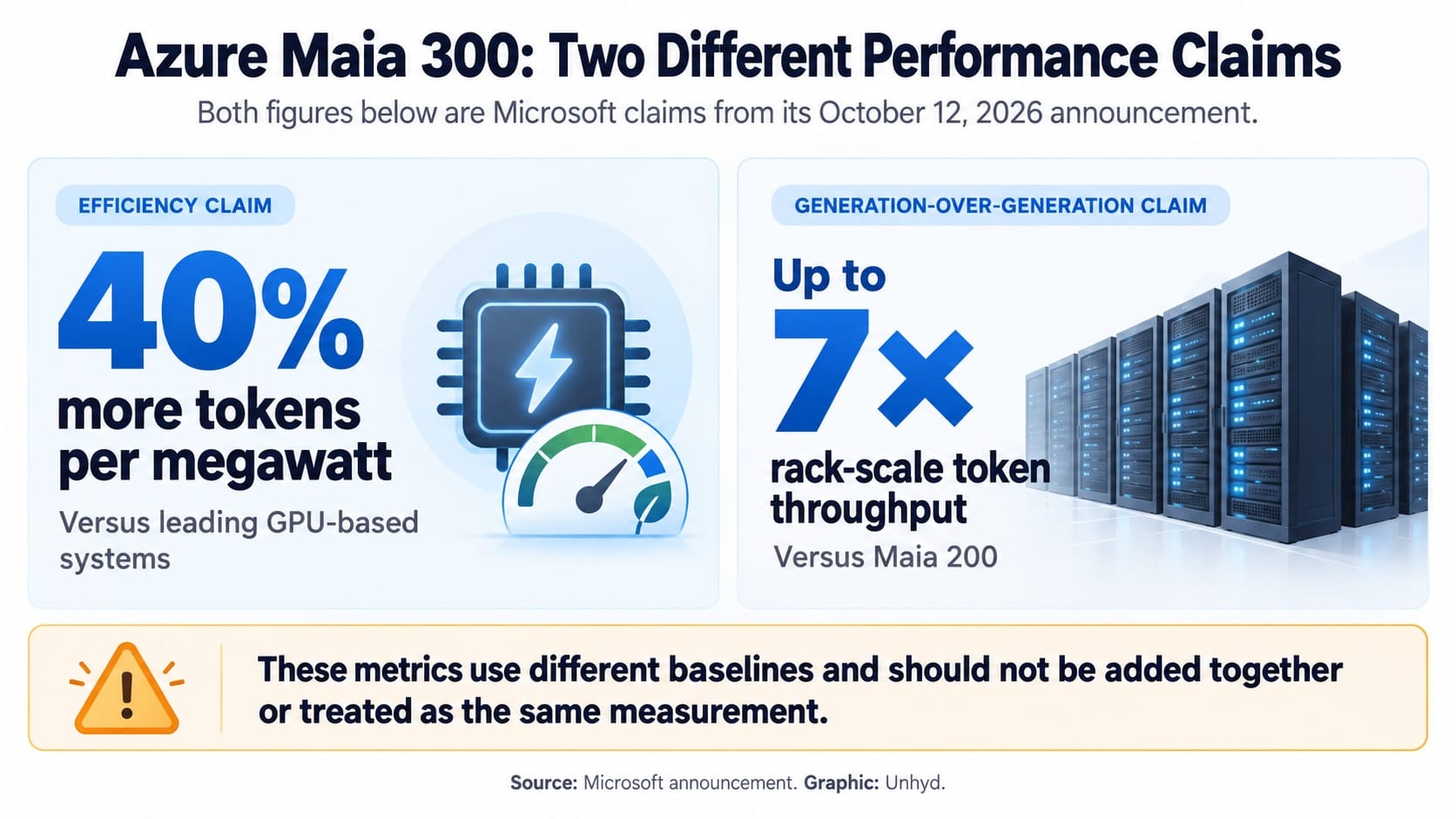
The announcement is about AI inference: the computing work performed when a model responds to a user, writes code or carries out a task. Microsoft says the new system is expected to deliver 40% more generated tokens per megawatt than leading GPU-based systems, while a full rack could deliver up to seven times the token throughput of its existing Maia 200 platform. Those are Microsoft's performance claims, not independently verified cross-vendor benchmarks.
What Microsoft announced about Azure Maia 300
Maia 300 is the third generation of Microsoft's custom AI accelerator program. Unlike a general-purpose server processor, it is designed around workloads that repeatedly run large models: long conversations, coding assistance, complex reasoning and AI agents that execute several steps in sequence.
Microsoft says its current Maia 200 chips are already serving production workloads, including Copilot, and are supporting development of its own models. The company expects broader use of Maia 200 in services such as GitHub Copilot and Microsoft Foundry before the end of 2026. Maia 300 is the next step, not a chip already installed at the announced scale.
In the official Maia 300 announcement, Microsoft says the new system is intended to handle the rising volume of AI requests while making better use of the electricity and data-center capacity required to serve them. The company is emphasizing useful output per unit of power rather than chip speed in isolation.
The Maia 300 specifications, and what they actually mean
According to Microsoft's published technical overview, a Maia 300 rack combines 96 accelerators inside a 167-kilowatt power envelope. The company lists 27.6 terabytes of high-bandwidth memory capacity and 1.7 petabytes per second of aggregate memory bandwidth across the rack. Each accelerator uses eight HBM4 memory stacks, with 18 terabytes per second of peak memory bandwidth and a stated 950-watt thermal design power.
Those figures describe different things. Memory capacity determines how much model-related information a system can hold close to its processors. Bandwidth describes how quickly information can move. Rack power describes the infrastructure's electrical demands. None of those numbers, by itself, tells a buyer how much a real application will cost to operate.
The headline comparisons also use different baselines. Microsoft's 40% figure concerns expected tokens per megawatt against unnamed leading GPU-based systems; its sevenfold claim concerns rack-scale throughput relative to Maia 200. They should not be added together or read as proof that every AI task will run seven times faster or 40% cheaper.
Why Microsoft is designing more of its own AI infrastructure
Running AI at scale involves more than purchasing a powerful processor. Cloud operators pay for electricity, cooling, networking, memory, servers and the software that keeps accelerators busy. A chip that performs well in a laboratory can still disappoint economically if data movement, memory limits or low utilization become bottlenecks.
Microsoft says Maia 300 uses a chiplet design that separates computing, memory-control and input-output functions, with compute chiplets built using TSMC's N2P manufacturing process. It also describes a software-defined approach to moving data across compute, memory and networking resources. The idea is to design the chip, rack and software together around the workloads Microsoft expects to run.
That approach could reduce dependence on third-party accelerators for some inference tasks. It does not mean Microsoft is abandoning NVIDIA hardware or that its own chips will be the best option for every model. The company describes a platform that can support multiple chip and model choices. Unhyd's earlier look at NVIDIA's AI infrastructure revenue provides context for how much spending is currently concentrated in the accelerator market.
Power efficiency is becoming a business question
The scale of the 2027 plan is notable. A multi-gigawatt deployment represents an enormous electrical commitment, although Microsoft has not established in its announcement exactly how much new capacity will be operational at any specific date. More efficient inference could let the company handle additional requests within a given power budget. It could also make more AI usage economically attractive, increasing total demand for compute and electricity.
That is why tokens per megawatt is a more consequential measure than a chip's marketing name. It connects AI output to one of the resources that can constrain expansion. But it is not a complete environmental metric: total energy use also depends on utilization, the electricity source, cooling, equipment manufacturing and how much demand grows.
The power challenge is visible beyond Microsoft. Unhyd previously reported on Google's nuclear power agreement with Constellation, a separate effort to connect AI-era electricity demand to additional grid capacity. The two developments are different strategies, but they reflect the same pressure to plan computing growth alongside physical infrastructure.
What is still unproven about Maia 300
Microsoft has disclosed system specifications and expected performance advantages, but its announcement does not provide a public, independently reproducible benchmark covering the same models, latency targets, operating conditions and full costs across rival hardware. The identity of the GPU systems behind the 40% comparison is also not specified in the release.
Commercial questions remain: how quickly Maia 300 can be manufactured and deployed, what share of Microsoft's inference traffic it will actually handle, how much software optimization will be needed, and whether expected efficiency gains persist across different applications. None of those outcomes should be treated as established before production data become available.
For enterprise customers, the near-term implication is not that they should switch chips. Most users consume AI through software or cloud services and may never choose an accelerator directly. What matters is whether better infrastructure economics eventually translate into more predictable pricing, capacity, speed and reliability.
What to watch in 2027
The next meaningful milestones are production deployments, disclosed workload performance and evidence of how Maia 300 changes the economics of Microsoft's AI services. Comparisons should use consistent definitions: tokens generated, response latency, model quality, utilization and total power consumed.
Microsoft's Maia 300 media and technical hub includes photographs and architecture resources, but the real test begins when the system moves from announced specifications to sustained production use. If Microsoft can achieve the efficiencies it projects, the result could change how one of the world's largest cloud providers pays to serve AI. Until then, the numbers remain a significant engineering claim rather than a demonstrated industry-wide result.