
The Toast FTC lawsuit filed on October 29, 2026, is about more than whether a restaurant was charged a fee it did not expect. The Federal Trade Commission and state and local authorities allege that restaurants using Toast's software and payment services encountered a combination of subscription charges, cancellation obstacles and financing restrictions. Read together, the allegations raise a broader business question: what does it actually cost a restaurant to leave a technology provider?
The 71-page federal complaint is a statement of allegations, not a court finding. Toast disputes the allegations and says it will defend the case. The FTC's case listing identifies the matter as pending. Those qualifications are essential: a filing establishes what officials claim and what relief they seek, not that the conduct has been proven.
What the Toast FTC lawsuit alleges about the cost of leaving
The complaint describes Toast as a provider of restaurant point-of-sale hardware, cloud software, payment processing and related services. According to the plaintiffs, subscriptions commonly renew automatically, with software billed monthly under annual or biennial arrangements. The alleged problem is not simply that a contract has a term. It is that officials say material terms were not clearly disclosed and that restaurants faced a difficult process to stop recurring charges.
The FTC says some customers were required to give 30 days' written notice of their intention not to renew, then navigate customer-service or sales conversations. The complaint describes instances of continued billing after attempted cancellation. Those are allegations about actual customer experiences collected by investigators, not a verified count of all Toast customers affected.
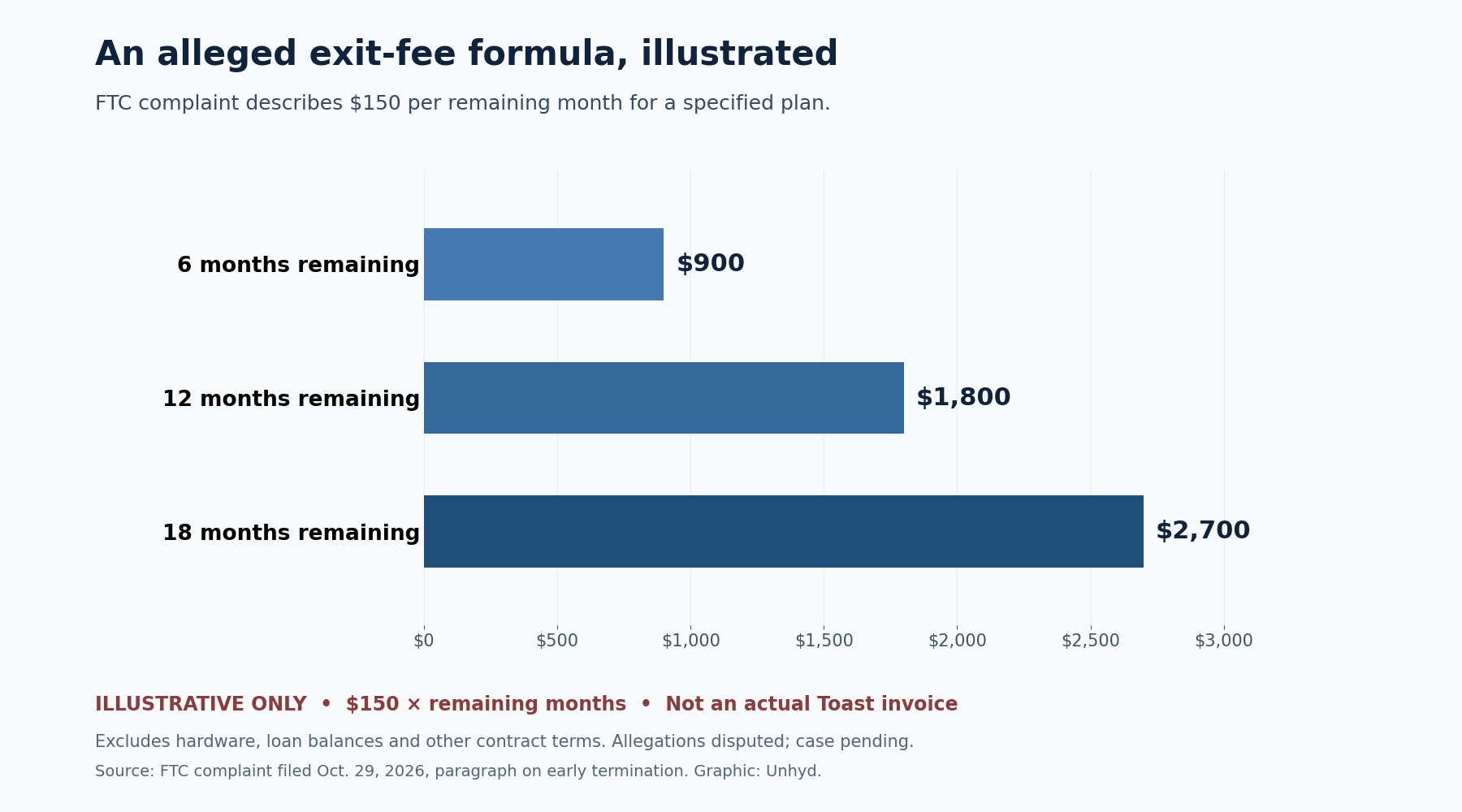
One of the most concrete allegations concerns a purported early-termination formula for the company's pay-as-you-go plan: $150 for each month remaining on the contract. The complaint says the charge was not disclosed in the enrollment screens in the way the plaintiffs believe was required. Toast disputes the case; Unhyd has not reviewed an individual restaurant's executed contract or invoice.
What $150 per remaining month means in a hypothetical exit
To make the claimed formula intelligible, consider three illustrative contract balances. Six months remaining would produce $900 under a $150-per-month formula; 12 months would produce $1,800; and 18 months would produce $2,700. The arithmetic is 150 multiplied by the number of months remaining. It is not an estimate of what an average Toast customer owes, and it does not establish that the formula applies to every Toast plan or that a court will uphold any particular fee.
The examples exclude hardware-return obligations, unpaid invoices, possible financing balances, taxes and any disputed charges. Adding those items without an actual contract would manufacture a total. The useful analytical point is that a fee expressed per remaining month can grow with the time left on a contract, so the price of switching depends on the exit date as well as the advertised monthly price.
The complaint cites one customer who allegedly faced a $5,318.87 early-termination charge after canceling an account. That figure is a case-specific allegation, not evidence that the hypothetical $150 formula alone produced it. It should not be used as an industry average or a standard Toast cancellation quote.
Three separate lock-in mechanisms appear in the complaint
The first is subscription lock-in: the contract term, automatic renewal, cancellation notice and any fee for leaving early. A business might accept a fixed term in exchange for better equipment pricing, but only if it understands the commitment and can document how to exit.
The second is hardware lock-in. The FTC alleges that some pay-as-you-go customers were promised hardware and software for $0 per month while paying higher processing rates, yet could have to return hardware or pay its retail value if they did not start processing within 120 days. A zero-dollar monthly line item therefore does not by itself mean the equipment is free to keep. The alleged condition is specific to the complaint; it should not be generalized to every restaurant POS contract.
The third is financing lock-in. The plaintiffs allege that certain Toast Capital loan terms could treat changing POS providers without prior permission as an event of default, potentially accelerating repayment. A restaurant considering a switch may therefore need to examine a software agreement and a separate financing agreement together. An exit-cost worksheet that includes only subscription fees would miss this exposure.
The $0.99 diner fee illustrates a different kind of control
The lawsuit also alleges that Toast added a 99-cent processing fee to certain online orders above $10 between 2021 and July 2023. The complaint says the fee was presented within a broader taxes-and-fees line and went to Toast rather than the restaurant. The historical period matters: the allegation does not establish that the same fee is charged today.
This part of the case differs from a restaurant's early-termination bill. It concerns who controls the customer's checkout price and what the customer understands about the recipient of a fee. For a restaurant, a provider's ability to change guest-facing charges can affect customer trust even when the merchant does not receive the money. For diners, the relevant question is whether a fee was disclosed clearly enough to understand the full transaction.
The FTC's complaint does not provide a reliable basis for estimating the nationwide number of diners affected or calculating an average charge per restaurant. Unhyd therefore makes no such estimate. A small amount per order is not evidence of a particular aggregate revenue figure without verified transaction counts and dates.
Why Toast says the federal legal theory is wrong
Toast's October 29 response says it strongly disagrees with the allegations. Its central legal objection is that the FTC is seeking to apply the Restore Online Shoppers' Confidence Act, or ROSCA, to negotiated business-to-business agreements with restaurants. Toast says no court has held that the statute applies to those negotiated arrangements and argues that extending it could disrupt commercial contracting.
The complaint takes the opposite position. It invokes ROSCA's requirements for certain online negative-option transactions, including clear material disclosures, informed consent and a simple way to stop recurring charges. It also alleges violations of the FTC Act and state laws. The dispute is not resolved merely by calling restaurants “business customers” or by quoting the statute's title. The court must evaluate the pleaded facts, the statutory scope and any defenses.
This distinction matters because Unhyd previously explained why click-to-cancel protections in 2026 are not one universal federal rule. The FTC's amended negative-option rule was vacated in 2025, while ROSCA and other laws remain separate potential enforcement tools. It would be misleading to describe this lawsuit as enforcement of the vacated amendment.
What a restaurant owner can learn without assuming guilt
The most useful response for a restaurant evaluating any provider is to map its commitments before signing. Request the complete executed agreement and every incorporated schedule, not just a sales summary. Identify the monthly software price, payment-processing terms, hardware ownership or return duties, renewal date, notice method, early-exit calculation and any financing cross-default clause.
Next, test the exit scenario. Ask the vendor to quote the amount owed if the restaurant closes, changes processor or cancels with six, 12 or 18 months remaining. Ask who can authorize the cancellation, how to prove notice was received and whether customer, menu and transaction records can be exported. The FTC's small-business guidance recommends obtaining all processing and equipment-lease terms in writing rather than relying on a salesperson's assurances.
Operational security is another dependency. A provider may run the payment infrastructure, but merchants still need to know which tasks remain theirs. Unhyd's small-business cybersecurity coverage addresses credential controls and recovery planning; the PCI Security Standards Council's merchant resources explain why using a third party does not eliminate every payment-security responsibility.
The unresolved questions after the filing
The case is pending. The public record reviewed for this article does not establish how many contracts contained each disputed provision, whether a particular restaurant's charges were lawful, or what relief a court will ultimately order. Toast's statement contests the allegations and the proposed legal interpretation; the complaint records the plaintiffs' version of events. Neither source substitutes for a final judgment.
The wider lesson is about bundled contracts, not a verdict on every POS provider. Restaurant technology can combine software, payment acceptance, equipment and loans into a single operating relationship. A quoted subscription price captures only one part of that relationship. Until the exit terms, customer-facing fees and financing dependencies are known, the real switching cost remains an unanswered business question.