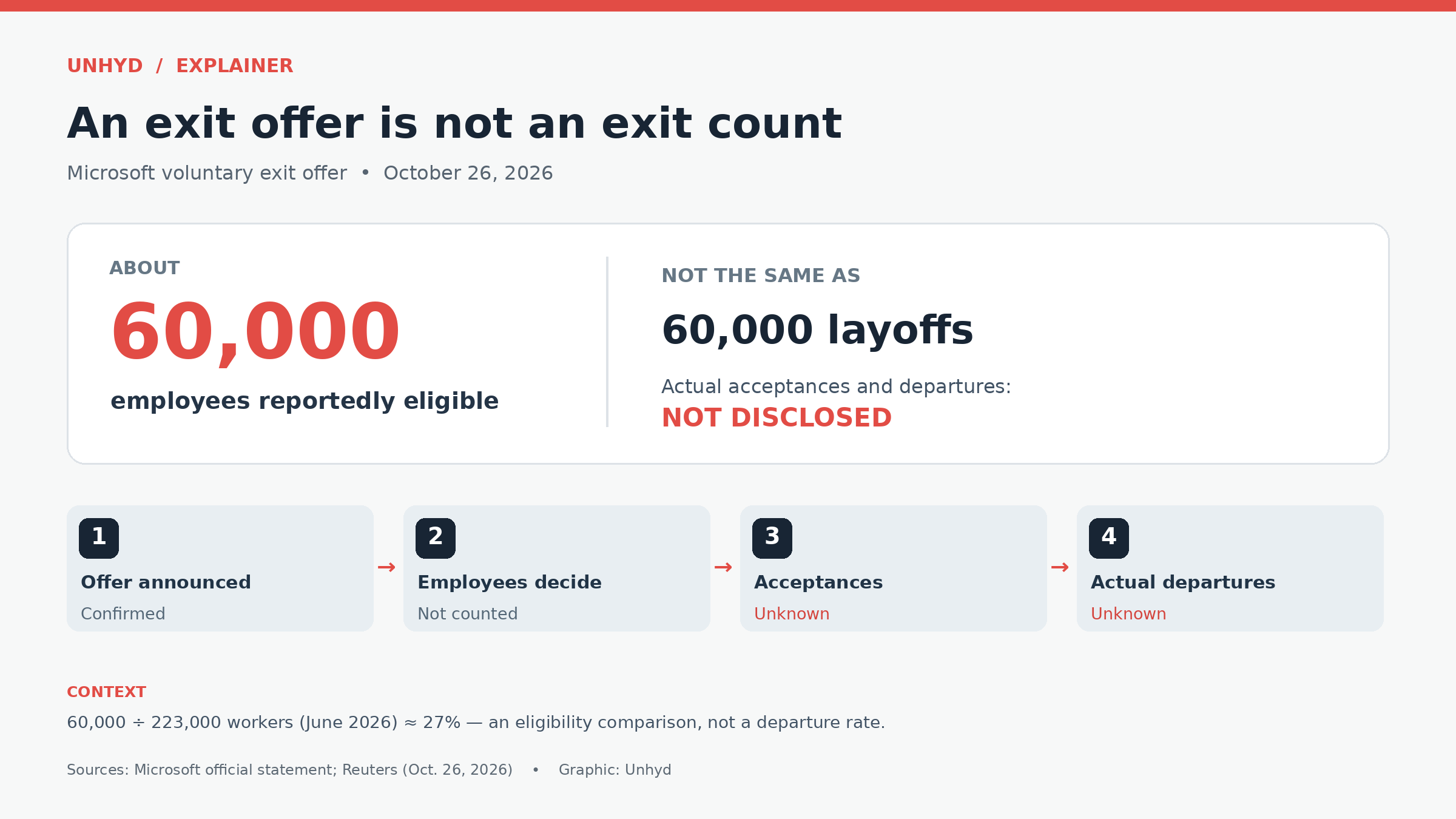
Microsoft announced a new voluntary exit offer on October 26 for eligible employees in selected teams across the United States, Canada, the United Kingdom and India. Reuters reports that about 60,000 employees may qualify. That is a substantial group, but it is not a count of layoffs, accepted buyouts or completed departures. The difference is essential to understanding what the company actually changed.
In a public message, chief people officer Amy Coleman described the Microsoft voluntary exit offer as a time-limited choice for eligible workers who are considering leaving. The company says participants can receive financial support and career-planning resources, while the details are being sent to qualifying employees. Microsoft has not publicly supplied a uniform severance amount or a target number of exits.
What the Microsoft voluntary exit offer actually covers
The program is open only in participating organizations and to eligible employees at level 70 and below in the four named countries. Microsoft says some business groups are taking part and others are not; eligibility depends on each group’s priorities, customer commitments and staffing needs. Its public statement does not establish that everyone below that level qualifies or that an employee must take the offer.
Coleman presented the program as an additional workforce-management option following an earlier voluntary retirement initiative. Her message says employees will receive individual offer details, rather than publishing a single set of terms that applies to all countries. The company also says it will continue to support skills development and internal opportunities. Those commitments do not disclose how many people will ultimately leave.
Why the 60,000 figure is not a layoff total
Reuters reported that about 60,000 employees are eligible, citing information about the participating groups. Microsoft’s own published memo confirms the program and eligibility framework but does not give the 60,000 figure. That distinction matters: the approximate number is independently reported, not a number in the company’s public announcement.
Microsoft reported 223,000 full-time employees worldwide as of June 30, 2026. Dividing 60,000 by 223,000 gives about 26.9%, or roughly 27% of that earlier workforce count. This is an illustrative comparison of two reported figures from different dates and definitions, not an official participation rate. Employees who are offered an exit can decline; employees who accept may have different departure dates. Neither the acceptance rate nor the eventual headcount change is known.
What employees need to verify before deciding
The public announcement is not a substitute for an individual offer letter. An employee weighing the program should check the precise deadline, payment formula, benefits continuation, treatment of unvested equity, rehire rules, and whether the offer changes any existing rights. Terms may vary by country and employing entity. Anyone whose immigration status, retirement eligibility or health coverage depends on employment should obtain advice specific to those circumstances before signing.
It is also important to distinguish an invitation to consider an exit from a requirement to leave. Microsoft calls this a voluntary program. Nothing in the published memo establishes that declining an offer triggers termination. At the same time, a voluntary program does not guarantee that the company will avoid future involuntary changes. Employees should rely on the actual documents they receive, not assumptions based on a headline.
AI spending is relevant context—not proof that AI replaced these jobs
The announcement arrives during heavy spending on AI infrastructure. Reuters says Microsoft has forecast about $175 billion in capital expenditures for calendar 2026. That provides context for investor scrutiny of costs and returns. It does not establish that an AI model can now perform the work of the employees offered buyouts, or that AI spending caused each eligibility decision.
Microsoft’s own announcement emphasizes organizational flexibility and changing workforce needs, without assigning the program to a particular technology or claiming a measured productivity gain. Unhyd made a similar distinction in its analysis of Barclays job cuts: technology investment, restructuring and changes in headcount can occur together without proving a one-to-one causal relationship. The same evidentiary standard should apply here.
There is also a question about how the remaining workforce will operate. In a separate review of IBM’s workforce research, Unhyd examined why employee judgment, validation and authority to challenge automated outputs matter as AI enters everyday workflows. A voluntary exit program does not answer how Microsoft will distribute work, preserve institutional knowledge or evaluate employee workload afterward.
What would make the workforce impact measurable?
Three subsequent disclosures would be more informative than the headline eligibility count: how many workers accept; how many actually depart, and when; and how the company changes hiring or redeployment in affected teams. Those figures would help separate a large potential offer pool from the realized workforce effect. They could also show whether exits are concentrated in particular occupations, geographies or businesses.
Until those details are available, the most accurate description is that Microsoft has opened a voluntary exit option reportedly covering about 60,000 eligible workers. Calling it 60,000 layoffs would treat a possible decision as an accomplished event. Calling it proof that AI eliminated 60,000 jobs would go further still, beyond the company’s disclosure and the independent reporting available on October 27.