
A hotel cancellation policy determines how much money you may lose when a trip changes. The useful comparison is not a “free cancellation” badge alone: it is the exact deadline, penalty, payment timing and party responsible for the refund. This guide gives travelers a six-field method for comparing rates before booking, using published consumer guidance and a transparent cost example rather than assuming that every hotel follows one rule.
Start with the exact cancellation deadline
A hotel cancellation policy is not simply “free” or “nonrefundable.” Before paying, locate the last date and local time when a cancellation avoids a charge. Confirm the hotel's time zone and whether the deadline means the beginning or end of a calendar day. A deadline expressed as “48 hours before arrival” may be different from one that specifies “two days before check-in,” especially when the reservation crosses time zones. Save the precise terms shown at checkout, not just the search-result badge. If a deadline is unclear, request written clarification before booking. A policy can also change by rate, room type, dates, season or sales channel; do not assume the hotel's general FAQ overrides the rate terms attached to your reservation.
Separate a refundable rate from a prepaid rate
“Pay now” does not necessarily mean nonrefundable, and “pay at property” does not necessarily mean cancellable without penalty. Prepayment describes when money is collected; refundability describes what happens if you cancel. Some refundable reservations require an advance deposit that is returned if you cancel on time. Other reservations charge nothing until arrival but impose a late-cancellation fee. Identify both the payment schedule and the cancellation consequences. For a nonrefundable rate, read whether any exceptions are expressly included. Illness, a changed itinerary or a delayed flight does not automatically override a contracted cancellation condition. A hotel may voluntarily make an exception, but an exception is not the same as a guaranteed right.
Check the actual penalty and the no-show rule
The penalty may be one night's room rate, a percentage of the stay, the full prepaid amount or another stated charge. Ask whether taxes and mandatory fees are included in the calculation. A “one-night penalty” on a five-night stay is not the same exposure as forfeiting the entire booking. A no-show rule may apply if you fail to arrive without notifying the property, and some reservations may be canceled for the remaining nights after a no-show. If your flight is delayed, contact the property and booking intermediary before the check-in cutoff, document their instructions and ask for written confirmation of any changes. Do not assume that a request to modify dates resets the original cancellation deadline.
Identify who actually holds the booking
When you book through an online travel agency, the hotel and the intermediary may have different roles. Your confirmation should identify the merchant charging your card, the reservation holder, the cancellation channel and any service fees. The FTC advises travelers to check whom they are buying from because the intermediary can affect refund rights and procedures. If the booking was made through a third-party platform, cancel through the channel specified in its terms and retain the confirmation. A hotel employee's verbal willingness to waive a fee may not automatically reverse a charge collected by a separate merchant. When both parties are involved, ask each to confirm what it can authorize.
Compare total costs, not just nightly prices
Consider two hypothetical three-night bookings for the same room: a nonrefundable rate of $150 per night and a refundable rate of $165. Ignoring taxes and identical mandatory fees for clarity, the totals are $450 and $495. The flexible rate costs $45 more. If the nonrefundable booking would be entirely lost upon cancellation, that $45 buys protection against a potential $450 loss, subject to the refundable rate's actual deadline. This is a transparent example, not a market-price estimate. A different hotel may impose only a first-night penalty, offer credits rather than refunds, or have substantially different amenities. Compare the total final prices, exact penalty, deadline and payment timing side by side. Do not describe a flexible rate as “free insurance”: it only offers the cancellation rights stated in the contract.
Understand resort fees, taxes and card holds
Cancellation terms should be read alongside the complete price. A rate may exclude parking, pet fees, deposits or other charges until later in the booking process; mandatory charges should be evaluated as part of the price you expect to pay. A security deposit or temporary card authorization is not necessarily the same as a final charge. Ask when a hold will be released and whether your bank may take additional time to restore available credit. If you cancel, ask which components will be refunded, whether the refund returns to the original payment method, and what processing timeline the merchant expects. Keep the final checkout price and receipt for comparison.
Use a six-field booking comparison
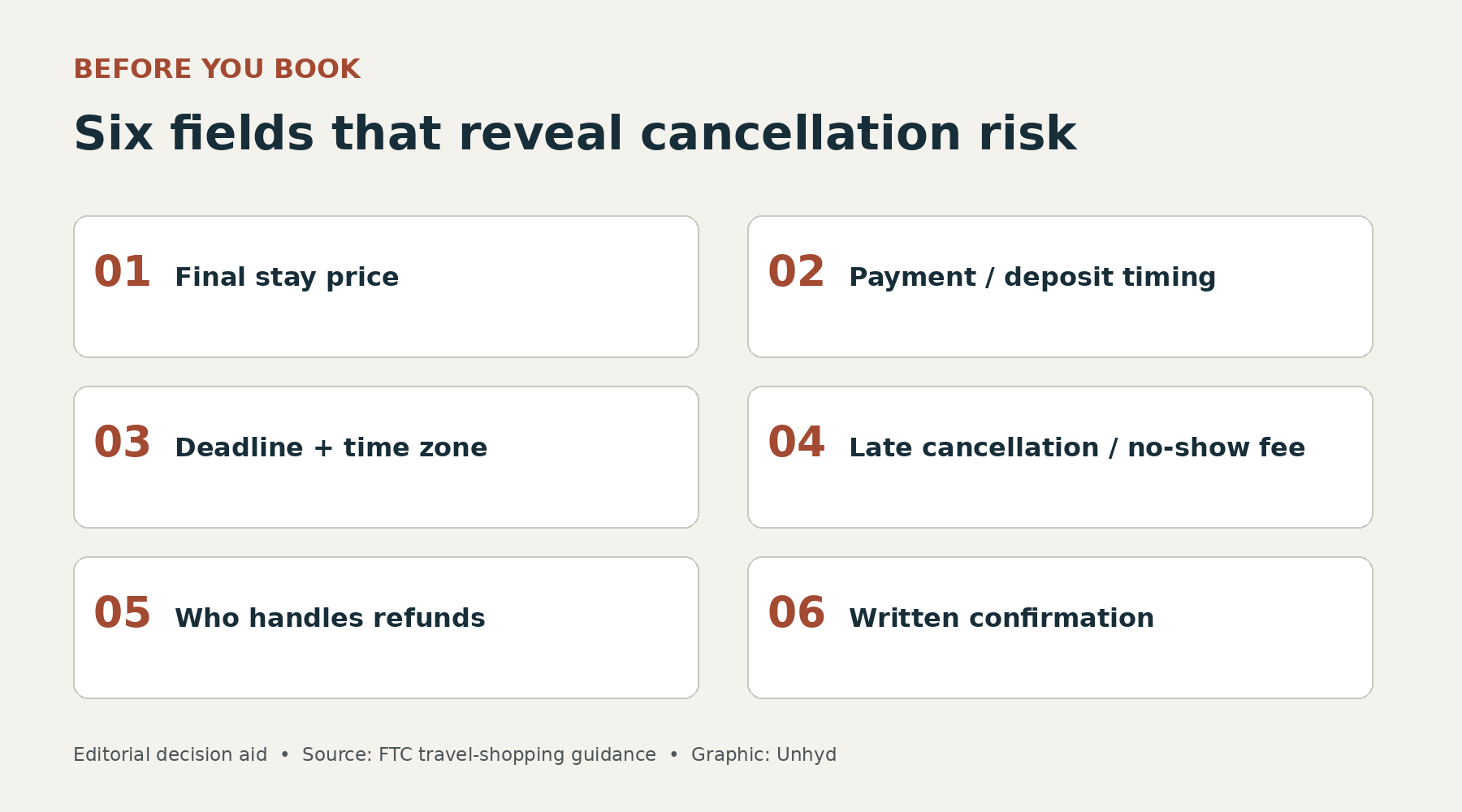
For each candidate rate, write down: (1) final stay price including disclosed mandatory charges; (2) payment or deposit date; (3) last penalty-free cancellation time and its time zone; (4) exact late-cancellation and no-show penalty; (5) who processes a cancellation or refund; and (6) how the terms are documented. These six fields make superficially similar “free cancellation” badges comparable. If one property cannot supply a critical term, mark it unknown rather than treating the missing information as zero cost. The most useful decision is not always the cheapest refundable room: it is the rate whose risk matches the probability and consequences of your plans changing.
What to do if the hotel refuses a promised refund
Start with the written booking terms and the cancellation confirmation. Send a concise request identifying the reservation number, date of cancellation, applicable deadline and the specific refund amount you believe is due. Ask the merchant to explain any discrepancy in writing. Keep emails, screenshots and transaction records. If the merchant does not resolve the issue, review your card issuer's dispute process promptly. A card dispute is not an automatic refund and does not erase a valid nonrefundable agreement; it is a mechanism for challenging qualifying billing problems. The FTC recommends preserving documentation and checking the seller and cancellation terms before payment. If the dispute concerns an intermediary, identify which entity actually charged the card before selecting a dispute reason.
When flexible booking is worth paying for
Flexibility becomes more valuable when travel dates are uncertain, a trip involves several dependent reservations, or a missed connection could prevent arrival. A firm itinerary, a modest penalty or a large flexible-rate premium may lead to a different decision. Travel insurance can sometimes cover specified disruptions, but it is a separate contract with exclusions, limits and claims requirements; do not assume it reimburses every voluntary cancellation. For expensive trips, read both the hotel contract and any insurance policy before purchasing either. The practical rule is to compare what you pay for flexibility against the actual amount you could lose, while checking the deadline and merchant responsible for honoring the terms.
For additional context, see the FTC's travel-shopping advice and Unhyd's guides to verifying an online seller and subscription cancellation laws. The latter concerns recurring services, not a general legal right to cancel hotel reservations.