

2027 Medicare Part D costs will be governed by a higher annual out-of-pocket threshold and a higher maximum deductible, even as federal officials project little change in the average premium for stand-alone prescription drug plans. Those three figures measure different things. Treating any one of them as the price a particular person will pay can produce a misleading comparison.
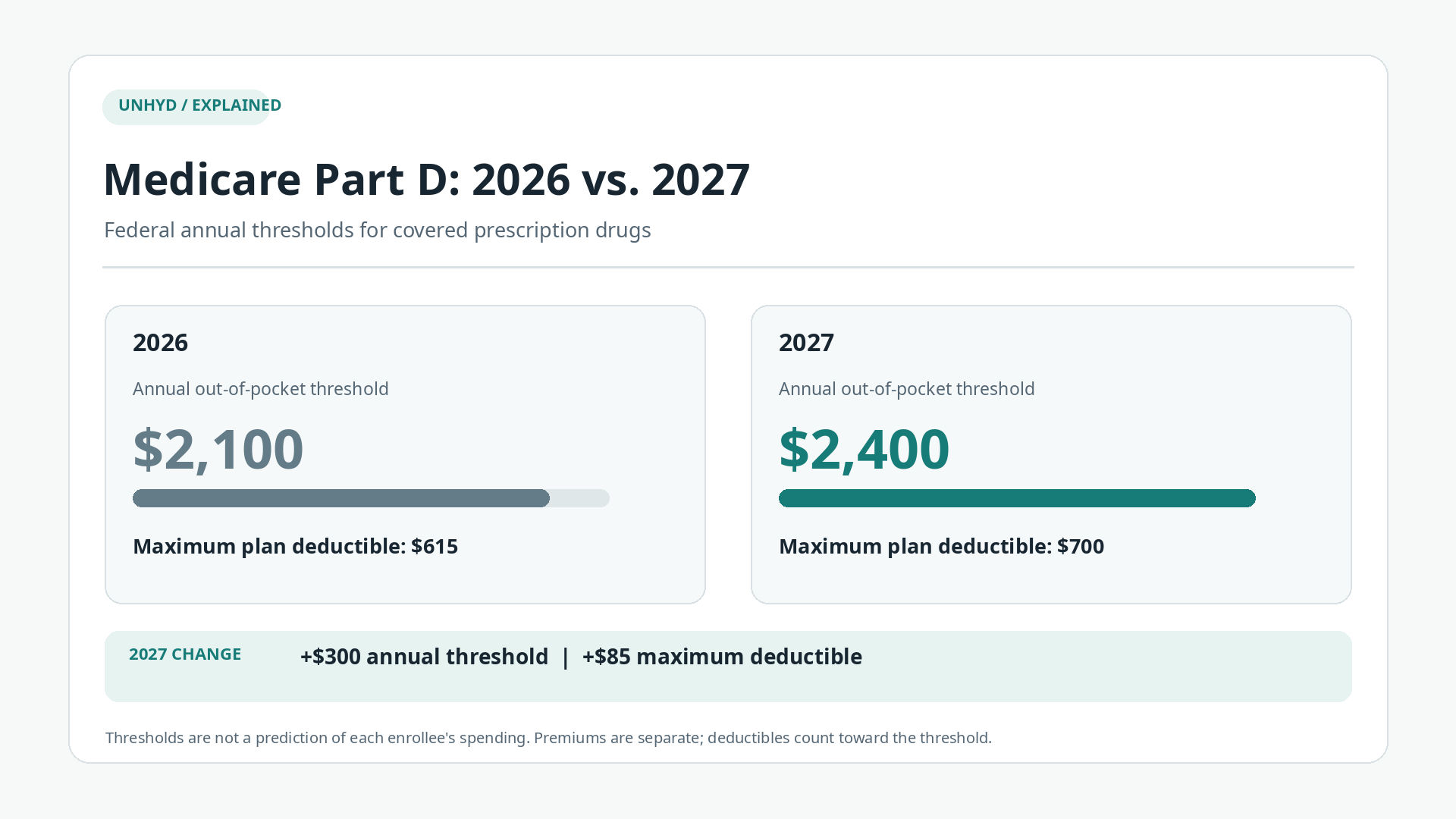
For 2027, Medicare lists a $2,400 annual out-of-pocket threshold for covered Part D drugs, up from $2,100 in 2026. The maximum plan deductible rises from $615 to $700. Separately, the Centers for Medicare & Medicaid Services (CMS) projects that the average monthly premium for stand-alone Part D plans will increase from $35.09 to $36. These are national program parameters and projections, not individualized plan quotes.
The distinction matters during Medicare's annual open enrollment period, October 15 through December 7, 2026, when beneficiaries can compare plans for coverage beginning January 1, 2027.
The 2027 Medicare Part D numbers, calculated carefully
Medicare's official drug-cost guidance gives the 2026 and 2027 deductible and out-of-pocket figures. CMS's September 28 premium projections supply the national average stand-alone premium figures.
- Annual covered-drug out-of-pocket threshold: $2,100 in 2026 versus $2,400 in 2027, an increase of $300, or approximately 14.3%.
- Maximum plan deductible: $615 in 2026 versus $700 in 2027, an increase of $85, or approximately 13.8%. A particular plan may charge less or no deductible.
- Projected average monthly stand-alone Part D premium: $35.09 in 2026 versus $36 in 2027, an increase of $0.91, or about 2.6%. An individual plan's premium can change by much more or less.
These percentage changes are Unhyd calculations from the published figures: change divided by the 2026 amount, multiplied by 100. They describe changes in the stated measures, not an estimate of the average enrollee's total spending.
Why the $2,400 cap is not your entire prescription budget
Medicare Part D's annual threshold applies to qualifying out-of-pocket spending on drugs covered under the Part D benefit. Once the threshold is reached, the enrollee enters catastrophic coverage and pays nothing out of pocket for covered Part D drugs for the remainder of that calendar year.
But the threshold is not a cap on every healthcare expense. Monthly Part D premiums are separate. Drugs not covered by the plan, and services or medications covered under different parts of Medicare, need separate consideration. The threshold can also include certain payments made on a beneficiary's behalf, including qualifying assistance, so it should not always be interpreted as money the person personally paid.
The deductible is not an additional $700 charged on top of the $2,400 threshold. Eligible deductible spending contributes toward the applicable out-of-pocket accounting. Adding $700 and $2,400 as though they were two independent maximum charges would double-count that component.
Nor will everyone reach the cap. Someone who fills only inexpensive covered prescriptions may pay far less than the annual threshold. Someone with expensive covered medicines may reach it, but the timing and amount paid along the way depend on the plan, the drugs and other applicable assistance.
A hypothetical budget shows what the numbers can and cannot prove
Consider a simplified example in which a person reaches the annual covered-drug out-of-pocket threshold in both 2026 and 2027, personally pays the full qualifying amount without assistance credited toward that threshold, and pays the same hypothetical $40 monthly Part D premium in both years. Ignore other medical expenses and assume no additional noncovered drug costs.
In 2026, the arithmetic is $2,100 plus 12 months at $40, or $2,580. In 2027, it is $2,400 plus 12 months at $40, or $2,880. The difference is $300. This is a comparison of maximum covered-drug exposure under fixed illustrative premium assumptions, not a forecast that a particular beneficiary's spending will rise by $300.
If the person never reaches the threshold, the comparison changes. If the plan's premium, formulary, pharmacy network or copays change, the comparison changes again. The national average premium should not be inserted into this example as though it were the individual's actual premium.
How to compare actual 2027 plans without confusing the measures
Start with a complete list of current prescriptions: exact drug names, dosages, quantities and expected refill frequency. Then use the official Medicare plan-comparison route to review available 2027 options in the relevant area.
Check whether each drug is on the plan's formulary, whether it falls on a preferred or higher-cost tier, and whether prior authorization, step therapy or quantity limits apply. Check the pharmacies you actually use; a preferred pharmacy can affect costs. Review the monthly premium, the plan-specific deductible and the estimated yearly drug cost together.
Pay particular attention to the annual notice of changes from an existing plan. Remaining enrolled does not guarantee identical 2027 drug coverage, pharmacy arrangements or prices. A lower premium is not necessarily a lower total cost if an important medicine becomes more expensive or harder to obtain.
Plan comparison also involves sensitive information. When using a third-party medication app or comparison service, consider what prescription details it collects and retains. Unhyd's health app privacy checklist explains how to evaluate permissions and data-sharing claims. That privacy review is separate from determining whether a plan covers a medication.
Spreading drug bills across months is not the same as reducing them
The Medicare Prescription Payment Plan is a voluntary option that lets people with eligible Medicare drug coverage spread qualifying out-of-pocket prescription costs over the calendar year. Medicare explicitly states that the arrangement does not reduce the underlying drug costs.
That distinction can matter for a person facing substantial expenses early in the year. Smoothing the timing of payments may make cash flow easier to manage, but it does not make an uncovered drug covered, remove a plan premium or turn a higher total into a lower one. Monthly payment amounts can change as additional prescriptions are filled.
People who qualify for Extra Help or other assistance should evaluate those programs separately. Assistance may reduce premiums or cost sharing; the payment plan is primarily about timing.
What the national premium forecast does not establish
CMS projects an average stand-alone Part D premium of $36 a month in 2027, compared with $35.09 in 2026. The difference is modest at the national-average level. But it does not establish that every beneficiary's bill will rise by only 91 cents, that every plan will remain available, or that drug coverage will stay unchanged.
These are projections aggregated across plans and enrollment assumptions. They are useful for describing the market, not for choosing an individual policy. The Medicare Extra Help guidance also makes clear that eligible beneficiaries can face materially different cost-sharing arrangements from people who do not receive assistance.
The decision to make before December 7
The most useful question is not simply whether the 2027 cap is higher. It is whether a particular plan covers the medicines you need at the pharmacies you can use, and what its estimated full-year cost looks like after premiums and covered-drug spending are considered separately.
The federal threshold offers an important backstop for covered Part D drugs. It does not replace plan-by-plan comparison, and it does not convert national premium averages into individual price guarantees. Use the official plan finder, keep copies of the relevant terms and ask the plan or Medicare for clarification before changing coverage. This article is general consumer information, not individualized medical, insurance or financial advice.