

Personalized pricing is the practice of tailoring a price or offer using information about a shopper. If you suspect an online price changed because of who you are, a careful comparison can help you make a better purchase decision—but a screenshot of two different prices cannot, by itself, prove that a company used your personal data. Time, inventory, location, loyalty status, delivery options and taxes can also change what appears on screen.
The distinction is especially relevant after the Federal Trade Commission's October 28, 2026, inquiry into how nine large companies may use personal information in pricing and gig-worker compensation. The agency has requested documents; it has not announced findings that those companies improperly charged shoppers. Unhyd's analysis of the FTC inquiry examines the official orders. This guide addresses a different reader need: how to compare a price responsibly before buying, without mistaking an ordinary price change for evidence of targeting.
Personalized pricing, dynamic pricing and discounts are not identical
Dynamic pricing means a price changes in response to conditions such as demand, available inventory or time. A ride may cost more when fewer drivers are available, or a hotel room may cost more on a busy weekend. That does not establish that the seller calculated a unique price from your browsing history.
Personalized pricing uses data about an individual or group of shoppers to shape a price, discount or offer. The FTC's January 2025 staff findings describe how intermediaries can use location, browsing patterns, purchase history and other behavioral information. The agency's examples include tailored offers and product rankings, not just changes to a displayed price.
A loyalty discount may be openly offered to every enrolled member, while a targeted coupon may vary by user. Either could affect the price you pay, but the reason for the difference matters. A coupon shown only to one shopper is not proof that the base price was raised for someone else. Likewise, two different totals can reflect a different delivery fee rather than a different product price.
Start by comparing the same item and the same transaction
For a product, write down the exact model, size, quantity, color and condition. For a flight, compare the same route, date, departure time, fare class, baggage allowance and refund conditions. For a ride, compare the same pickup and destination, service tier and estimated time. If those inputs differ, the price comparison may be useful for shopping but cannot isolate personalization.
Next, record the time of each quote. If possible, compare within a short window rather than hours apart. A retailer can update inventory or promotions while you are testing. Keep the same delivery ZIP code and fulfillment method where the site permits. Do not falsify an address or identity to obtain a price; the goal is to understand an offer, not circumvent a seller's eligibility rules.
Compare the total payable amount, not only the large number on the first page. Shipping, service charges, mandatory fees and taxes may appear later. The FTC's online shopping guidance specifically recommends comparing total costs and keeping records of the offer and transaction. A lower product price with higher required fees may not be a better deal.
A five-field price comparison that avoids false conclusions
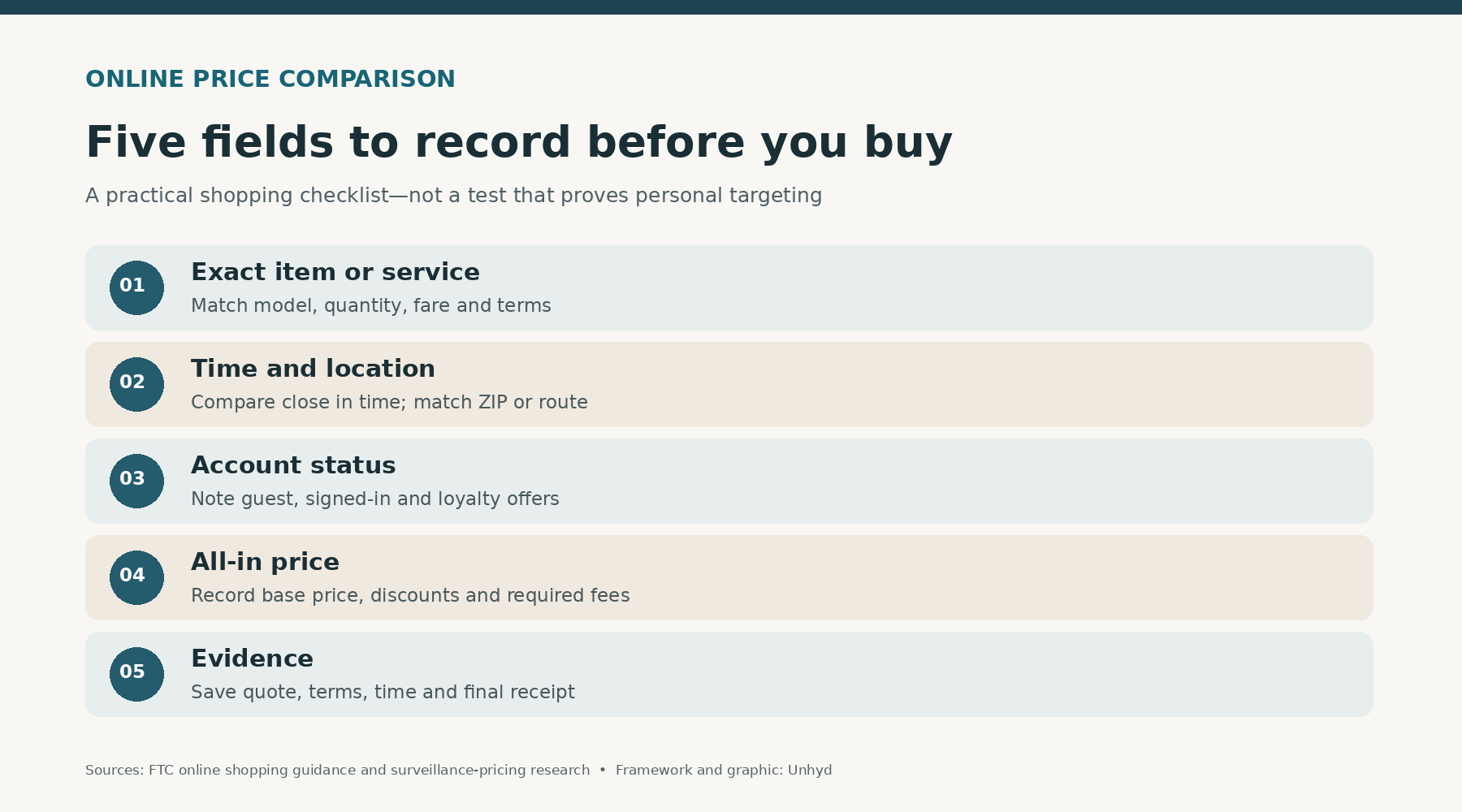
Make a simple note with five fields: (1) exact item or service and its terms; (2) time and location; (3) logged-in, guest or loyalty status; (4) item price, discounts, required fees and final total; and (5) a screenshot or saved confirmation showing what was actually offered. This is an Unhyd decision aid, not a validated forensic test for algorithmic discrimination.
If the same offer differs between an account session and a guest session, check whether one has a membership discount, coupon, promotional credit or different delivery address. If you cannot explain the difference, ask the seller how the price was determined and whether account or browsing data affect it. Save the answer. A difference that remains unexplained is a reason to seek clarity, not conclusive evidence of unlawful conduct.
Even a carefully matched comparison has limits. A website may run a randomized experiment, rotate promotions or update prices between page loads. Two accounts may be assigned to different tests without using personal information to predict willingness to pay. Establishing the underlying cause usually requires internal pricing rules, experiments or records that an ordinary shopper cannot access.
What private browsing and a VPN can—and cannot—tell you
A private browser window can reduce reliance on cookies stored in your normal session, but it does not make you anonymous. A site can still see information such as your network address, and you may reveal your identity again when signing in or checking out. A virtual private network can change the apparent network location, but it can also change the regional offer or trigger fraud checks. Neither method guarantees the lowest price.
The FTC's August 2026 proposed enforcement policy statement discusses private browsing and VPNs as measures consumers might consider. It does not establish that these methods reliably defeat personalized pricing. A change in price after switching browsers or locations remains an observation requiring explanation, not proof of the algorithm's intent.
If you want to limit unnecessary tracking, review an app's location permissions and the seller's privacy settings. The FTC advises consumers to examine what personal information shopping apps collect, how it is used and whether a less intrusive option exists. Unhyd's guide to removing personal information from the internet explains the different, longer-term problem of data broker records. Deleting broker data is not a guaranteed fix for pricing differences inside a retailer's own account.
How to compare prices without giving up a genuine discount
Check whether a logged-in price includes a loyalty benefit you would lose as a guest. For groceries, compare unit prices for the same package size; a larger package can appear more expensive while costing less per ounce. For travel, compare the full fare and included services, not a basic fare against a refundable fare. For deliveries, compare delivery windows, service fees and minimum-order rules.
When you see a lower price elsewhere, check the retailer's published price-match policy. Some policies exclude marketplace sellers, member-only prices, clearance goods or different fulfillment channels. A screenshot may help document an offer, but the retailer's written terms govern whether a match is available. Consider setting a price alert for purchases that can wait, and compare multiple reputable sellers rather than repeatedly refreshing a single page.
Do not assume a higher price means discrimination or a lower price means generosity. A seller can lawfully use some promotions and pricing models, subject to applicable law and disclosures. The consumer's immediate goal is to make a well-informed purchase; a legal conclusion requires more evidence than an individual comparison usually supplies.
What the FTC has established, and what it is still investigating
The FTC's 2025 staff study found that intermediaries offered tools capable of tailoring prices, promotions or rankings using granular consumer information. Its public examples were illustrative and the study focused on intermediaries rather than proving that a particular retailer charged a named customer more. The 2026 inquiry seeks information directly from companies, including methods and data inputs. The orders themselves are requests for information, not findings of misconduct.
In August 2026, the FTC proposed an enforcement policy statement concerning undisclosed personalized pricing. The agency said it cannot ban personalized pricing in every circumstance, but some undisclosed practices could violate existing consumer-protection law. A proposal for public comment is not a blanket final federal ban. State requirements may differ, so readers should check current rules where they live rather than relying on a national one-line answer.
This guide also should not be confused with Unhyd's analysis of alleged shelf-to-checkout overcharges at Dollar General. A shelf price that differs from the register price raises an accuracy issue. Personalized online pricing asks whether personal information shaped an offer. Both warrant careful documentation, but they involve different evidence and legal questions.
When to contact the seller or report a concern
Ask the seller to explain a discrepancy when two otherwise comparable offers differ materially, when an advertised discount disappears at checkout, or when required fees are not clearly disclosed. Give the company the product identifier, quote time, relevant terms and screenshots without sending sensitive account credentials. Keep the correspondence and final receipt.
If you believe an advertisement or checkout process was deceptive, the FTC's consumer guidance explains how to report problems and preserve records. Reporting a concern does not guarantee a refund or prove that the seller violated the law. If the issue is a billing error, contact the payment provider promptly and follow the applicable dispute procedures.
The most useful outcome of a price comparison is often modest: discovering a cheaper legitimate offer, identifying a fee, or learning that a loyalty discount explains the difference. A disciplined comparison can protect a purchase decision even when it cannot reveal the seller's algorithm. Treat price differences as questions to investigate, not conclusions to announce.