

An extended warranty can sound like inexpensive peace of mind at checkout, particularly when a new phone, laptop, television, or appliance already feels costly. But deciding whether to pay for extra protection requires a different question: what would this particular contract pay for that the product’s existing warranty, return policy, or other coverage would not?
The Federal Trade Commission’s guidance on service contracts makes the distinction explicit. A paid plan may overlap with coverage already included in the purchase, impose a deductible, exclude common problems, or require an inconvenient claims process. The sensible decision is therefore a contract comparison, not a vote for or against all warranties.
Start with the warranty you already have
Before accepting a paid offer, obtain the manufacturer’s written warranty for the exact model and purchase location. Record its start date, duration, covered components, exclusions, and available remedies. The FTC says written warranties must be available to read before purchase, whether the transaction takes place online or in a store.
Next, distinguish that manufacturer warranty from the retailer’s return policy. A return window is the period in which a merchant may accept a product back under stated conditions. A warranty generally addresses specified failures or defects under its terms. One does not automatically substitute for the other. A store might allow a short return period while the manufacturer provides a longer repair warranty.
Also check any benefits attached to the payment method or a separate policy you already hold, but verify eligibility and exclusions directly rather than assuming a credit card, insurance policy, or retailer membership extends coverage. The relevant documents—not the marketing slogan—control.
State-law implied warranties can add another layer of protection. The FTC explains that these are legal promises about a product’s fitness or ordinary function, but their scope, duration, and possible disclaimers vary by state. Do not assume a paid service contract is the only route to a remedy for a defective product. If a significant dispute arises, consult the relevant state consumer-protection office rather than treating a national checklist as a ruling on your legal rights.
Where an extended warranty may overlap with a one-year warranty
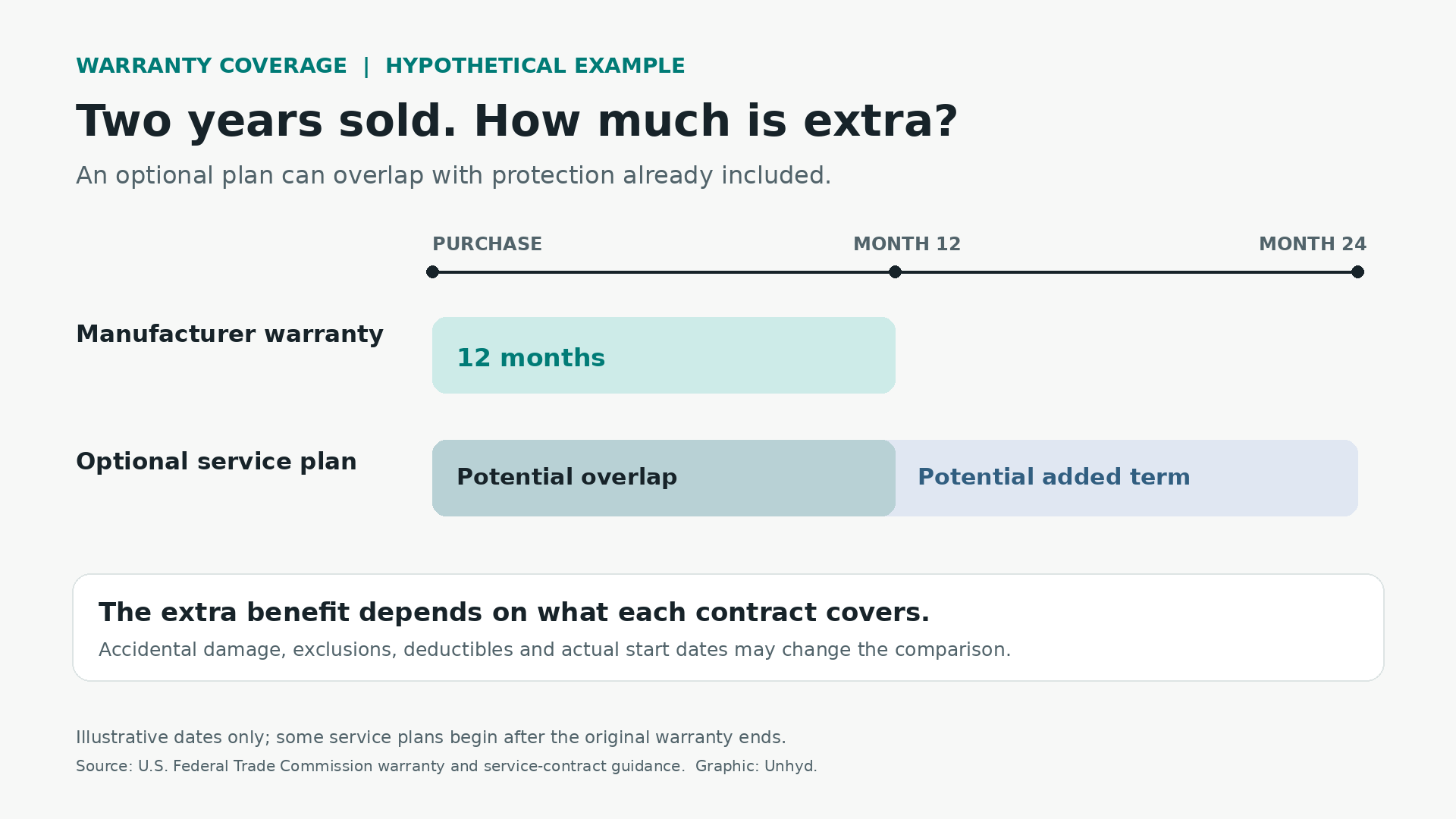
Consider a hypothetical electronic device with a manufacturer’s limited warranty covering certain defects for 12 months from purchase. At checkout, the seller offers a separate 24-month service contract that also begins on the purchase date. If the contract covers only some of the same defects in the first year, part of the paid term may duplicate protection already provided by the manufacturer.
That does not mean the entire contract is useless. It might include accidental-damage protection the manufacturer excludes, or provide qualifying repairs during months 13–24. But the two-year headline does not prove the buyer receives two additional years beyond the manufacturer’s warranty. The effective extra benefit depends on when the paid contract starts and which failures it covers.
Some plans begin after the original warranty ends; others run concurrently, and terms vary by product and provider. Ask for the actual coverage dates and whether a claim is directed to the manufacturer first. Do not assume a contract described as “extended” necessarily extends the calendar by its full advertised duration.
Calculate the price of protection, including the claim fee
Here is a second, deliberately simplified example. Suppose a paid service contract costs $120 upfront and requires a $40 deductible for one eligible repair. Assume a repair after the manufacturer’s coverage expires would cost $220 without the plan, and assume the contract would cover the entire eligible repair cost apart from the $40 deductible. Exclude taxes, shipping, limits, and delays for this illustration.
If no repair occurs: the buyer spends $120 for the optional plan and $0 on repair. If exactly one qualifying $220 repair occurs: the buyer spends $160 with the plan ($120 plus $40) versus $220 without it, a $60 difference in favor of the plan. These are two possible outcomes under stated assumptions, not predictions of the chance of failure.
That $60 advantage disappears if the repair is excluded, the provider denies a claim, the plan imposes additional fees, or the same defect would have been fixed under existing coverage. If the repair would cost less than $160, paying out of pocket is cheaper in this single-claim illustration. Actual policies can have multiple claims, different deductibles, reimbursement caps, and replacement rules.
A proper expected-cost calculation would also require a defensible estimate of the likelihood, timing, and cost of covered failures. This article does not invent one. A buyer can still make a useful decision by comparing the known contract price and maximum potential benefit, then considering their own ability to absorb a repair bill.
Read exclusions before you compare prices
For electronics, ask whether the plan covers accidental drops, liquid damage, battery degradation, charging ports, screens, power surges, or only mechanical and electrical defects. These are examples of questions, not a claim that any specific plan covers them. “Full protection” in an advertisement may have limits in the actual contract.
Check whether cosmetic damage is excluded, whether the provider uses refurbished replacement units, whether parts and labor are included, and whether there is a maximum total reimbursement. A replacement may be subject to a service fee, model-substitution rules, or a payout capped at the original purchase price. If a term is unclear, request a written explanation before paying.
For a phone, repairability and service availability matter separately from warranty coverage. Unhyd’s explanation of the EU phone repairability label shows how standardized repairability information can help assess design and parts access, while also noting that the label is not a promise of a cheap repair or a warranty benefit in the United States.
Who actually owes you the repair?
The name on the retail checkout page may not be the company administering claims. The FTC advises consumers to identify the company responsible for coverage, examine its reputation, and understand how claims work. Confirm whether repairs require prior authorization, a specific service center, shipment at your expense, or reimbursement after you pay a technician.
Ask how long a repair or replacement typically takes, what happens if a replacement is unavailable, and whether the contract can be transferred or canceled. Do not treat a customer-service estimate as a guaranteed turnaround unless the contract makes it enforceable. A plan that looks generous but is difficult to use may be worth less than the marketing presentation suggests.
Keep a copy of the contract, receipt, product serial number, and any promises made in writing. The FTC’s warranty guide recommends saving proof of purchase and warranty documents because they may be needed when a claim arises.
When paying for coverage can make sense
Extra coverage may be more useful when it addresses a realistic loss that the original warranty excludes, the replacement cost would strain the buyer’s budget, and the contract provides a credible route to repair or replacement. For example, accidental-damage coverage can be a different product from a defect-only manufacturer warranty. Whether it is worth the price depends on the actual exclusions and the buyer’s circumstances.
It may be less compelling when the device is inexpensive to replace, the contract substantially duplicates existing coverage, the deductible is high relative to a typical repair, or the buyer expects to replace the product before the paid coverage provides much incremental benefit. None of those judgments requires an unsupported industry-wide claim that most plans are good or bad.
The FTC also suggests a different approach: setting aside money for future repairs rather than paying for a service contract. That is not risk-free. A savings fund may be insufficient if a major repair occurs immediately, but the money remains available for other needs if the device never fails.
What to do if the product is recalled
A safety recall is a separate issue from an ordinary breakdown or optional protection plan. Before paying for a repair to a potentially recalled product, check the manufacturer’s and relevant agency’s notices. Unhyd’s guide to checking U.S. product recalls explains how to match a model or lot number and follow the issuing authority’s instructions. Do not assume a paid warranty is necessary to obtain a remedy described in an applicable recall.
A six-question test at checkout
- What coverage is already included? Compare the manufacturer warranty and return policy.
- When does the paid plan begin and end? Identify overlapping months rather than counting the headline term twice.
- What specific failures are covered? Read the exclusions, limits, and accidental-damage terms.
- What is the complete cost? Add the premium, claim deductible, shipping, and any known fees.
- Who handles a claim? Verify the administrator, service network, authorization process, and remedies.
- Could you reasonably self-fund a repair? Compare the worst manageable bill with the cost of protection.
During the 2026 holiday shopping season, the question is especially timely: an October 21 Consumer Technology Association survey found that 86% of respondents considered pricing extremely or very important when choosing where to buy technology gifts. The survey of 1,210 U.S. adults measures stated shopping attitudes; it does not establish whether those shoppers will buy extended warranties or whether such plans save money.
The best answer to “Is an extended warranty worth it?” is specific to the device, the written contract, and the risk the buyer is trying to cover. An offer that adds useful protection at a manageable cost may deserve consideration. An offer that mostly repeats coverage already included in the price deserves skepticism. Read the contract before treating the extra charge as insurance against every future problem.