
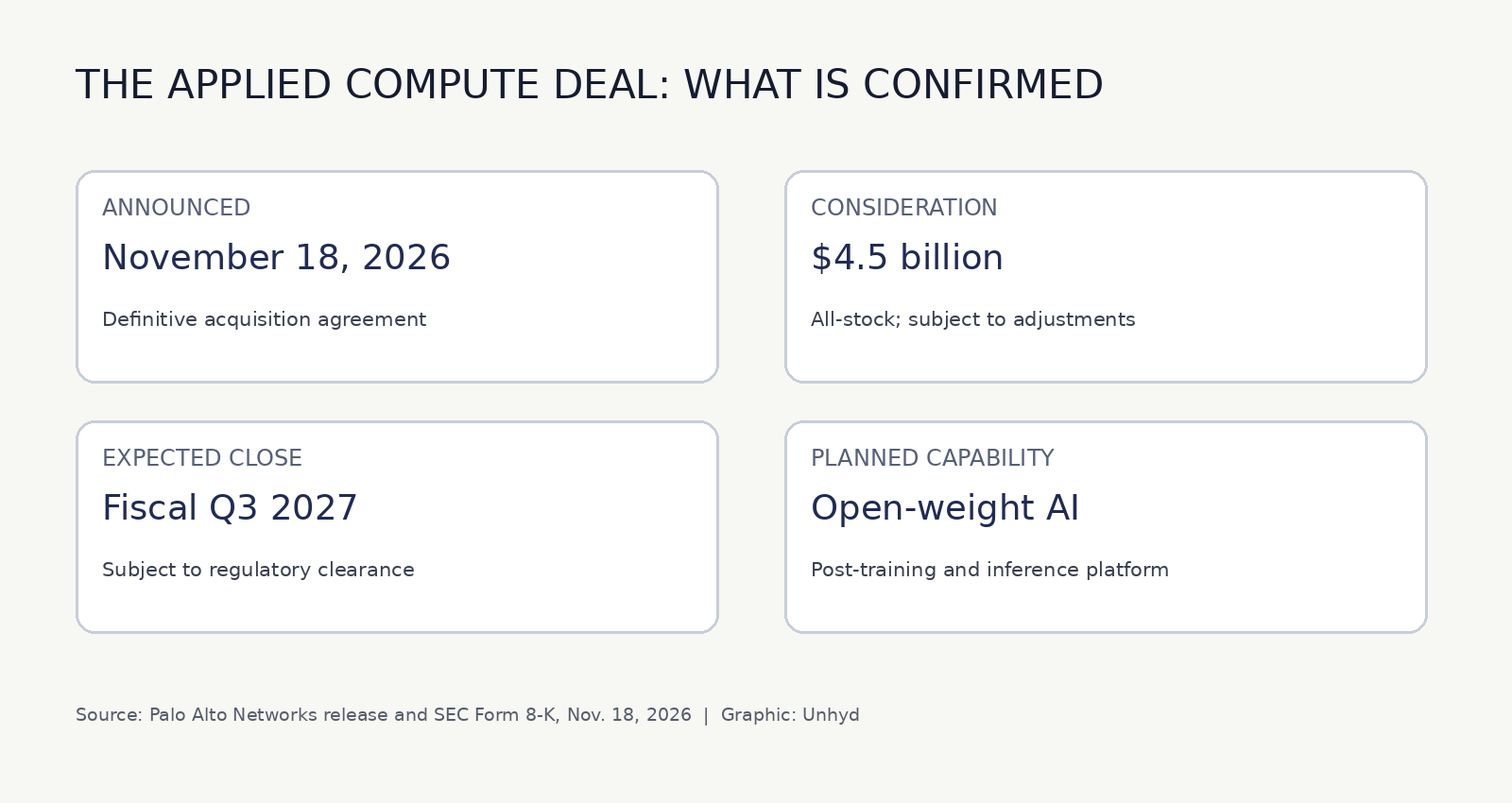
Palo Alto Networks' proposed acquisition of Applied Compute is more than another cybersecurity deal. Announced on November 18, 2026, the $4.5 billion all-stock agreement would give the company a platform for adapting and running open-weight artificial intelligence models. It also raises a question enterprise customers cannot answer from an acquisition announcement alone: what does it mean to secure an AI model throughout training, deployment and operation?
The transaction is a definitive agreement, not a completed acquisition. In its SEC filing, Palo Alto Networks said the consideration is subject to adjustments and will be paid in its common stock. The number of shares to be issued was not yet known when the filing was made. Closing is expected during the company's fiscal third quarter of 2027, subject to regulatory approval and other conditions.
What Palo Alto Networks is buying
Applied Compute specializes in post-training and inference for open-weight AI models. Post-training refers to work performed after a foundation model's initial training, such as adapting its behavior for a particular application. Inference is the process of running the model to generate outputs. Both stages matter to enterprises seeking to customize models while retaining control over sensitive data and operating costs.
According to the company's announcement, Palo Alto Networks intends to offer capabilities to train, adapt and deploy open-weight models in public-cloud and sovereign environments. The company also expects Applied Compute's research team to support AI development across its broader product portfolio.
Yash Patil, Applied Compute's co-founder and chief executive, is expected to become Palo Alto Networks' co-chief AI officer after the deal closes. That leadership plan indicates the buyer is acquiring technical talent and research capacity as well as a software platform. It does not, by itself, establish how the two companies' products will be integrated.
Why open-weight AI changes the security discussion
Open-weight models make model parameters available for use and adaptation under applicable license terms. That flexibility can give organizations more deployment choices than a service available only through a closed provider's interface. It also transfers significant operational responsibility to the organizations deploying and modifying those models.
Security is therefore not a single feature. A company evaluating an open-weight deployment must consider where its data is stored, who can change model configurations, how access is controlled, whether outputs can expose sensitive information and how incidents can be investigated. The appropriate safeguards depend on the deployment and threat model; neither an open-weight nor a closed model is automatically secure.
Palo Alto Networks says its Unit 42 Frontier AI Assessment identified strong security foundations at Applied Compute. That is a statement about an assessment by the acquiring company's own security organization. The public announcement does not provide enough detail to treat the claim as an independent, comprehensive validation of all future combined offerings.
What the $4.5 billion figure does—and does not—show
The merger filing specifies $4.5 billion in consideration, subject to adjustments, and a reference share price of $337.16 calculated from a 15-trading-day volume-weighted average ending November 17. It does not establish a final closing share count. The consideration is a transaction valuation, not evidence that the acquired platform will generate a particular amount of revenue or savings.
The acquisition comes as Palo Alto Networks expands its broader security platform strategy. Reuters reported that the company also raised its fiscal 2027 revenue forecast to $14.52 billion–$14.57 billion, from $14.10 billion–$14.20 billion. Those company-wide financial projections should not be confused with forecasts for Applied Compute or for the eventual combined AI offering.
Five questions enterprise buyers should ask
First, what security controls are available now? Buyers should distinguish existing, generally available functions from features promised after the transaction. Palo Alto Networks' announcement itself warns that unreleased capabilities may not arrive when expected—or at all.
Second, where do models and customer data operate? The promise of public-cloud and sovereign deployment is meaningful only when buyers can review the actual hosting architecture, geographic controls, contractual commitments and applicable compliance evidence.
Third, how are model changes governed? Organizations need to understand who can modify weights, adapters, prompts and deployment settings, and whether changes are recorded in a way that supports auditing and rollback.
Fourth, what has been independently tested? Internal assessments can inform product development, but customers should request appropriate technical documentation and third-party assurance where their risk profile requires it. A marketing description of secure AI is not a substitute for evidence.
Fifth, what happens during integration? The transaction has not closed. Procurement teams should establish which company is responsible for support, service levels, incident response and data handling before and after any future product migration.
The bigger strategic test
The proposed acquisition illustrates a shift in cybersecurity competition: vendors increasingly want to provide the infrastructure on which AI is customized and run, rather than only tools that protect applications built elsewhere. That could simplify procurement for some customers, but it could also make the boundaries between AI platform provider, security assessor and security vendor harder to evaluate.
For now, the clearest verified facts are the agreement, its consideration, its expected closing period and the buyer's stated ambitions. Whether the combined business can deliver demonstrably safer enterprise AI deployments remains a question for product documentation, customer testing and independent scrutiny after integration—not a conclusion established by the announcement.