
Hotel resort fees are mandatory charges that some properties add for facilities or services such as pools, fitness centers or Wi-Fi. The name on the bill does not determine whether the charge is optional. For travelers comparing rooms, the most useful question is what they must actually pay for the stay—and when that total must be displayed.
In the United States, the Federal Trade Commission's Rule on Unfair or Deceptive Fees has applied to covered short-term lodging offers since May 12, 2025. The rule requires businesses that advertise prices to display the total price, including mandatory fees they can calculate upfront, prominently. It does not ban resort fees outright. This guide separates what a hotel must disclose from what a traveler can realistically avoid.
What hotel resort fees cover—and why the label matters less than the terms
Properties may use names such as destination fee, amenity fee, urban fee or resort fee. Some describe bundled facilities or services; others list conveniences a traveler may never use. The legally relevant question under the FTC rule is generally whether the charge is mandatory, unavoidable, or attached to something needed for the booking's intended purpose—not whether the hotel has called it a resort fee.
A property may still show a truthful itemized breakdown of the room rate and mandatory charges, but the full required price must be displayed more prominently than the breakdown. A booking platform that displays the offer is also covered by the rule's requirements; the responsibility is not limited to the property's own website. The FTC's published examples specifically address mandatory resort and vacation-rental cleaning fees.
The hotel resort fees rule: what must appear upfront?
For covered short-term lodging, a business advertising a price must generally include mandatory charges in the prominently displayed total price. This covers the types of fees a traveler cannot reasonably avoid. A hotel cannot transform an automatic mandatory charge into an optional one merely because a guest might succeed in disputing it at check-in.
There are important exceptions. Government-imposed charges, including taxes, and genuinely optional add-ons can be excluded from the initially displayed total, subject to the rule's disclosure requirements. Before asking the traveler to pay, the business must disclose excluded fees and prominently show the final payment amount. The rule also restricts misleading descriptions of a fee's nature, purpose, amount or refundability.
The distinction is why a listing that says “$199 plus a mandatory $39 resort fee” in smaller text may not satisfy the all-in-display requirement. The FTC's compliance FAQ explicitly uses this type of example. State and local rules can provide additional protections, so the federal rule is not the only applicable standard.
Compare the same stay by the pre-tax total—not the room-rate headline
Imagine two hotels for a two-night stay. This example is invented solely to illustrate comparison arithmetic; it is not a quote from any hotel.
- Hotel A: $160 nightly room rate plus a required $35 nightly resort fee. The total before tax is $195 per night, or $390 for two nights.
- Hotel B: $189 per night with no additional mandatory property fee. The total before tax is $378 for two nights.
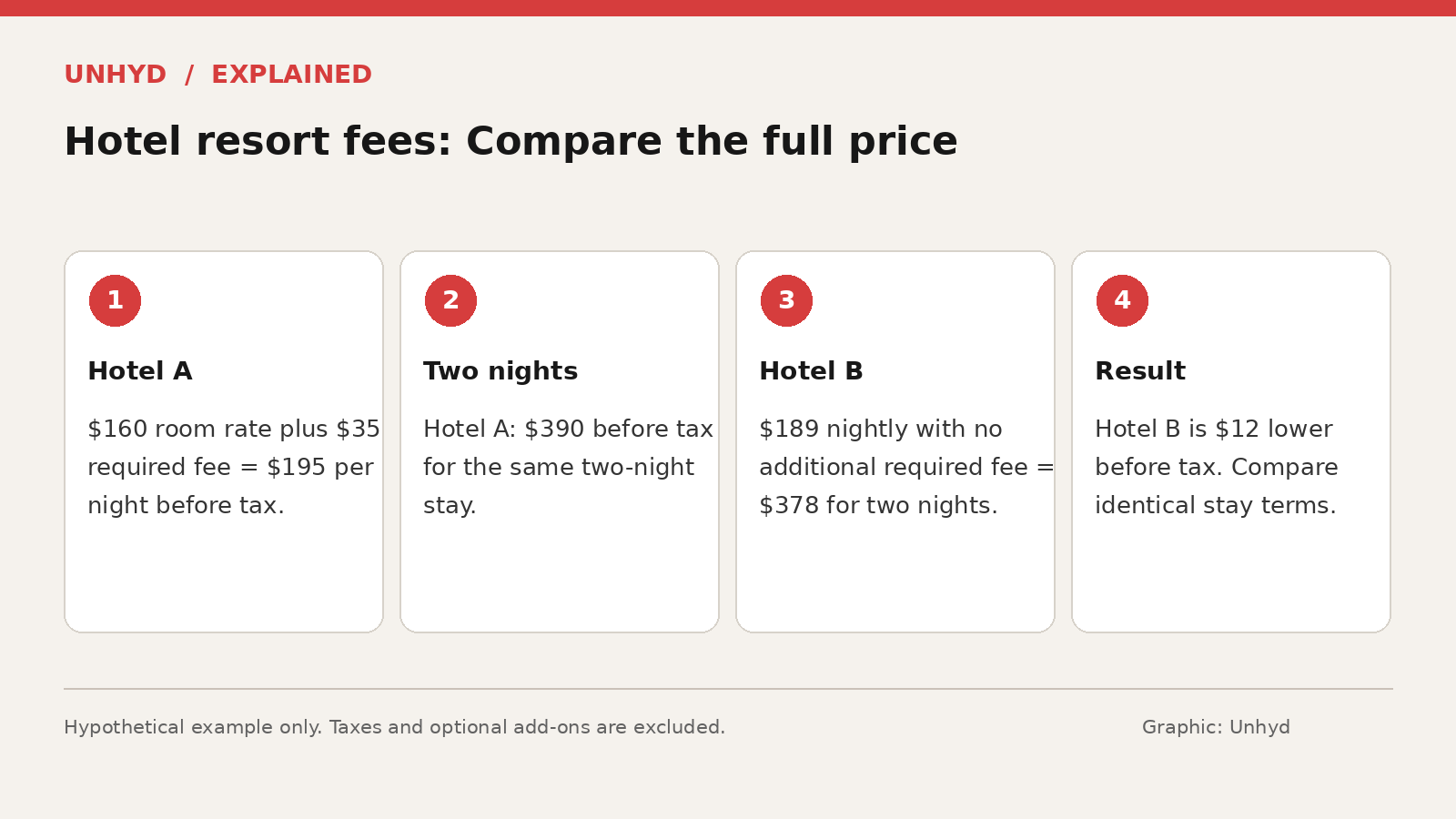
Hotel B is $12 cheaper before tax, even though its headline room rate looks higher. The booking's final payable amount may also depend on applicable taxes and genuinely optional extras. Compare the same dates, number of guests, room type, cancellation conditions and included services. Do not compare a prepaid nonrefundable rate with a flexible booking as if they are identical offers.
Unhyd's guide to checking online price differences addresses a separate question: how to compare offers without assuming that every difference was caused by personal-data-driven pricing. Hotel resort fees concern mandatory charges and display of the total. A higher hotel quote does not by itself show personalization, discrimination or unlawful conduct.
Five checks before booking
First, inspect the total for your exact dates. Use a complete itinerary rather than a one-night teaser rate. Confirm that the displayed total includes all mandatory property and platform charges known at the time of the offer.
Second, open the price breakdown. Identify which charges are truly optional and which are applied automatically. If a fee is described as an amenity fee, inspect the details rather than assuming you can decline the amenities and remove the charge.
Third, verify the final payment amount. The initial prominently displayed total may properly exclude taxes and optional extras, but the final amount should be clear before payment. Watch for checkout differences and document the screen if the mandatory price changes unexpectedly.
Fourth, compare cancellation and refund terms. A property may have a lower nonrefundable rate and a higher flexible rate. Look for when your card will be charged, whether a deposit is required, and how the property describes refundable and nonrefundable charges. The FTC rule prohibits misrepresenting refundability; it does not create a universal free-cancellation right.
Fifth, save the confirmation. Keep the booking page's stated total, a breakdown, the cancellation policy and the confirmation email. If the hotel later applies a charge you cannot reconcile with the disclosed terms, those records make a specific customer-service inquiry possible.
Can you avoid a resort fee or ask for it to be waived?
Sometimes a property will agree to a waiver or provide a promotional or loyalty benefit. But there is no general federal right to refuse a disclosed mandatory fee merely because you will not use the pool, gym or other covered amenity. Nor does the FTC rule require hotels to stop charging the fee. It requires honest, prominent price disclosure for covered offers.
You can ask a property about fee-free rates, qualifying memberships or promotions before booking. Confirm any waiver in writing and compare the resulting final total. If you believe a mandatory fee was concealed or misrepresented, raise the issue promptly with the business and preserve the booking evidence. You can also report potentially deceptive fee practices through the FTC's consumer complaint channels; reporting does not establish a violation or guarantee a refund.
What about vacation rentals and booking platforms?
The FTC rule covers short-term lodging more broadly than traditional hotels. Vacation rentals and home-share listings can fall within its scope. The agency's examples specifically include mandatory cleaning fees that must be included in the advertised total price. A platform does not escape the rule merely because another business owns or operates the property.
However, charges determined by a later optional choice, certain government charges and fees that genuinely cannot be calculated until later can receive different treatment under the rule. Check the actual booking circumstances rather than applying one blanket assumption to all charges. For extended stays, confirm whether the particular arrangement counts as short-term lodging; the rule does not set a single maximum number of nights that covers every case.
A better decision rule for every booking
Hotel resort fees should not require travelers to do investigative accounting just to compare two room offers. The practical protection is to insist on the complete, comparable price for the same stay, examine any exclusions and keep the final checkout terms. The federal requirement for prominent all-in pricing helps with that task, but a good purchase decision still involves cancellation rules, location, room quality and the services that matter to you.
The reliable question is not “Can I avoid every fee?” It is “Do I know what is required, what is optional, and what I will pay before I commit?” That remains useful whether a hotel calls the charge a resort fee, amenity fee or something else.