

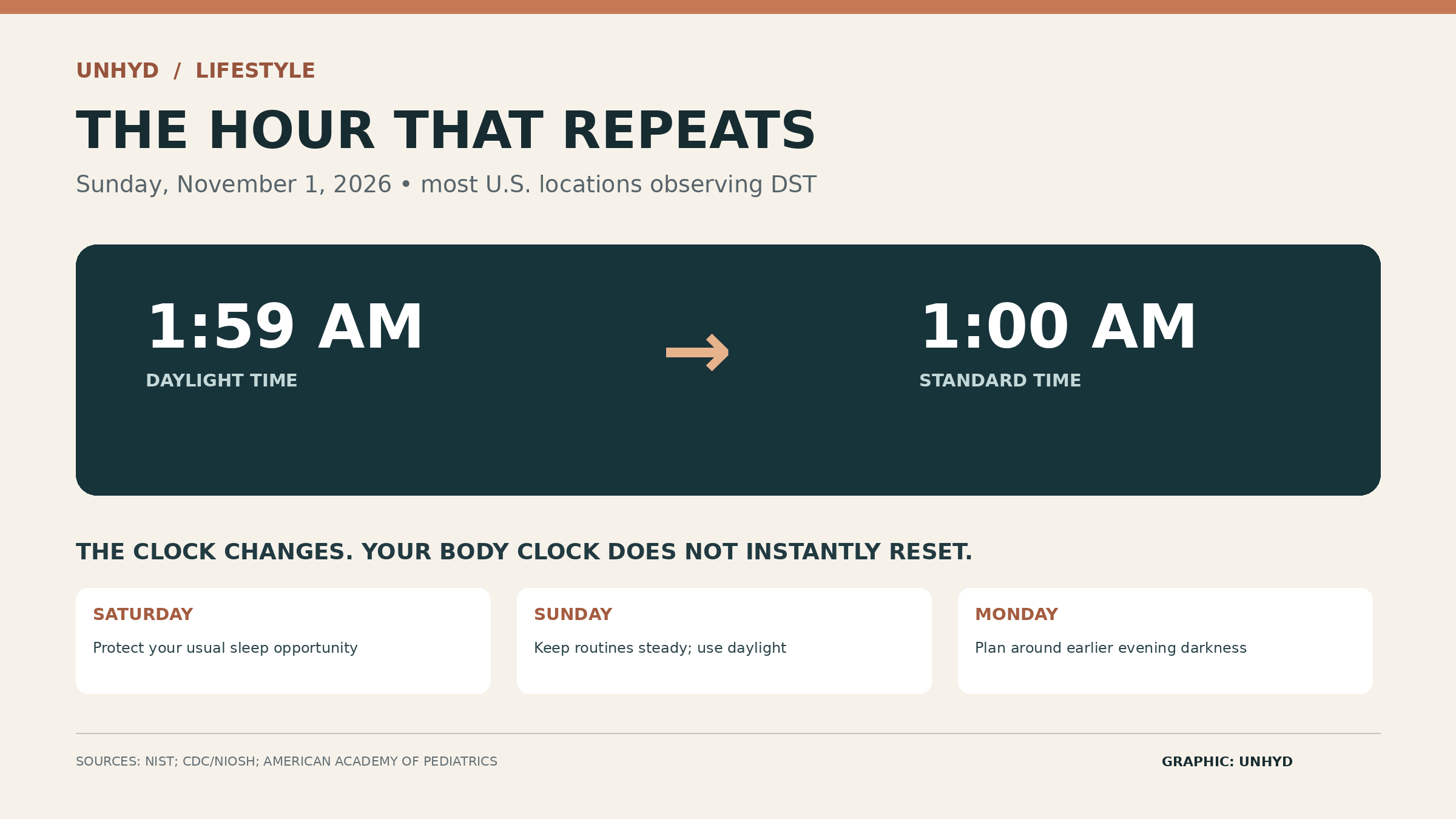
The November 1 clock change will turn clocks back one hour for most Americans who observe daylight saving time in 2026. At 2 a.m. local daylight time, the clock returns to 1 a.m. standard time. That produces a repeated hour on the clock, but it does not guarantee anyone an extra hour of sleep—or reset a person's biological clock on command.
The National Institute of Standards and Technology confirms the date and mechanics. For people trying to plan the next two days, the more useful question is what changes about morning light, evening routines and the time their bodies expect to feel awake.
What the November 1 clock change actually does
The fall transition changes the label on the clock, not the position of the sun. Relative to local clock time, sunrise and sunset will occur about one hour earlier than they otherwise would have immediately before the change. The exact daylight hours depend on location and season. People on ordinary daytime schedules may welcome brighter mornings but notice the earlier darkness when commuting home.
Not everyone in the United States changes clocks. The U.S. Department of Transportation lists Hawaii, most of Arizona and several U.S. territories among the areas that do not observe daylight saving time. If you are traveling or coordinating calls across time zones, check the specific destination rather than assuming every state makes the same change.
An apparent extra hour can create confusion around overnight shifts, device schedules and appointments. Phones usually update automatically when their time-zone settings are correct, but manually set clocks and household appliances may not. For time-sensitive work, verify the displayed time and any recurring alarms.
Why an extra clock hour may not mean an extra hour of sleep
Sleep is regulated partly by circadian timing: a roughly daily rhythm influenced by light and darkness. As the CDC's National Institute for Occupational Safety and Health explains, bright morning light and bright evening light can shift that internal timing in different directions. Moving a clock hand does not move the circadian system instantly.
That is why the advice to simply enjoy another hour in bed misses a common experience: someone accustomed to waking at 7 a.m. daylight time may wake around 6 a.m. by the new clock even if they wanted to sleep until 7. Children can be particularly sensitive to the shift. The American Academy of Pediatrics notes that younger children may become sleepy before their usual bedtime and wake earlier than expected after the fall change.
One night of extra rest can feel welcome, but it is not a substitute for an adequate sleep schedule. Unhyd's recent analysis of sleep debt distinguishes occasional recovery from reliably compensating for repeated short nights. The clock change is a good moment to protect regular sleep, not a reason to try to bank hours.
A practical plan for Saturday, Sunday and Monday
Saturday night: Keep your bedtime routine reasonably familiar. Avoid treating the repeated hour as permission for a much later night if you need to be functional on Sunday. Check any manually programmed alarms, medication reminders or overnight work schedules against local time and professional instructions.
Sunday morning: Wake without assuming the extra hour will feel restful. Get some natural daylight and ordinary movement when it fits your schedule. The CDC recommends regular sleep and wake times and natural light earlier in the day as general sleep-health habits. Families may need extra patience with children whose usual waking time arrives earlier on the newly adjusted clock.
Sunday evening: The earlier darkness can make a familiar evening feel later. Maintain a predictable wind-down routine, reduce disruptive bright light before bed and plan your next morning rather than attempting a dramatic sleep-schedule correction. If the clock change leaves you unusually sleepy, take extra care with driving or tasks requiring sustained attention.
Monday: See how your actual alertness compares with the clock. If you commute in daylight but return after sunset, consider visibility and schedule changes. A consistent routine is more sustainable than forcing a perfect first day.
Morning light helps—but timing and individual circumstances matter
There is an important nuance in widely repeated sleep advice. Morning bright light tends to move the body clock earlier; evening bright light tends to move it later, according to NIOSH. That means light is not a one-size-fits-all lever for anyone who is waking too early after the autumn transition. The same light exposure can support daytime alertness without being the precise remedy for every circadian timing problem.
For most readers, the practical baseline is modest: enough daylight while awake, a dark and quiet place to sleep, and an achievable schedule. Avoid complicated self-prescribed light therapy or drastic shifts in bedtime. People working night shifts, managing a sleep disorder or following medical treatment plans may need individualized guidance rather than a generic seasonal checklist.
Parents may also find that a gradual adjustment of routines works better than an abrupt demand that a child sleep on command. The American Academy of Pediatrics recommends calming bedtime rituals, physical activity during the day and outdoor light exposure while acknowledging that the transition can take time.
The longer-term debate is about daylight, not just lost sleep
The annual clock change often revives arguments about whether the United States should keep one time year-round. Those debates sometimes combine separate questions: whether seasonal changes are disruptive, whether later evening daylight is preferable, and whether permanent standard time or permanent daylight time would better align with people's schedules and biology.
Those choices are not interchangeable. The Department of Transportation says states may choose not to observe daylight saving time, but generally cannot adopt permanent daylight saving time on their own under existing federal rules. A personal preference for brighter evenings is also not the same thing as a scientific finding that later sunsets improve sleep for everyone.
For this weekend, the immediate answer is less political and more practical. The time change is real, the repeated hour is real, and the body's response varies. Preserving enough sleep, paying attention to light and making room for a few days of adjustment will serve readers better than the promise of a free hour.