

The UK's Financial Conduct Authority issued new expectations for AI agents in financial services on November 24, 2026, warning that a product marketed as a technology assistant can still fall within financial regulation when it performs regulated activities. The distinction matters as software moves beyond answering questions to arranging payments, transactions, borrowing and investment decisions. The regulator's point is not that every AI chatbot needs a financial-services licence; it is that the actions a product actually performs determine which rules may apply.
The FCA's update is directed both at regulated businesses deploying agents and at technology or social-media companies considering financial products for UK customers. It accompanies separate consumer guidance about permissions, personal data and what happens if an agent makes a mistake. The development creates a practical test for providers and users alike: where does a suggestion end, where does an authorized financial action begin, and who is accountable between them?
What the FCA actually changed on November 24
The FCA did not announce a blanket prohibition on autonomous financial software or introduce a universal new licensing category for AI. Instead, it set out more specific expectations under the existing regulatory framework, saying some products may require authorization when launched or may evolve into regulated activities later. That is an important distinction from treating the announcement as a ban on AI financial assistants.
In its published guidance, the regulator identifies several activities technology providers should examine: payment services, financial promotions, authorized information services, credit broking or intermediation, and financial advice. Whether a particular agent crosses the line depends on its actual service and the applicable UK rules, not simply the use of a large language model or an 'agentic' label. Providers should engage the regulator early rather than assuming that calling themselves a technology platform settles the question.
The timing is significant. Reuters reported on November 24 that the warning coincided with Meta's UK introduction of its Muse agent. Reuters said the initial UK version would not access bank-account statements or provide personalized financial guidance, illustrating how geographic product boundaries and licensing decisions can shape a launch. The FCA did not name Meta in its own statement, so the guidance should not be described as an enforcement action against that company.
Information, recommendation and transaction are not the same
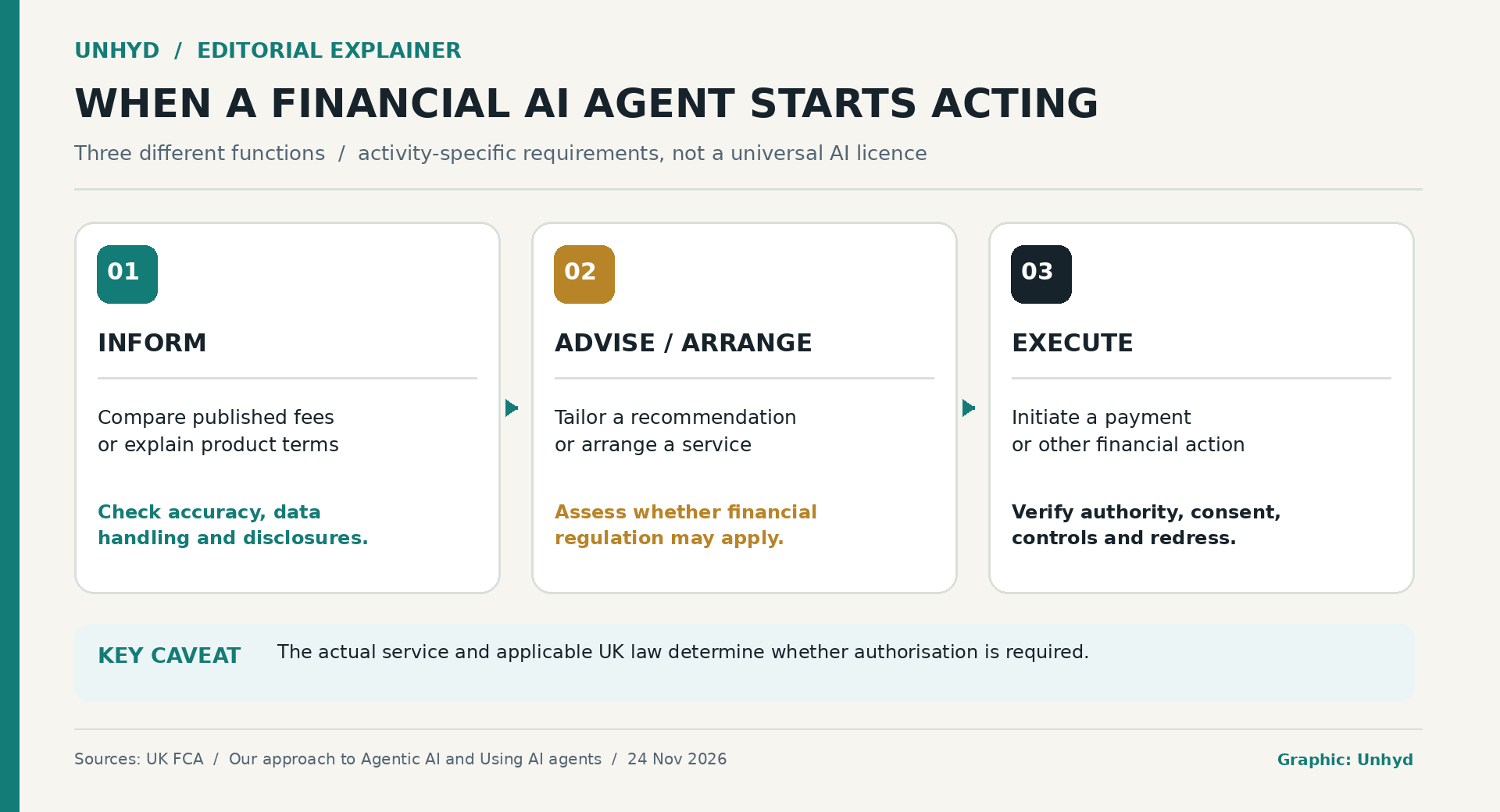
Consider three hypothetical customer requests. First, an agent summarizes the published fees on two savings products. Second, it uses a person's circumstances to recommend one financial product. Third, it is allowed to arrange an application or initiate a payment. The three experiences may look nearly identical on a screen, but the underlying functions, risks and potentially applicable regulatory obligations differ. These examples explain the boundary; they are not official FCA rulings that every service in each category is always regulated.
That functional distinction also changes the evidence a provider needs. A financial assistant that only retrieves information must still handle data accurately and responsibly. An agent that can act needs to demonstrate who authorized the action, what spending or product limits applied, what records were retained and how an error or disputed instruction can be addressed. The concern is not the speed of the model's answers. It is the consequences when those answers become executable instructions.
Responsibility stays with regulated firms
For established financial institutions, the FCA is explicit: deploying an agent or relying on a third-party model does not transfer regulatory responsibility away from the regulated firm and its senior managers. They must understand relevant risks, maintain oversight and ensure appropriate controls and escalation arrangements. The watchdog also asks institutions to consider how they will recognize an agent acting for a customer, what consent exists and whether agent-initiated payments should be accepted.
This is more than an AI model-selection problem. A bank may need to establish whether a customer's instruction was genuine, whether its scope was exceeded and whether a customer can get meaningful support after a problem. Those issues echo Unhyd's earlier examination of six banks' voluntary principles for agentic commerce. The banks' principles were industry proposals, however; the FCA's new publication is regulator guidance about compliance with existing requirements. The two should not be mistaken for the same policy instrument.
Four questions before letting an AI agent handle money
The FCA's consumer advice offers a short decision framework. Before using an agent, establish what data it receives and whether that sharing is safe; what actions it can take without another approval; whether individual transactions or categories can be limited; and what protections, complaint routes or remedies apply if something goes wrong. A polished interface is not evidence that a particular transaction is protected.
Users should also distinguish between a tool that suggests what to do and one that is authorized to do it. For example, a purchase limit cannot help if the user cannot tell when the agent has actually placed an order, which connected account paid for it, or how to revoke permission. Unhyd's coverage of agent-assisted checkout explored a related distinction between a customer's approval and the software carrying out a purchase. That earlier product example is not evidence that the FCA has approved any named wallet or agent.
What developers and consumers should watch next
The FCA says it intends to facilitate further industry discussion through a dedicated Agentic Policy Sprint and its innovation services. Those are channels for clarifying requirements, not a guarantee of authorization or blanket approval of new financial products. The meaningful follow-up will be evidence that companies can explain the permissions agents hold, maintain records of important decisions, and provide realistic help when financial actions go wrong.
For developers, the safest reading of November 24 is not 'financial AI is banned' or 'every assistant now needs a licence.' It is that product design, the functions actually performed and consumer protections must be assessed together. For customers, the question is simpler: before software acts with your money, can you see exactly what it is allowed to do—and who will put things right if it fails?