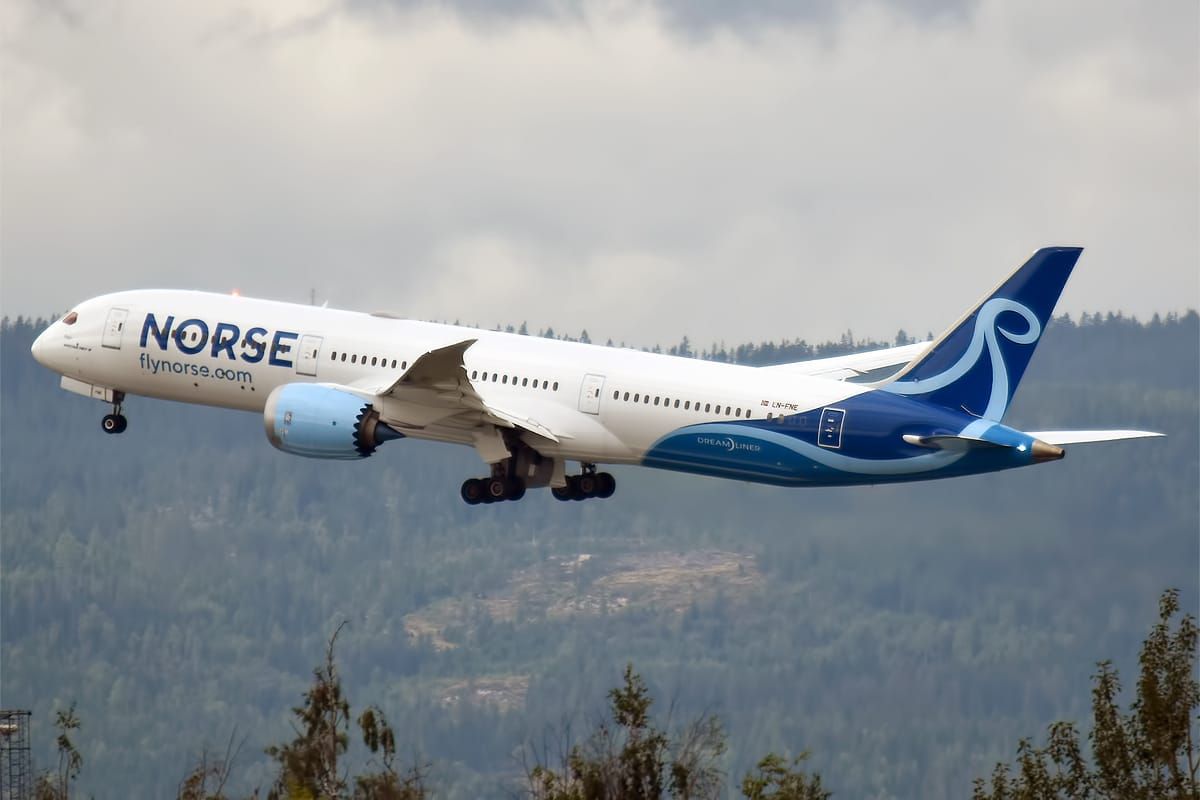
The Norse Atlantic financial crisis has brought renewed uncertainty to the low-cost long-haul aviation market after the Norwegian airline warned on November 25 that its continued operations depend on securing additional short-term financing. The announcement raises immediate questions for passengers with existing reservations and highlights the financial pressures facing airlines that compete on affordable international fares.
In a stock exchange announcement, Norse Atlantic ASA described its financial position as critical. The company disclosed that it was pursuing potential takeover discussions, evaluating alternative commercial arrangements and seeking additional funding.
No successful financing agreement was announced in the disclosure. Subsequent reports of flight disruptions have added urgency to the situation, although the scope of those disruptions should not be confused with confirmation that the entire airline has ceased operating.
For travelers and investors, understanding the distinction between financial distress, operational disruption and formal insolvency is essential.
What happened to Norse Atlantic Airways?
Norse Atlantic's warning concerns liquidity, the availability of funds needed to meet immediate financial obligations and maintain business operations.
An airline may have valuable aircraft operating arrangements, future ticket revenue and commercial partnerships while still experiencing a shortage of immediately available cash. Expenses such as fuel, aircraft leases, employee wages, maintenance and airport services must be paid according to contractual schedules that do not necessarily align with incoming revenue.
The November 25 disclosure did not specify how much additional financing Norse requires or establish a deadline by which a funding agreement must be completed.
The company also indicated that it was considering arrangements involving aircraft, crew, maintenance and insurance, commonly known within aviation as ACMI contracts. Such agreements allow an airline to provide operating capacity to another carrier rather than rely exclusively on selling tickets through its own network.
However, the financing warning makes clear that the company's strategic alternatives have not yet resolved its immediate funding requirements.
Why strong passenger demand has not prevented the Norse Atlantic financial crisis
One of the most revealing aspects of Norse Atlantic's situation is that its financial distress follows several reports of improving commercial performance.
In its October operating update, published on November 6, the airline reported a combined load factor of 94.9% across its scheduled network, charter and ACMI operations.
Revenue per available seat kilometer within its own network increased by 19% compared with October 2025, reaching 5.1 US cents.
At the same time, the number of flights operated within its own scheduled network fell from 355 to 199.
These figures illustrate an important distinction in airline economics. Improving revenue per unit of capacity does not necessarily mean that total revenue, profitability or available cash is sufficient to support the entire business.
A nearly full aircraft can still generate inadequate financial returns when ticket prices and ancillary revenue fail to cover the combined costs of operating that flight and maintaining the wider airline.
Earlier financial disclosures provide further context. In its second-quarter results, Norse reported $132 million in revenue and negative earnings of $8.4 million before interest, taxes, depreciation, amortization and rent, a measure commonly abbreviated as EBITDAR.
The company attributed pressure on profitability to high fuel prices, reduced aircraft utilization and operational disruptions.
The contrast between improving passenger metrics and financial losses demonstrates why an airline's commercial appeal cannot be evaluated independently of its cost structure and cash requirements.
The difficult economics of low-cost transatlantic travel
Long-haul airlines face a different operating environment from carriers focused primarily on shorter regional flights.
International services typically require larger aircraft, longer crew assignments and substantial fuel consumption. Aircraft may spend several hours completing a single journey, reducing the flexibility available to adjust schedules when demand changes.
Fuel prices are particularly important because even relatively small changes in fuel costs can materially affect the economics of long-distance operations.
Seasonal demand creates another challenge. Transatlantic travel can experience significant variations between peak summer periods and quieter months, while aircraft ownership or leasing obligations and other fixed expenses may continue throughout the year.
Airlines can respond by reducing capacity, shifting aircraft to different markets, changing ticket prices or providing charter services to other businesses. Each approach carries its own financial and operational considerations.
Norse Atlantic has attempted to diversify its revenue through partnerships that allow other airlines to use its aircraft and operating services.
In a July 31 strategic update, Norse announced that its ACMI cooperation with India's IndiGo would end on November 1. The companies cited difficult operating conditions, including elevated fuel costs and disruptions affecting international routes.
The return of aircraft from such arrangements creates opportunities for redeployment, but it can also leave an airline needing to find replacement commercial activity to support its fleet.
These pressures help explain why the financial performance of a low-cost long-haul airline depends on more than the popularity of its fares.
Flight disruptions and unpaid passenger claims add to the uncertainty
Pakistan International Airlines reported that two flights connecting the United Kingdom and Pakistan were canceled following an unexpected interruption involving Norse Atlantic, its wet-lease partner.
According to Reuters, Pakistan International Airlines said it planned to use its own Boeing 777 aircraft for UK operations beginning November 26.
Separately, aviation publication Airways reported that a November 25 Norse service from London Gatwick to Cape Town was listed as canceled in the airline's flight-status system.
These developments establish reported operational disruptions, but they do not establish the status of every Norse Atlantic flight or confirm that the entire airline has permanently suspended operations.
Norway's Civil Aviation Authority also announced a separate enforcement measure concerning outstanding financial claims owed to passengers.
In its November 25 announcement, the regulator said the airline had recognized the validity of the claims but had not paid them promptly.
The authority imposed a coercive financial penalty of 8,000 Norwegian kroner per working day, defined as Monday through Saturday, effective from November 20 until Norse demonstrates compliance.
The enforcement action highlights a distinction that becomes especially important during financial distress: establishing a passenger's legal entitlement to money does not necessarily establish that payment will be received promptly.
What passengers with Norse Atlantic bookings should do
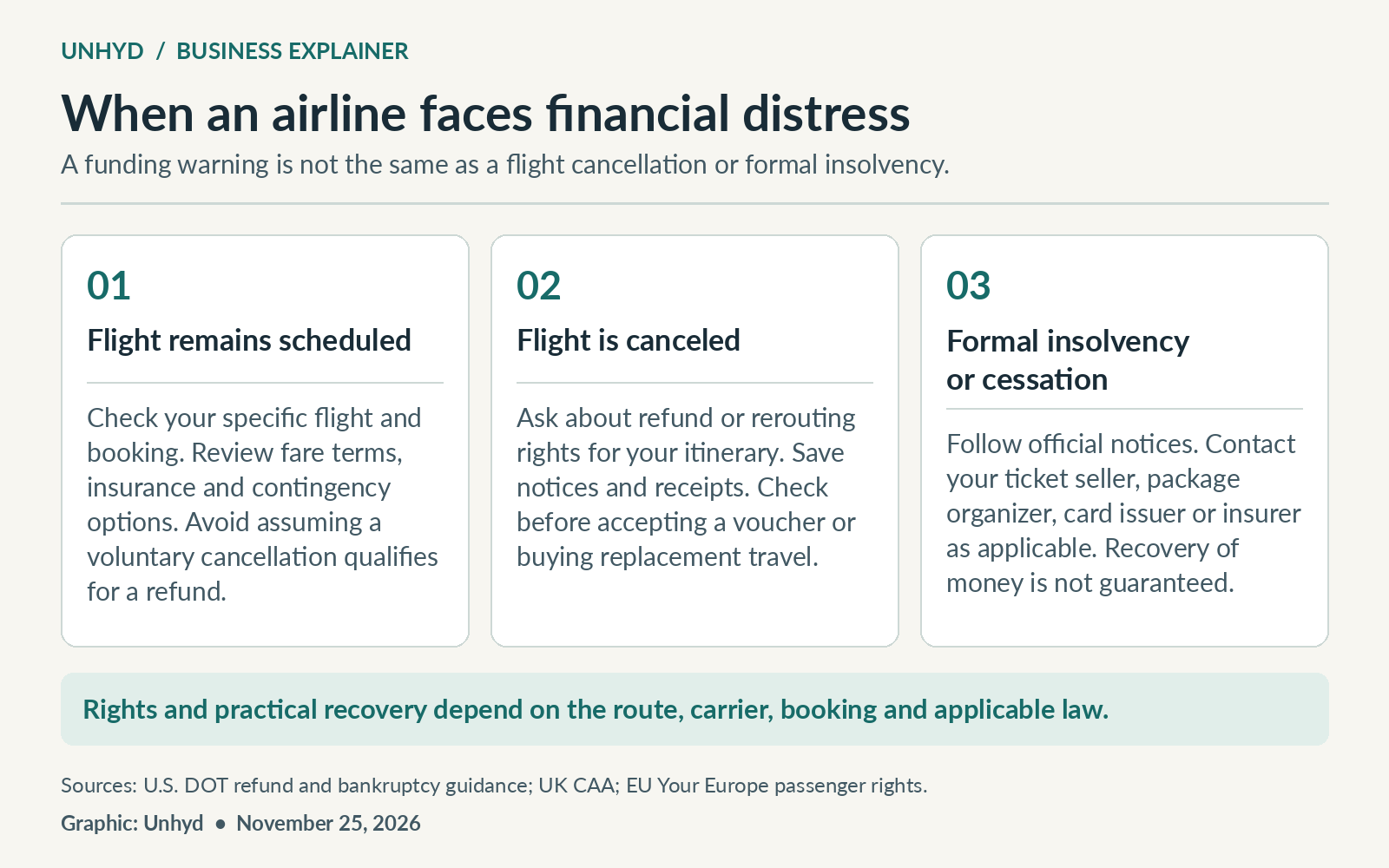
Passengers with upcoming reservations should first establish the status of their individual itinerary rather than make decisions based solely on reports about the airline's financial condition.
- Check your specific flight: Review the airline's website, booking records and direct communications. Confirm both outbound and return journeys.
- Identify your ticket seller: Determine whether the reservation was made directly with Norse, through a travel agency or as part of a package holiday.
- Preserve booking documentation: Keep ticket confirmations, payment receipts, cancellation notices and correspondence.
- Review insurance coverage: Establish whether the policy includes airline failure or other relevant financial protection and what exclusions apply.
- Consider contingency options: Research alternative flights and accommodation flexibility without assuming that replacement expenses will automatically be reimbursed.
The airline maintains an official customer information portal with guidance on booking changes and travel disruptions.
Passengers should also understand the consequences of voluntarily canceling a reservation. A traveler who cancels an otherwise scheduled nonrefundable flight may have different rights from someone whose flight is canceled by the airline.
Unhyd's earlier coverage of flight recovery and passenger refund rights following an FAA ground stop explains why the status of an individual reservation matters when evaluating refund eligibility.
How passenger protections differ across the United States, Europe and the United Kingdom
Passengers affected by airline disruption may have legal protections, but the applicable rules depend on the itinerary, operating carrier and booking circumstances.
United States
The U.S. Department of Transportation's refund guidance applies to qualifying flights within, departing from or arriving in the United States.
When an airline cancels or significantly changes a covered flight, passengers who decline the altered travel arrangements or alternative compensation are generally entitled to a refund.
That entitlement is distinct from a guarantee that an airline experiencing severe financial distress will be able to process the payment promptly.
Passengers should also distinguish ticket refunds from reimbursement for additional expenses, such as independently purchased replacement tickets and hotel reservations.
European Union and Norway
Under applicable European air passenger-rights rules, passengers affected by covered cancellations may have a choice between recovering the ticket price and receiving alternative transportation. Depending on the circumstances, additional assistance and compensation may also apply.
The European Commission's Your Europe passenger-rights guide explains the geographical coverage and conditions associated with these protections.
Norway has incorporated common European passenger-rights requirements into its national law, as confirmed by its aviation regulator.
Passengers should assess their individual itinerary rather than assume that every international flight operated by Norse falls under identical compensation requirements.
United Kingdom
The UK Civil Aviation Authority's cancellation guidance explains the refund, alternative transportation and assistance requirements that apply to flights covered by UK passenger-rights legislation.
Travelers who purchased qualifying ATOL-protected arrangements may have additional protection through their travel organizer.
However, a flight purchased independently from an airline is not automatically protected by ATOL. The booking confirmation and any ATOL certificate should be reviewed to establish what protection is available.
What would happen if Norse Atlantic entered formal insolvency?
The November 25 financing announcement does not establish that Norse Atlantic has entered formal insolvency proceedings.
Nevertheless, passengers can benefit from understanding how their practical options might change if an airline becomes unable to fulfill its obligations.
The U.S. Department of Transportation's airline bankruptcy guidance advises affected travelers to examine potential payment-card remedies and travel insurance coverage when an airline cannot provide transportation or issue an eligible refund.
Depending on the circumstances, passengers who paid by credit card may be able to dispute charges for services that were not provided. Eligibility, documentation requirements and time limits vary.
Similarly, the UK Civil Aviation Authority's airline failure guidance distinguishes between protected package arrangements, independently purchased flights and insurance products covering airline failure.
Ordinary travel insurance should not be assumed to include protection against airline insolvency. Travelers should review the wording of their individual policies and contact their insurers where necessary.
Neither payment-card remedies nor insurance should be treated as a universal guarantee of reimbursement.
What to monitor as Norse Atlantic seeks a financial solution
For investors and industry observers, the next significant developments will concern whether Norse can secure sufficient short-term funding, complete a strategic transaction or establish commercial arrangements that improve its operating position.
The company's financial disclosures should also be evaluated for evidence of available cash, near-term obligations and the relationship between operating performance and liquidity.
Unhyd's guide to reading a cash flow statement explains why reported revenue and profitability alone cannot establish whether a company has sufficient cash to meet its obligations.
For passengers, the most important developments are likely to be confirmed changes to flight schedules, official communications about booking arrangements and any subsequent guidance issued by aviation or consumer-protection authorities.
The Norse Atlantic financial crisis illustrates a broader challenge confronting low-cost long-haul aviation: strong demand for affordable travel does not necessarily create a financially sustainable airline.
Whether Norse can overcome its immediate difficulties will depend on the financing and strategic alternatives available to the company. Until further developments are confirmed, travelers should distinguish verified changes to their reservations from speculation about the airline's future.