
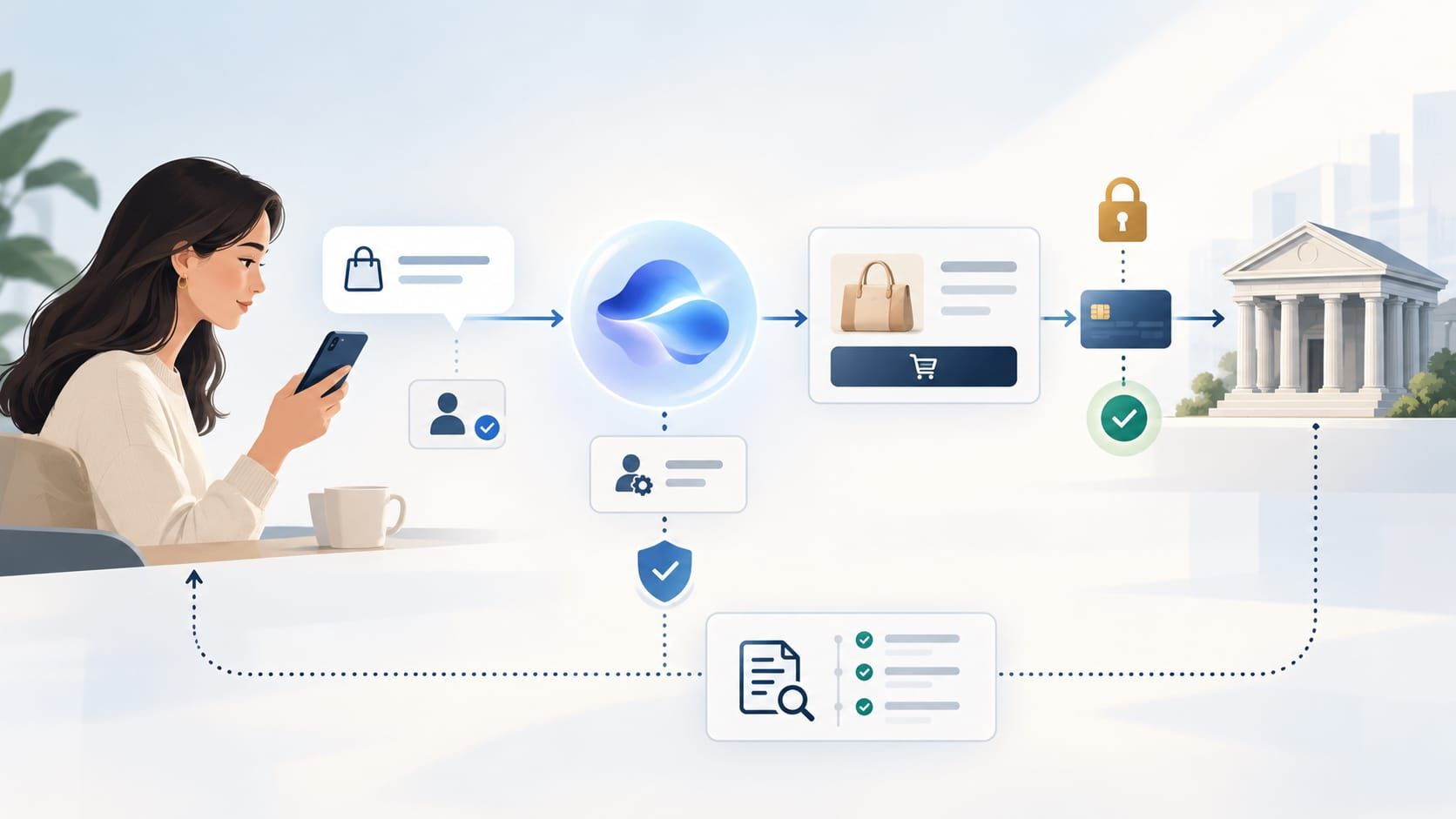
Six banks have published a shared set of voluntary agentic commerce principles, a sign that the debate over AI-powered shopping is moving from product demonstrations toward the less glamorous questions of control, security and accountability.
On September 22, ASB Bank, Bank of America, Capital One, Commonwealth Bank of Australia, ING Group and NatWest Group said they had jointly released the framework. The group describes agentic commerce as a future in which AI agents could play a larger role in how people choose and pay for products and services. Its paper is not a new payment network, a regulatory rulebook or a consumer product launch. It is a set of principles intended to guide further industry work.
The principles arrive as AI-driven shopping begins to move beyond demonstrations. British retailer John Lewis recently said searches originating from AI agents had risen to 2.5% of site searches from 0.3% a year earlier, according to Reuters. That is still a small share of activity, but the increase helps explain why banks are starting to address authorization, customer control and liability before agent-led transactions become commonplace.
What the agentic commerce principles emphasize
The framework names five areas: transparency, safety, privacy and data, choice, and interoperability. That list sounds broad, but it captures the core tension in AI-assisted commerce. An agent may be able to search, compare and recommend more quickly than a person can. Once it moves closer to a purchase or payment, however, the stakes change. The shopper needs to understand what the system is doing, what information it is using, and when a decision remains theirs.
The release places customer and merchant control at the center of the group’s stated goal. That matters because a useful agentic shopping experience will not be judged only on whether it finds a lower price or saves time. It will also be judged on whether a user can set limits, see what has been authorized and undo a decision when something goes wrong.
Bank of America’s release frames the principles as a starting point for wider collaboration. ING’s parallel announcement says the banks are inviting merchants, technology providers and other financial institutions to help turn the principles into practical standards. The consortium says a subsequent paper will address how the principles can be applied.
Why agentic commerce principles matter now
AI shopping tools have so far been easy to understand when they stop at discovery: a system suggests a product, and the person completes the transaction. Agentic commerce raises a harder design question when software begins to act more directly on a person’s behalf. Even before a payment is made, the system may shape choices through search, ranking, recommendations and the information it retains about a customer.
That is why the five categories matter together. Transparency is of limited use if a customer cannot make a meaningful choice. Privacy protections need to work alongside security controls. Interoperability can make services easier to use across merchants and providers, but it also makes clear responsibility important when multiple systems touch a transaction.
For now, these are voluntary principles, not technical standards, payment-network rules or regulatory requirements.
The announcement does not resolve those implementation questions. It does not establish a common technical protocol, a regulatory mandate or a shared liability regime. Readers should therefore treat the document as an early industry position, not as evidence that bank-backed AI purchasing has reached a uniform operating standard.
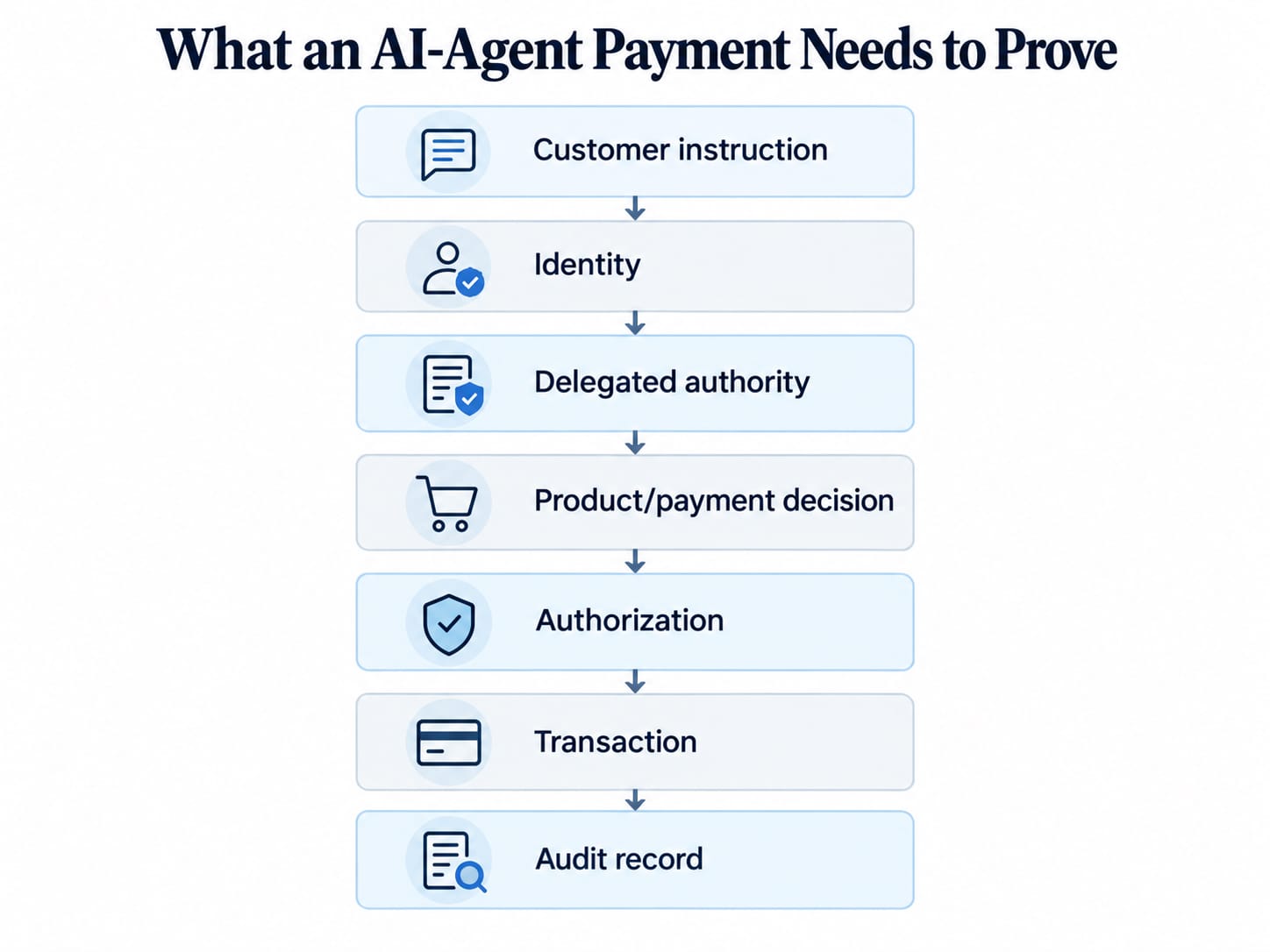
An AI-agent payment should preserve a clear chain from the customer’s instruction and identity through delegated authority, authorization, transaction, and the final audit record.
The practical test is customer control
For consumers, the useful questions are concrete. Can an agent act only within a budget or a merchant list set by the user? Does it clearly distinguish a recommendation from an action it is authorized to take? Can a customer see the data used to tailor an offer and withdraw permission? If a purchase is disputed, can the customer identify which party handled the instruction, payment and delivery?
A particularly important implementation question is the transaction record itself. If an AI agent searches, selects and pays on a customer's behalf, institutions may need an audit trail that preserves the customer's original instruction, authentication, the authority granted to the agent, the transaction decision and the eventual outcome. A conventional payment authorization may not be enough to reconstruct what the customer actually asked the agent to do.
Those questions are also relevant to merchants and financial institutions. An ecosystem that cannot clearly explain identity, authorization, fraud prevention and customer protection is unlikely to earn sustained trust, regardless of how smooth the interface feels. The banks’ publication is notable because it puts those concerns ahead of any claim that the technology is already solved.
For Unhyd readers following the broader shift to autonomous systems, the development is a specific extension of the governance challenge. Agentic AI in the enterprise has already raised questions about oversight and audit trails. In commerce, those questions become especially immediate because the agent’s output may affect a person’s money, data and ability to choose.
What to watch next
The next meaningful signal will not be another statement of principles. It will be whether the group can translate its five areas into testable practices: clear authorization flows, understandable disclosures, dispute processes, data controls and workable connections between banks, merchants and AI providers. Until then, the consortium has defined a useful agenda, but not a finished standard.