SpaceX orbital data centers have moved from a proposed infrastructure concept toward a regulatory pathway after the Federal Communications Commission authorized the company to deploy up to one million computing satellites on November 25, 2026. The decision marks a significant development in the effort to move some artificial intelligence computing beyond Earth's surface.
In its official announcement, the FCC said the proposed constellation, known as Starmind, would process information in orbit for applications on Earth. The agency also authorized radio communications intended to support spacecraft control and provide backup for the system's optical communications network.
The scale of the authorization is unprecedented for this type of infrastructure. But permission to deploy a million satellites is not equivalent to a million manufactured spacecraft, a functioning computing network or a commercially competitive alternative to terrestrial data centers.
Those distinctions will determine whether orbital computing becomes an important part of the AI infrastructure market or remains concentrated in specialized applications.
What the FCC approval means for SpaceX orbital data centers
The authorization establishes regulatory permission for a proposed constellation of orbital computing modules. Unlike conventional communications satellites, which primarily transport information between locations, the proposed system would perform substantial information processing in space.
That approach could theoretically allow some computing workloads to operate independently of terrestrial electricity networks. SpaceX has argued that access to solar energy in orbit could improve the economics and environmental characteristics of computing infrastructure.
Those potential benefits remain dependent on the design, deployment and operation of the actual satellites. The FCC announcement does not establish the computing capacity of a completed constellation or its cost per unit of useful processing.
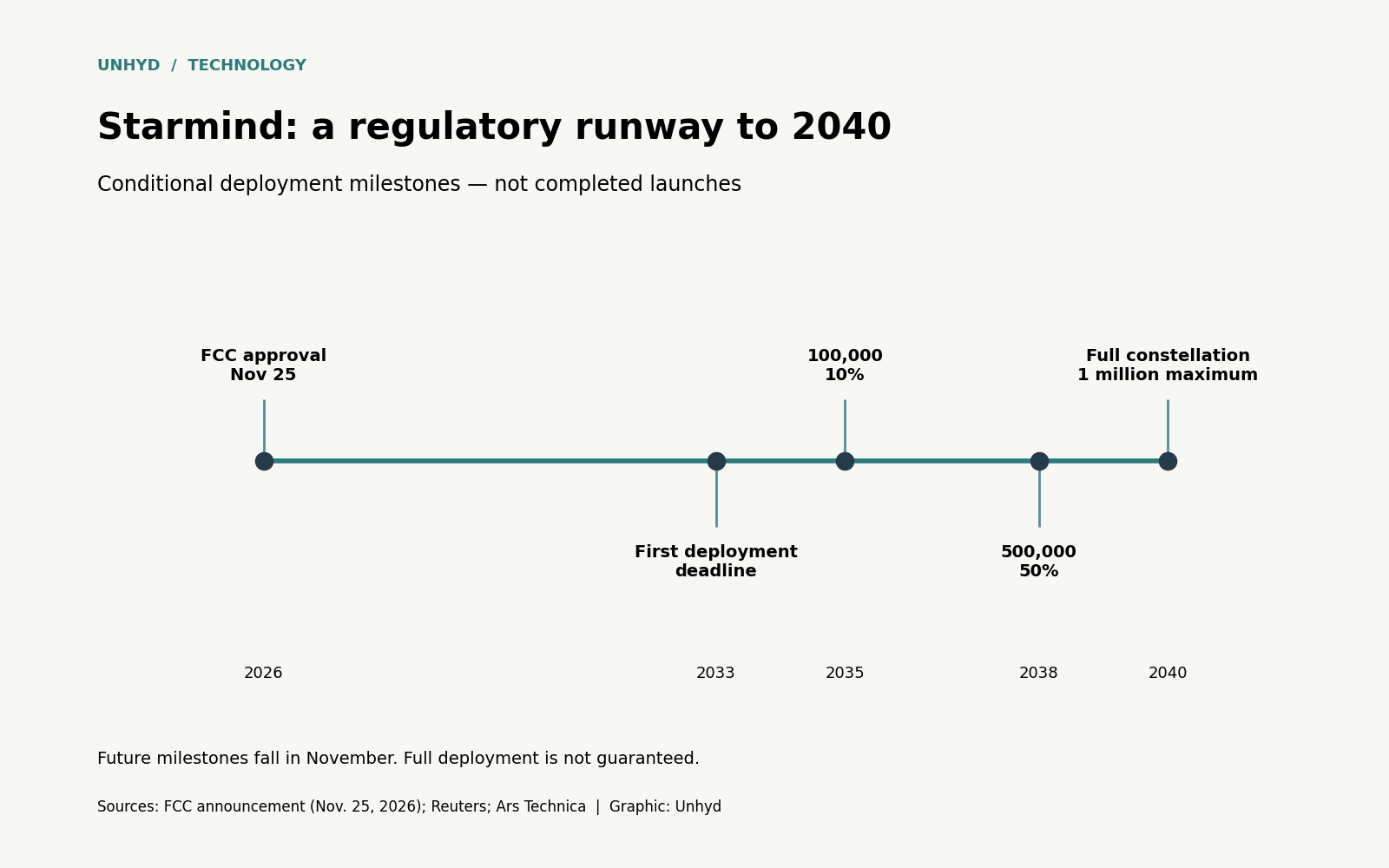
According to independent reporting by Reuters, the authorization requires deployment to begin by November 2033, with 100,000 satellites deployed by November 2035 and half the authorized constellation by November 2038. The full deployment milestone extends to November 2040.
The lengthy timeline provides room for substantial engineering development. It also means the authorized scale should not be interpreted as a near-term operational forecast.
Why launch economics are only part of the challenge
Moving computing infrastructure into orbit introduces costs that do not exist in the same form for terrestrial facilities. Equipment must be manufactured for the space environment, transported aboard launch vehicles, deployed successfully and maintained through remote operations.
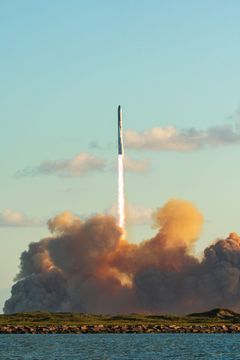
The ability to reduce launch costs could improve the commercial case for orbital infrastructure. SpaceX's efforts to develop fully reusable launch systems are therefore relevant to the economics of the Starmind proposal.
However, as Unhyd previously examined in its coverage of Starship's orbital recovery milestone, recovering one component of a launch system is not equivalent to demonstrating complete, routine and economical reuse of the entire vehicle.
For orbital data centers, launch costs would also need to be considered alongside satellite manufacturing expenses, equipment reliability, replacement requirements and the useful operating life of the computing hardware.
A lower launch price alone would not establish that an orbital system can deliver computing services more cheaply than an equivalent facility on Earth.
Solar power does not eliminate the cooling problem
One of the most frequently discussed advantages of orbital computing is access to sunlight without many of the land-use and electricity-grid constraints associated with terrestrial data centers.
Solar exposure, however, depends on orbital characteristics and spacecraft orientation. A system would still require equipment to generate, distribute and regulate electrical power, with energy storage or workload adjustments where appropriate.
Heat presents a separate challenge. Computing equipment converts much of the electricity it consumes into heat that must be removed to maintain safe operating temperatures.
On Earth, facilities can transfer heat through air or liquids and ultimately release it into the surrounding environment. In the vacuum of space, spacecraft must ultimately dissipate their unwanted heat through thermal radiation.
Liquid cooling can still transport heat inside a spacecraft, but radiators must release that energy into space. The required radiator area depends on factors including heat output, permissible operating temperatures and exposure to external radiation.
Consequently, additional electrical power does not automatically translate into additional usable computing capacity. A satellite must also be capable of managing the thermal load associated with that computing activity.
Which AI workloads could operate effectively in orbit?
Not all artificial intelligence workloads have identical networking and latency requirements.
Some computing tasks can be divided into independent jobs that process information and return results without continuous communication between processors. Other workloads depend on large numbers of accelerators exchanging information rapidly throughout a computation.
Dividing tightly coordinated computing workloads across separate satellites could introduce networking requirements that differ substantially from those inside terrestrial computing clusters.
SpaceX's planned optical inter-satellite communications could support information exchange across its constellation. The FCC authorization also addresses radiofrequency backup communications.
But the presence of optical links does not establish that a distributed orbital system can match the bandwidth, latency or reliability required by every advanced AI workload.
The distinction between loosely coupled processing and tightly coordinated model training will be useful when assessing future technical demonstrations. SpaceX has not established through the FCC announcement that every category of terrestrial AI computing can be moved into orbit economically.
Environmental questions extend beyond terrestrial electricity use
Orbital computing could reduce some forms of demand for terrestrial infrastructure if it eventually replaces computing workloads that would otherwise operate on Earth. Its overall environmental impact, however, would also depend on spacecraft production, launch activity, operational lifetimes and end-of-life disposal.
Questions about orbital congestion and the management of retired satellites become particularly important at the scale contemplated by Starmind.
As Ars Technica reported, the authorization does not grant every requested disposal flexibility, leaving additional regulatory requirements to be resolved for certain proposed spacecraft disposal methods.
Any meaningful environmental comparison between orbital and terrestrial data centers would need consistent boundaries. It would need to account for how equipment is manufactured, deployed, powered, operated and eventually retired.
What would demonstrate commercial viability?
The most valuable evidence will come from operational demonstrations rather than the authorized satellite count.
Early spacecraft could establish measurable computing capacity, actual power consumption, thermal performance and communication reliability. Longer operating periods would help establish equipment durability and maintenance requirements.
Commercial comparisons would eventually need to show the total cost of delivering useful computing services, including deployment, communications, equipment replacement and the consequences of service interruptions.
The FCC decision gives SpaceX an opportunity to pursue computing infrastructure on an extraordinary scale. It does not resolve the engineering or business questions that determine whether that infrastructure will be useful.
For now, Starmind represents a major regulatory milestone in the development of space-based computing. Its commercial significance will depend on the evidence SpaceX produces as the project moves from authorization toward deployment.