ChatGPT Wallet, announced by OpenAI on November 13, 2026, brings a new payment step to AI-assisted shopping: an eligible user can authorize an agent to complete a purchase without giving the agent the underlying card details. The initial rollout is narrow, but the design raises a much broader question for shoppers and merchants: who controls a purchase when software handles the checkout?
OpenAI says the wallet is beginning to roll out through dots for US ChatGPT Pro subscribers aged 18 and older with eligible US-issued cards. It is working with American Express, Mastercard and Visa. This is an announced initial rollout, not evidence that every retailer, card or ChatGPT account can already use the service. The company's November 13 announcement describes the payment flow and merchant preparation guidance.
How ChatGPT Wallet separates a shopper's decision from checkout
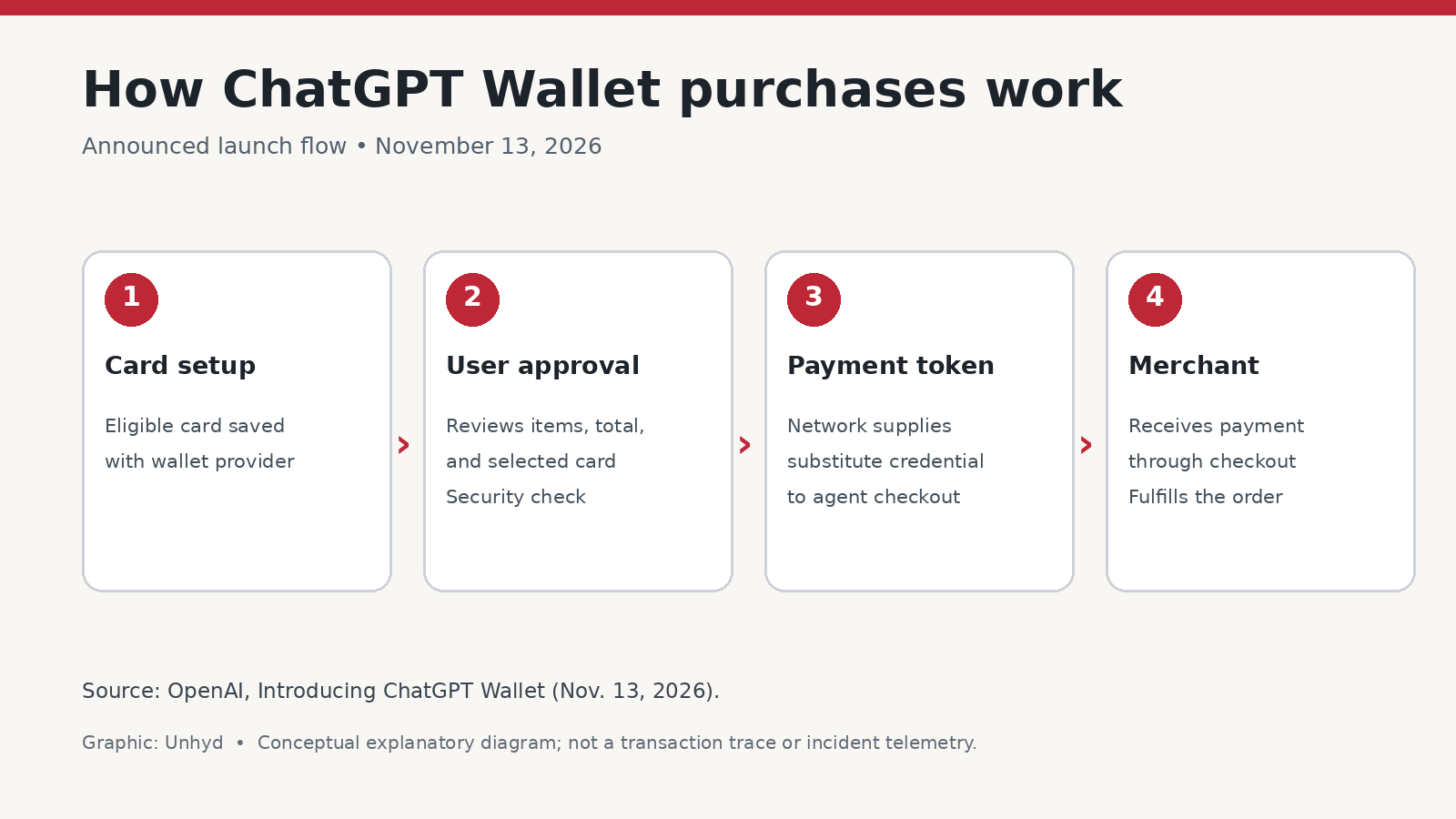
The sequence matters. An eligible user first adds a card. Before a purchase, the user reviews the items, total and selected card, then approves the transaction using a security check such as a fingerprint or Face ID. A payment network supplies a substitute credential for checkout. OpenAI says the agent and business do not receive the user's actual card details through that flow.
Tokenization does not mean a purchase is risk-free. The customer still needs to verify the seller, item, price, shipping terms and return conditions. The wallet changes how payment credentials are presented; it does not independently certify the quality of a product or the reliability of a merchant.
The distinction also matters for future automation. OpenAI says it expects to support more delegated purchasing with spending limits, categories or time windows. That is a direction the company describes, not a reason to assume unrestricted automatic spending is generally available today. Its wallet terms address user approval and authority, while the launch announcement emphasizes a security check for each purchase in the initial experience.
What changes—and what does not—for cardholders
The wallet is not a new bank account or a stored cash balance. OpenAI's terms state that it does not extend credit or change the customer's relationship with the card issuer. OpenAI says eligible transactions preserve existing card rewards and protections for qualifying disputes. Those protections depend on the underlying card and the circumstances of a dispute; the announcement is not a promise that every disagreement will be reimbursed.
There is a separate privacy question. According to OpenAI's wallet privacy notice, a service provider collects payment-card information through a secure form, while OpenAI receives a tokenized credential and limited card metadata. A shopper deciding whether to enroll should read the notice for information about data handling, not infer from the word “token” that no payment-related information is collected.
Why merchants cannot treat agent checkout as ordinary website traffic
OpenAI says merchants can continue to use existing checkout systems, but an agent may encounter a website firewall, bot controls or a fraud filter that was designed around human browsing. The company advises businesses to make accurate product information available, review agent access and work with payment and risk providers to recognize legitimate transactions.
That creates two distinct failure points. An agent may be unable to reach a site or operate its checkout at all. Or it may reach the checkout and still have a legitimate payment declined by a risk system. Neither outcome alone proves that a retailer has deliberately rejected agentic commerce. Businesses need to test access and payment acceptance separately.
The announcement names payment and fraud-prevention providers that OpenAI is working with, but those relationships should not be mistaken for universal acceptance across their customers. Merchants still control pricing, fulfillment, returns and customer service. A transaction initiated by an agent remains a transaction with the merchant.
How this differs from Businesses in ChatGPT
Earlier in the week, OpenAI introduced tools for business profiles, discovery information and optional Business Agents. As Unhyd explained in its examination of Businesses in ChatGPT, verification and discovery insights do not guarantee recommendations or sales. Wallet addresses a different part of the journey: authorizing payment once a shopper has decided to buy.
The distinction is useful for publishers, retailers and software providers evaluating the announcements. A verified business profile is not a payment integration. A product feed is not proof of checkout compatibility. And a successful agent checkout does not, by itself, establish whether a product was discovered through a business profile, an ordinary website or another route.
Unhyd has also examined six banks' agentic-commerce principles, which emphasize control, transparency and accountability. ChatGPT Wallet offers one concrete implementation of some of those ideas, but a product announcement is not an independent audit of how reliably the safeguards work at scale.
What to check before using or accepting it
For shoppers, the immediate checklist is straightforward: confirm account and card eligibility; review the full cart and total before approval; check the merchant's delivery and return terms; and retain transaction confirmations. Do not assume that an AI agent can resolve a refund or delivery problem more effectively than the seller or card issuer.
For businesses, the first steps are similarly practical. Check whether product prices and stock information are accurate, whether legitimate signed agent requests are blocked by security tools, and whether payment-risk systems can distinguish authorized agent transactions from suspicious automation. Any changes to bot controls should preserve security rather than broadly allow unknown automated traffic.
The important unanswered questions are empirical: how many merchants can complete these transactions reliably, how often legitimate purchases are declined, and whether consumers can understand authorization and dispute handling when multiple providers are involved. OpenAI has announced a starting architecture and limited availability; those real-world outcomes still require measurement.