

The newly released SEC 2027 examination priorities put artificial intelligence, deepfake-enabled fraud and tokenized securities into a more explicit supervisory framework. But the most important finding from comparing the new document with the agency's 2026 priorities is what has not changed: the Securities and Exchange Commission was already examining AI-driven investment tools, complex private investments and firms' cybersecurity controls. The October 23 announcement sharpens the examples of risk; it does not, by itself, create a new rule for Wall Street.
That distinction matters to investors and to firms selling technology-led financial services. A regulator's list of examination priorities is a statement about where staff expect to focus risk-based reviews, not evidence that a particular company has broken the law. The SEC's October 23 release says the division's program covers more than 34,000 registrants across multiple categories, from investment advisers to broker-dealers and clearing agencies. It does not say every registrant will be examined, or that every listed issue will lead to enforcement.
What changed in the SEC 2027 examination priorities?
The most revealing comparison is between the full fiscal 2027 priorities and the fiscal 2026 document released in November 2025. Both discuss automated investment advice, trading technology, cybersecurity and private credit. The newer document names additional scenarios and market infrastructure more directly. This is a comparison of two published texts, not a quantitative count of examinations or a claim that the SEC previously ignored the issues.
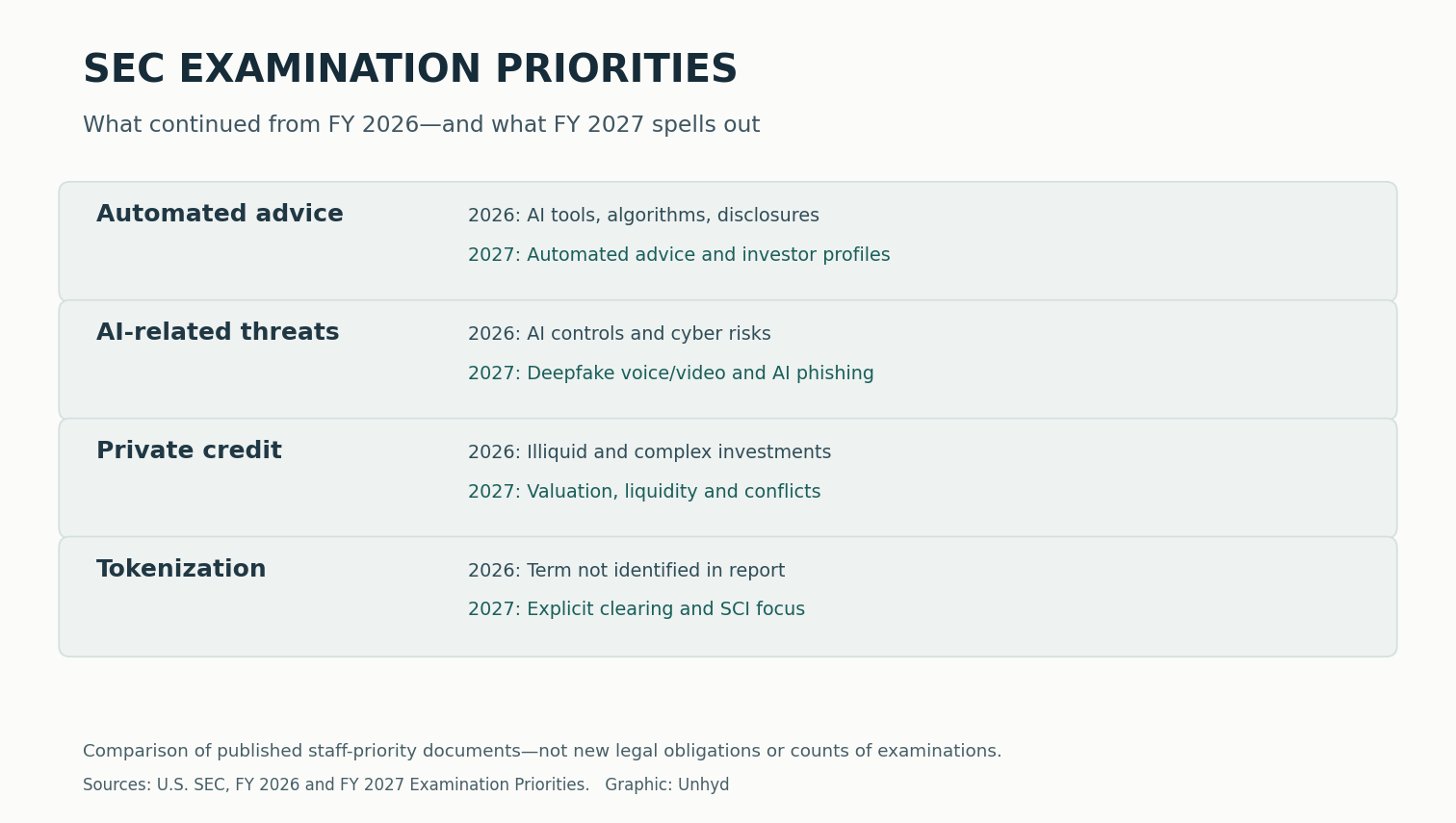
AI supervision is not new, but deepfake attacks are now named
In the 2026 report, the Division of Examinations said it would review firms' representations about their AI capabilities, controls over AI used in fraud prevention and trading, and whether automated recommendations matched investor profiles. The 2027 report continues those concerns, using the term “super intelligence” (SI) in place of the earlier report’s “AI.” That wording is the agency staff’s terminology; it does not independently establish that deployed systems meet any technical threshold for general intelligence. Its section on emerging financial technology also explicitly discusses AI-generated phishing and synthetic or deepfake voice and video used for social engineering.
That is a meaningful shift in specificity. An adviser may use automated systems to research securities, produce client communications or monitor transactions; an attacker may use similar technology to impersonate a client or employee. The relevant control questions are different. For the firm's own tools, examiners may ask whether representations are accurate and recommendations align with the investor's profile. For an impersonation attempt, the practical question is whether an unusual transfer or account change can be authorized by a convincing voice alone.
Unhyd's earlier analysis of deepfake social engineering made the operational case for independent verification of consequential requests. The SEC's new language places that kind of scenario explicitly inside the financial industry's examination discussion. It does not establish how many deepfake attacks have succeeded at registered firms, nor does it certify that any particular defense will stop every attack.
Private credit was already on the examination agenda
Private credit can be harder for ordinary investors to evaluate than a widely traded public security. Valuations may depend on models or infrequent transactions, redemption terms may be restrictive, and fee arrangements can be layered. Those characteristics do not make every private-credit product improper. They do make the underlying disclosures and the investor's ability to exit particularly important.
The 2026 priorities already singled out alternative investments including private credit and private funds with long lockups, as well as complex funds holding less-liquid assets. The 2027 report again addresses private credit in its reviews of investment advisers, registered investment companies and broker-dealer practices. It names valuation, liquidity, fees, conflicts and the consistency of recommendations with client needs. Describing this as the SEC's first private-credit crackdown would therefore be inaccurate.
The more defensible interpretation is continuity with additional detail. The agency is examining how firms explain and manage investments that can be difficult to price or sell, especially when they are recommended to retail investors. For a reader considering such an investment, a better question than whether a regulator mentioned the product is: When can I get my money back, how is the asset valued, and what happens in a stressed market?
Tokenization appears more explicitly in market-infrastructure reviews
The 2027 report identifies tokenization in the clearing-agency section and alongside other emerging trends in its Regulation Systems Compliance and Integrity discussion. Tokenization generally refers to representing an asset or interest using a digital token, but the legal rights and infrastructure behind any given arrangement can vary substantially. A tokenized security does not automatically become more liquid, less risky or more transparent merely because its recordkeeping uses a different technology.
A text search of the published 2026 priorities did not identify the word “tokenization,” whereas the 2027 document names it in these specific contexts. That is a verifiable difference in wording, not proof that tokenization was absent from the SEC's other work in 2026. The practical supervisory issues concern settlement, custody, resilience, operational dependencies and whether market systems continue to satisfy applicable rules.
The overlooked point: a priorities document is not a new regulation
On its opening pages, the 2027 report explicitly states that it reflects the staff's views, has no legal force or effect, and does not create new obligations. The division also says the list is not exhaustive and may change as risks evolve. That limits what a headline can responsibly infer. “SEC examines AI risks” is supported; “SEC bans AI advisers” is not supported by this announcement.
The document is nevertheless consequential because examination priorities shape the questions supervisors may ask and the records firms may need to produce. A firm advertising automated investment advice should be prepared to explain what its systems actually do, how they are monitored and how recommendations fit clients' circumstances. A firm using external vendors should be able to describe controls around customer information and access. Those are practical implications of the stated focus areas, not new requirements invented by the report.
What the priorities mean for an ordinary investor
The first lesson is not to treat regulatory attention as a quality seal. The fact that a product type appears in an SEC document says little about whether an individual product is appropriate. Nor does the absence of a particular product name imply that it is safe. The second lesson is to look beyond the marketing language of innovation. “AI-powered,” “private,” and “tokenized” describe technologies or structures, not a promised level of investor protection.
Before accepting a recommendation, an investor can ask how the adviser is paid, whether the product can be sold promptly, what fees apply at entry and exit, and whether the recommended investment matches the investor's time horizon and capacity for loss. Those questions are particularly useful for complex or illiquid investments, but they apply more broadly. The SEC's public investor tools also allow people to check a professional's registration and background independently.
Fraud prevention belongs in the same conversation without conflating ordinary investment risk with criminal activity. Unhyd's comparison of FTC and FBI fraud-loss figures shows why even large official numbers need careful interpretation. Similarly, a published SEC risk priority is not an estimate of misconduct, an incident count or a prediction of losses.
Three questions to carry into 2027
Will firms document the actual boundaries of automated recommendations rather than relying on broad AI claims? Will complex and illiquid products be explained in terms of fees, valuation and redemption under stress? And will payment and account-change workflows resist impersonation even when the request arrives by convincing voice or video? The SEC's priorities make these reasonable questions to ask. They do not answer them for every firm.
The useful conclusion from the October 23 announcement is a narrower one than the most dramatic headlines suggest. The SEC's examination staff have not suddenly discovered AI or private credit. They have given more explicit attention to synthetic-media attacks, tokenized market infrastructure and the familiar problem of matching complex financial products to real investors. The difference between a sharper examination plan and a new law is exactly the difference readers should understand.